

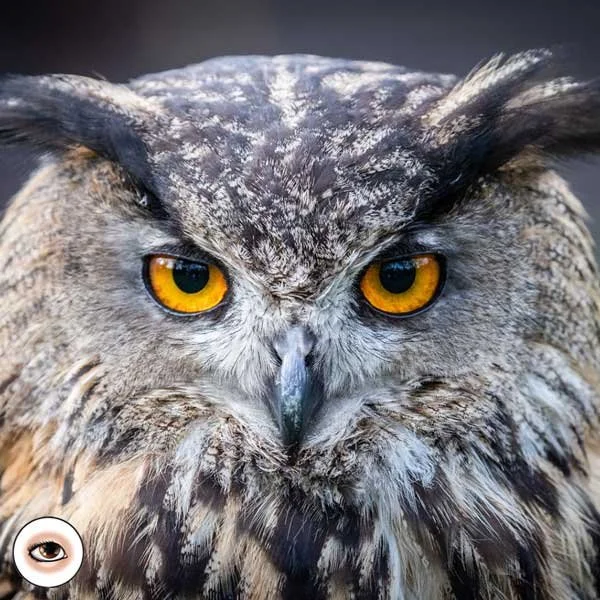
Owl Eyes
For many of us, we have become accustomed to spending much of our time focusing our attention on specific things in front of us. This can sometimes lead to us experiencing less awareness of other things going on all around us, and sometimes this can result in us failing to notice the beauty that is all around.
In order to increase your nature connection and redevelop your awareness of nature it can help to practice both ‘focused vision’ and ‘wide-angled’ or peripheral vision. Owls have an impressively broad peripheral vision. Their eyes are also tube-shaped and don’t move, so you'll never see an owl move its eyes. Instead, it moves its head to shift its view - an owl can turn its head up to 270 degrees!
Today from your Sit Spot, or when you stop briefly when out on a walk, try practicing ‘Owl Eyes’:
Start by focusing your vision on something ahead of you in the distance
Now soften your focus and, without moving your head or your eyes, begin to take in as much as you can from left and right of that point
Continue to soften your gaze and take in as much as you can from above and below the original point
Practice this less focused, wide-angled point of view for as long as you wish and then continue walking or just sit and ‘be’.