

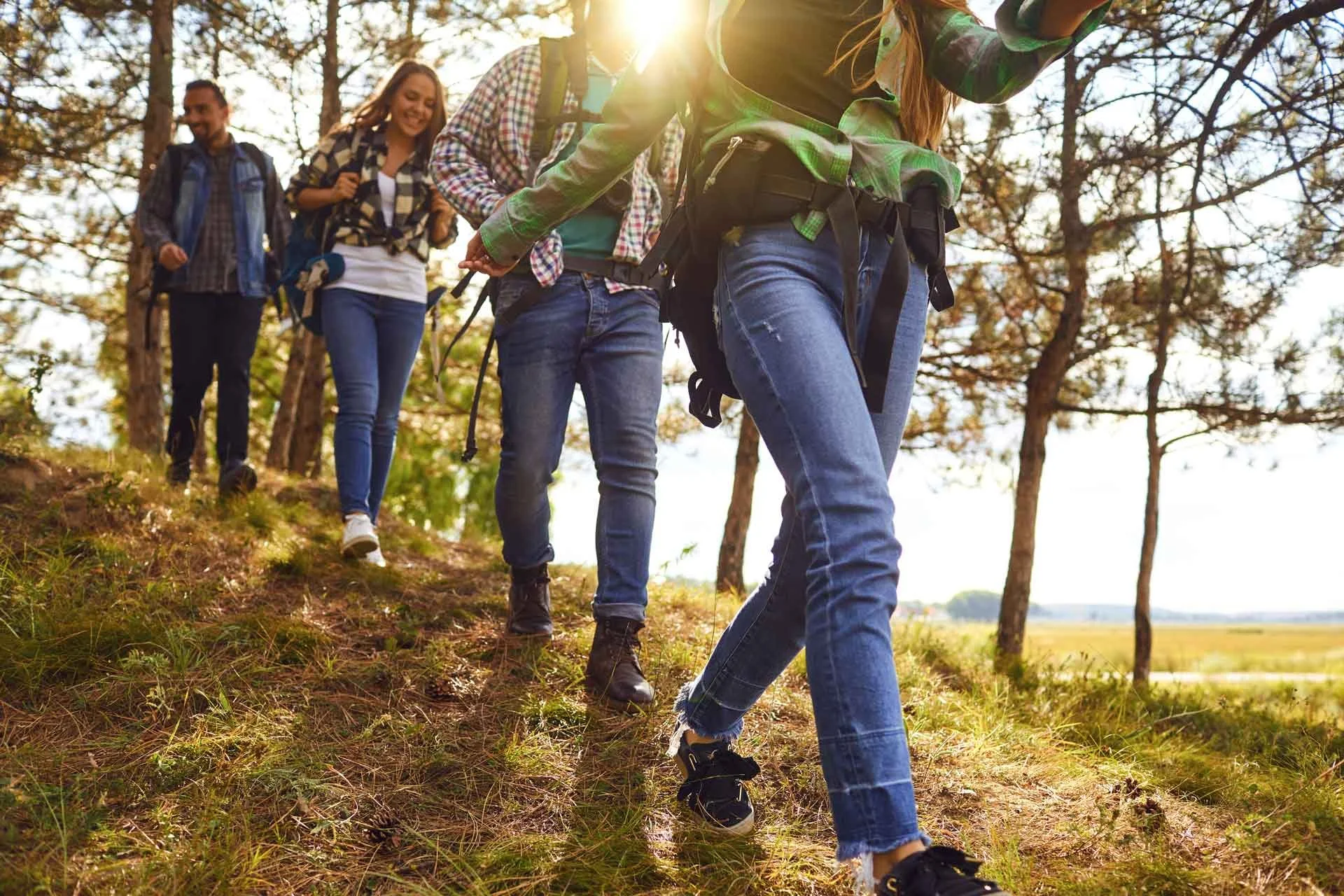
What to Expect on a Forest Bathing Walk
For me, this favourite quote of mine from ‘Shinrin-yoku: The Japanese Way of Forest Bathing for Health and Relaxation’ by Yoshifumi Miyazaki creates a perfect image in my mind’s eye of what a Forest Bathing walk comprises and how it makes me feel:
“Imagine taking a walk in the forest right now. You feel the earth and leaves under your feet, the snap of twigs. You listen to the birdsong and look up through the breaks in the canopy to the sky above, noticing how the light filters through to a point just further along the path.
You breathe in, deeply. You smell the distinct forest aromas:
Moss, Sap, Earth and Wood.
You take it all in.”
What A Forest Bathing Walk Is Not
It may be best to start with what a Forest Bathing walk is not.
Forest Bathing is not a long hike or a walk with a geographic goal. It is not a naturalist activity where you learn the names of trees, and how to identify plants or animals. Despite the name, it is not wild swimming in the woods, although we may interact with water by sitting by it or dipping our hands in the water - the practice has its roots in Japan and the name ‘Forest Bathing’ comes from the translation of the Japanese ‘Shinrin-yoku’ - instead it is a ‘nature immersive experience’ rather than actually ‘bathing’. Whilst Forest Bathing is sometimes referred to as Forest Therapy, it is not a psychotherapy session where you will be asked to talk about anything in particular, you will not be asked to discuss problems that you are having, but it will offer you a safe space in which to encounter the benefits of nature connection. The whole experience is about opening up to nature and allowing the woods and forest to support you in ways that will be beneficial to your health and wellbeing.
Instead of focusing on knowledge and learning about what something in the forest is, Forest Bathing is more about learning how the forest makes you feel. The aim is to reconnect with yourself and the natural environment around you for the benefit of both.
What Forest Bathing Is
Forest Bathing is a health-promoting, nature-connection practice that aims to enhance mental, physical and emotional wellbeing. It has been shown to relieve stress and anxiety; to lower blood pressure and increase heart rate variability; to improve immune functioning; to increase attention, short-term memory and focus; and to enhance creativity. It involves walking slowly and leisurely, and periodically sitting or standing, in a natural environment, mindfully taking in your surroundings through all your senses.
What To Expect
A Forest Bathing walk usually lasts between two and three hours, but in this time you will rarely walk more than a mile. Forest Bathing is about taking in your surroundings through all your senses, noticing what you can see, feel, hear, smell and sometimes taste in nature (you are often encouraged to take in scents through your mouth and nose at the same time). To help with this, your guide will usually offer a sequence of nature-connection invitations as described below.
Slowing Down in Forest Bathing
Ralph Waldo Emerson once wrote "Adopt the pace of Nature - her secret is patience."
The purpose of Forest Bathing is to slow down both physically and mentally, but you will need to give yourself time to let go of your thoughts and really tune in to your surroundings. Physically slowing down and walking at a pace that is much slower than normal can be the hardest part for many people, but we really do see things from a different perspective when we truly slow down. Slowing down in this way is also important to gain the most physical and psychological benefits, such as lowering cortisol levels (the hormone released when we are stressed), lowering blood pressure, increasing heart rate variability and boosting your immune system.
Nature Connection Invitations
On a guided Forest Bathing walk, your guide might invite you to take part in nature connection activities known as Forest Bathing Invitations. These Forest Bathing invitations are offered in a carefully designed sequence to create an experience that enhances nature-connection and boosts the therapeutic and restorative effects of nature for health and well-being. However, these are only ever recommended activities to try and there is never any pressure to engage in activity that you do not wish to, although it sometimes good for you to go a little outside your comfort zone (maybe try hugging a tree!). These invitations are not things to be ‘achieved’ in order to feel that the Forest Bathing activity was ‘successful’ though.
Invitations may last anywhere between about 5 minutes and half an hour and could include:
Sitting by a stream or lake and noticing how the water makes you feel
Exploring a tree with your hands and your eyes, feeling the texture, swaying in harmony with the tree or gazing up into the canopy
Looking for features of nature that are moving, as you walk slowly along a path to through the woods
Sharing Circles

Following completion of these nature-connection invitations, you might be invited share what you noticed in a ‘Sharing Circle’. It is common to use a piece of wood, a feather or a pine cone as a ‘talking piece’ and the guide may offer a suggested prompt such as “I noticed that the water was …..” or “Inside I am noticing …..”, “Outside I am noticing ….”. Members of the group are free to follow these suggestion or not and are free to share through silence, to share through movement or expressive dance, to express themselves in way they would like, or to remain silent and still.
A Sharing Circle offers (or should offer!) the opportunity to talk uninterrupted and to be listened to non-judgmentally and for each person's voice and experiences to be heard, valued and respected. Other members of the Sharing Circle just listen and learn, they do not comment or provide their opinion on what the person sharing their experience says, other than to sometimes thank them for sharing. As well as deepening nature-connection and improving our understanding of nature, Sharing Circle can increase inter-personal connection, empathy and a better understanding of each other.
Other than during Sharing Circles, Forest Bathing tends to be a fairly silent activity in which you notice detail in your surroundings.
What To Bring
A small rucksack with some extra clothing, a water bottle and a sun hat or sunscreen and maybe a snack is always useful. On my guided walks I usually offer everyone a Sit Spot Seat Pad to sit on if they would like to sit down to take in their surroundings whilst they connect with nature.
What Not To Bring
Your guide will also usually suggest that you take a break from technology as far as you can and either leave your mobile phone behind, turn it off, or turn it onto Flight Mode.
Here are more details about our Calendar of Guided Forest Bathing Activities.