

How to Take Yourself Forest Bathing
10th August 2024

This post will look at how you can take yourself Forest Bathing and spend time mindfully immersing yourself in nature, particularly in woodland or forested areas. Whilst there are Certified Forest Bathing Guides such as myself, you can easily take yourself on a self-guided ‘Forest Bathing’ outing. Although a wood or forest away from the noises of civilisation is ideal, the ideas discussed here can be practiced almost anywhere — the aim is to allow yourself to experience your natural environment through your senses. The distance you walk is not important, and the speed at which you walk should be slow enough to take in your surroundings. The intention is to help you to relax rather than to raise your heart rate.
A Beginners Guide to (Self-Guided) Forest Bathing
It is often best to try Forest Bathing somewhere you know well, initially. This is partly to reduce the chances of getting lost, and partly to enable you to reflect better on how much more you notice when you actively seek to experience what is around you, with all your senses ‘open’. Recognising and reflecting on what you might usually not notice or might take for granted is valuable.
What to Bring
I usually carry a small backpack with a water bottle and some snacks in. I also carry a small sit spot seat pad with me, but a small blanket or an off-cut from a camping mat also work well. A notebook to use as a nature journal can be very useful.
What to Wear
Try to wear loose comfortable, weather-appropriate clothing suitable for walking and sitting. Dressing in layers and bringing extra layers in a backpack with you will allow you to adjust to changes in temperature. The motto “Be Bold — Start Cold” can be helpful — if you start your walk a little cold, the action of walking, even slowly, will warm you up, and then if you add a layer or two when you choose to stop you should find you stay warm. Experience has taught me that starting with to many layers and starting to sweat whilst you walk can mean that you feel too cold and get distracted when you stop or slow down. It is also advisable to wear comfortable walking shoes or hiking boots that support your feet and ankles, and are suitable for the terrain.
Before You Start
To get the most out of Forest Bathing you need to start by doing your best to leave your worries at the start of the walk. Some people find that visualising themselves placing their worries on a rock or tree stump near the entrance to the woodland helps. It is also good practice to resist the urge to tell yourself that you will only use your mobile phone for taking pictures, but instead to turn it off fully and put it away, or leave it behind in your car or at home. Before you begin, it can be helpful to set an intention for your Forest bathing session — this might be to be mindful of your surroundings, to connect with nature through your different senses, or just to try to relax. It can also be helpful to try and let go of expectations as much as possible — There’s no right or wrong way to forest bathe; it’s about being present in the moment so try to approach the experience with an open mind. It can also be helpful to decide in advance how log you hope to be out Forest Bathing for — start with 1 to 2 hours if possible, but even 20 to 30 minutes can be beneficial.
Forest Bathing ‘Invitations’
A Forest Bathing ‘invitation’ is an activity to encourage you to connect with the natural world around you through your different senses. These activities are designed to heighten your sensory awareness and increase your nature connection. If you are being guided during your Forest Bathing activity, your guide will periodically stop to offer you such ‘invitations’. However, if there is not a guide close at hand, we sell resources that can help you take yourself Forest Bathing or you can just allow yourself to be guided by the invitations that nature offers to you, by opening up your awareness to interesting sights and sounds; textures or patterns; smells and tastes.
Although Forest Bathing is not about completing set exercises, sometimes it works well to just concentrate on one sense at time, so once you have gone a little way into the forest, a nice first Forest Bathing activity is to just close your eyes and focus on your others senses in turn. It can be surprising what you notice when you close your eyes, in part because you tend to stand still when you do this, allowing you to concentrate and focus on your other senses. So find a place to stand, put down anything you are carrying, relax your arms letting them hang by your side and close your eyes.
Start by engaging your auditory sense and listen to what you can hear around you. Can you hear animals or birds?
Can you hear the wind rustling the leaves?
Take a deep breath in through your nose. What can you smell?
Think about what you can feel.
Is the surface that you are standing on hard or soft?
Is there a breeze? Is it blowing your hair? Can you feel which way the sun is oriented in relation to you?
Try turning though 90 degrees to your left or right. Does what you hear change? If the sun is shining, how does it feel now that you have turned.
Continue turning in the same direction until you are facing the same direction that you started. Once you open your eyes again, focus for a while on the thing that first grabs your attention.
Next we are going to look at specific other ‘invitations’ or experiences that you can try. Note that these should constitute invitations to look out for, rather than exercises to be completed — Forest Bathing should resemble an improvised ‘dance’ with nature, rather than a choreographed one. However, it is often easier to think about concentrating on just one thing at a time, but with a child-like curiosity and willingness to immerse yourself in the little things that you see, hear, smell, touch and taste.
Touching and Feeling
As you wander through the forest, notice the textures around you and see which ones ‘invite’ you to focus on them. Collect a few items that have different textures. Explore these textures with your fingers and think about how the different textures feel to you.

If there is a stream, dip your fingers in and focus on the cooling effect of the water and think about how it moves around your fingers.
If the ground is dry and not too cold, you may like to take your shoes off and experience walking barefoot. The soles of your feet are very sensitive and you can focus on how the ground feels underneath you.
As you move from sunlight into shade, think about how you experience the changes in temperature, or the changes in your body temperature. Whilst the aim of Forest Bathing is not to raise your heart rate, if it is a warm day, you may still find yourself perspiring. Think about how this affects your body and helps to regulate your temperature.
Seeing and Looking
When something of interest invites you to look more closely at it, stop and focus on it for a little while. Look at what else is immediately around it. Take your time and take note of what you see, and maybe wonder at why you have never noticed such things before. If it has recently rained, have a look at how the light glints off the raindrops, or if it is sunny, what patterns the shadows make on the forest floor.
Focusing ‘Up Close’
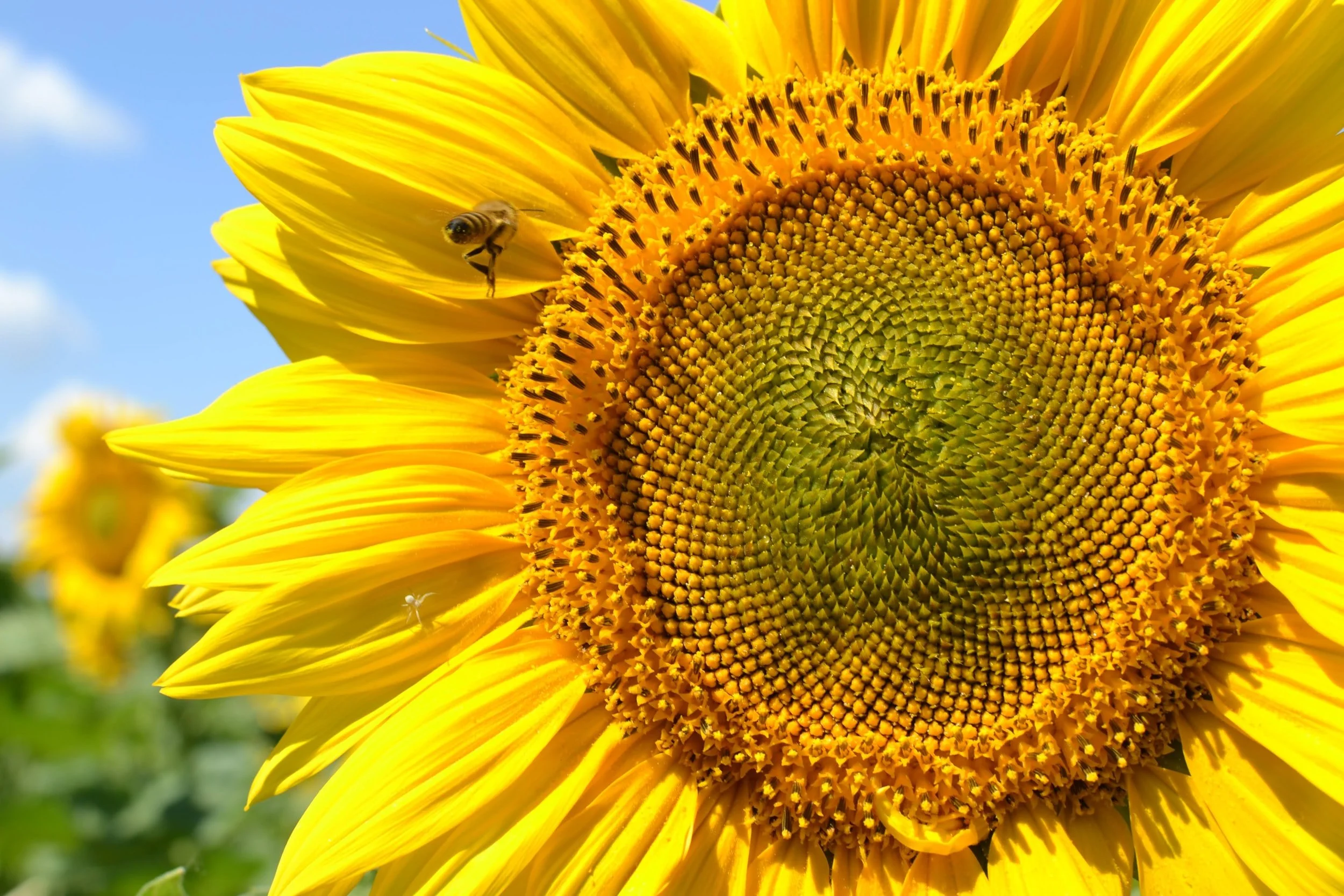
The number of seeds in the clockwise and anticlockwise are usually two numbers from the Fibonacci Sequence.
Pick up a leaf from the ground or pick one from a tree or shrub and examine it. What does the top look like? Is it shiny or matte? What about the underneath? What shape is it? Does it have serrations? How does it smell?
If you sit quietly for a little while, you might find that insects start to go about their activities without concern about you, and you can watch them close up.
Looking for repeating patterns
You often find repeating patterns in nature. An example of this is the Fibonacci Sequence. The Fibonacci Sequence is a sequence of numbers in which each number is the sum of the previous two numbers: 0, 1 , 1 , 2, 3, 5, 8, 13, 21, 34, 55, 89, 144 etc. If you count the clockwise and anticlockwise spirals that reach the outer edge of a sunflower head you will usually find a pair of numbers from the sequence: 34 and 55, or 55 and 89, or—with very large sunflowers—89 and 144. Alternatively, just marvel at the beauty of the seed head and the pattern that it makes.
Smelling
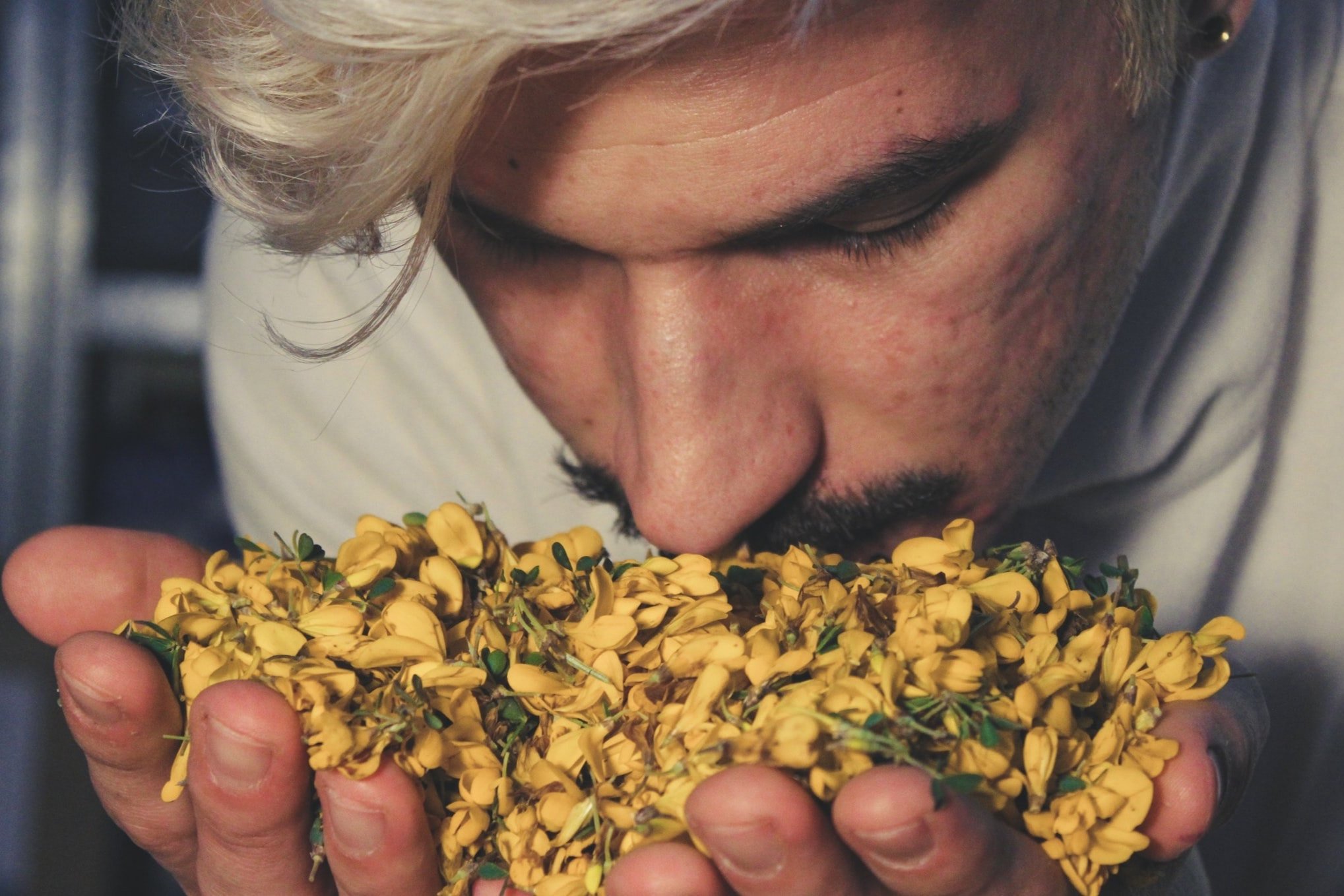
Again it is sometimes easiest to stop and close your eyes. Take a few deep breaths and think about what you can smell. A pine forest will have a very distinct smell, and depending on the time of year, you might smell wild garlic for instance.
Do the smells change as the wind blows? Pick a flower, hold it to your nose and spend a little while just thinking about how it smells.
Smells are one of the senses most closely related to memory. Think about any feelings or emotions that the smell creates. Notice how the smells change as you progress through the wood or forest.
Hearing
Think about what the forest or woodland sounds like. Can you hear animals or birds? Are they calling to each other? Can you hear the sounds of other people, such as forestry, an airplane overhead or a dog barking further along the path? Try to focus on the quiet too. What is the faintest sound that you can discern?
Tasting
You can either bring things with you, or experience what is on offer around you. If you take a handful of water from a stream to drink, think for a moment about how it tastes. If there are berries to other fruit that you recognise and know are safe, them eat them one or two at a time, savouring the taste as you eat them, and think about the aftertaste.
Sitting Still (or ‘Sit Spot’)
At some point during your Forest Bathing, it is nice to find somewhere to sit and just let nature do its thing all around. You may notice a spider building a web, or a Ladybird on a flower stem. You may hear things that you hadn’t previously acknowledged or notice the earthy smell of the forest. You may wish to try lying back and staring at the sky, maybe through the tree branches or watch the clouds as they move across the sky and change shape. You may wish to gather together a few items that you find nearby and arrange them in a pattern on the ground.

Don’t think only about the things that you experience through your senses, but also focus on how these experiences interact with each other and how they affect you emotionally. As well as looking at textures and patterns with your eyes, also pay attention to how these different patterns and textures make you feel.
Can you find something that simply feels good to look at?
Try to remember at all times, that the aim of the exercise is to immerse yourself in your environment, slowly taking in everything around you. If you find yourself speeding up, or notice that your mind drifts towards mundane things, stop and ground yourself again in your environment.
At the end of the walk, look to where you left your mental ‘baggage’ when you entered. Often people find that it has got smaller whilst they have been away. Before you leave, look back at where you have come from, and bring to mind three things that you experienced that made you feel good.
After Your Forest Bathing Walk
Before you leave, take a moment to reflect on how you feel after the experience. Notice any changes in your mood, body, or energy levels. An important component of nature connection is reflection on the experience. Nature journaling — writing down any feelings, thoughts, or observations you have during the experience can really help you to process and deepen your connection to nature. Our Nature Connection Journals are designed to help you to get the most out of this activity, providing 28 spaces for you to reflect on your nature connection activities. The left-hand page provides a blank space to write or draw and contains a quote related to nature and nature-connection. The right-hand page offers the opportunity to write down what you noticed in nature, what you noticed in yourself, and what you have learned.

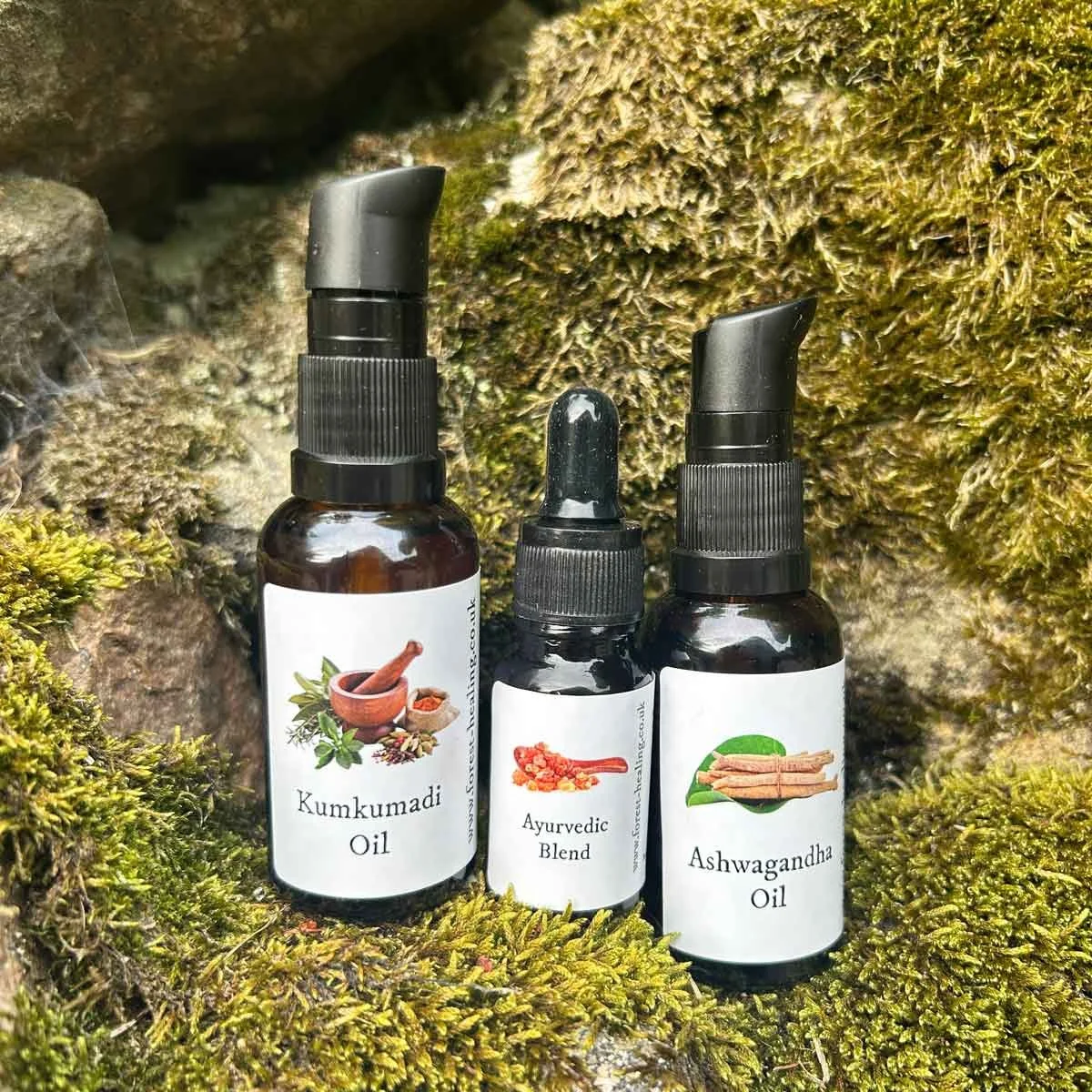
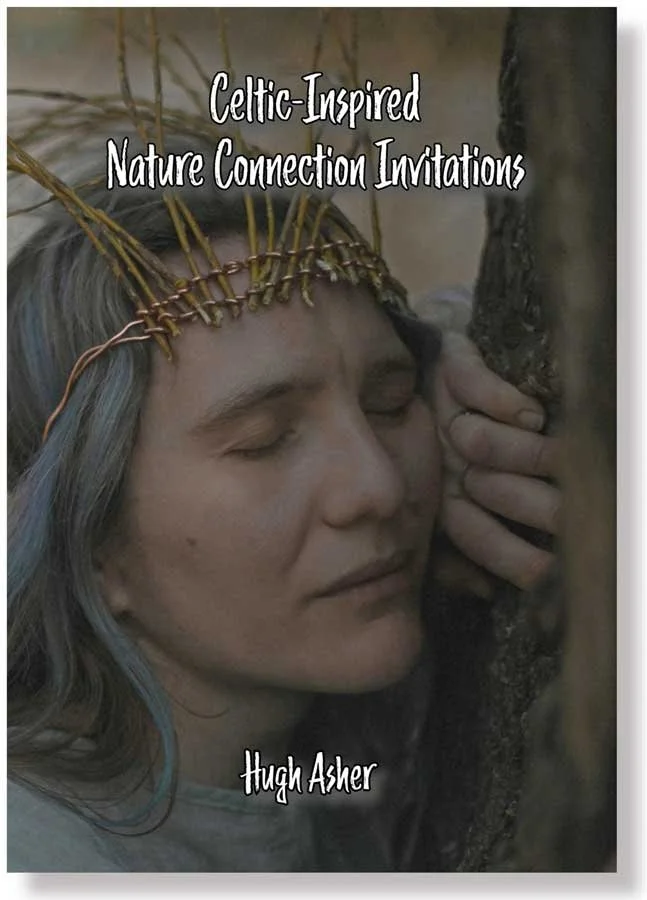


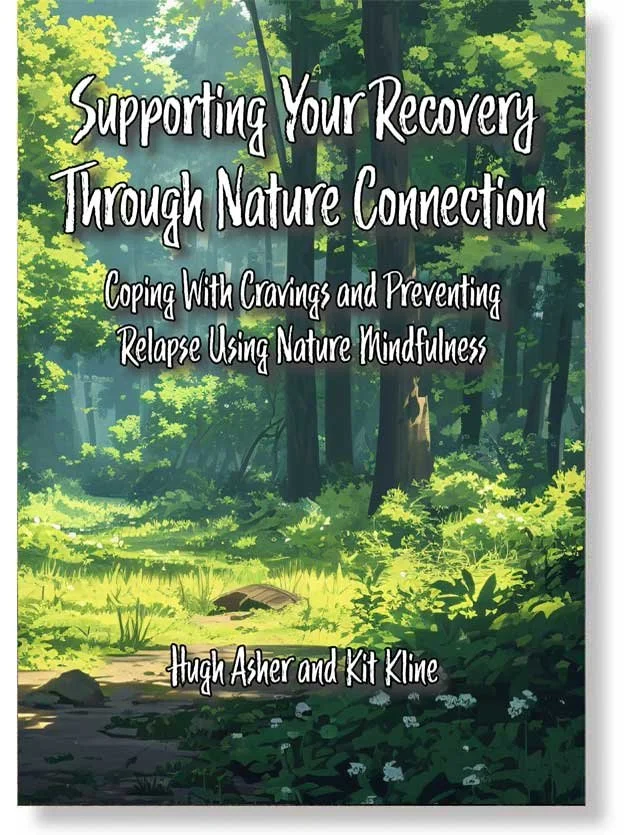






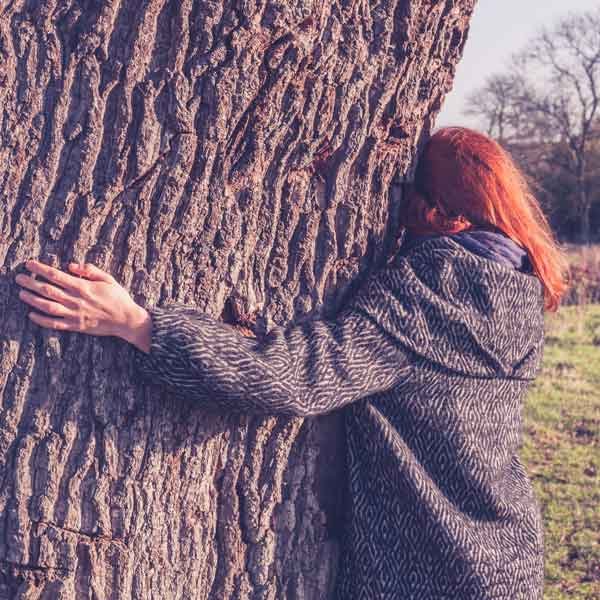
A small collection designed to gently open the door into deeper relationship with the natural world.
This complete set of four Forest Healing booklets brings together practical guidance, reflective ideas, and simple nature connection practices that can be used anywhere — from ancient woodland to a nearby park, garden, or even a single Sit Spot outdoors.
Written to be accessible, grounding, and easy to follow, these booklets offer a pathway into the core practices of Forest Bathing (Shinrin-yoku), Silvotherapy, and everyday nature connection. Rather than asking you to achieve anything, they simply invite you to slow down, notice more deeply, and allow nature to become an active presence in your wellbeing.
Across the four booklets you will explore:
• What Forest Bathing, Silvotherapy, and Nature Connection actually are
• The key benefits of spending mindful time in natural environments
• The practice of the “Sit Spot” and how to develop your own relationship with a chosen place
• Simple, practical Forest Bathing invitations you can try alone or with others
• Ways to bring nature connection into everyday life, even in small moments
Together, they form a gentle introduction to practices that have been shown to support reduced stress, improved mood, greater clarity of thought, and a deeper sense of belonging within the natural world.
These are not academic texts or rigid instruction manuals. They are invitations — encouraging you to step outside, slow your pace, and rediscover the quiet intelligence of trees, weather, and landscape.
Whether you are completely new to nature connection or looking to deepen an existing practice, this collection offers a simple, supportive starting point for building a more intentional and restorative relationship with the living world around you.
A small set of booklets that can change the way you experience even the most familiar patch of nature.
Buy all Four Forest Bathing and Nature-Connection Booklets for £11.00 including FREE P&P within the UK.
Postage to the Rest of the World is £4.