

Attention Deficit Trait and Nature-Connection
12th November 2022
In 2005, Edward Hallowell, a psychiatrist, wrote an article in the Harvard Business Review called ‘Overloaded Circuits: Why Smart People Underperform’ describing a phenomenon that he was regularly recognising in his patients. These patients often demonstrated increasingly poor organisational skills, problems with prioritising tasks and managing time, and feeling a constant low level of panic and guilt. He began to call this condition Attention Deficit Trait (ADT). The core symptoms of ADT are distractibility, inner frenzy, and impatience. Hallowell describes it as like a mental traffic jam, where occasional mental overloads are manageable, but when the ‘traffic’ is stopped and begins to back up, the problems start - such as increased stress and anxiety; increased irritability; decreased productivity and concentration-span; and problems relaxing and ‘shutting the brain down’, especially at night. It is caused by the perpetual pressures that modern life, combined with modern technology, can put us under. When I first read about ADT I recognised it as something that I had experienced a number of years ago. I was working in a high pressure job and gradually I became more and more overwhelmed and then one day things just started to slip away from me - and the harder I tried to get things back under control, the worse things became. All I was doing was working and sleeping during the week, not really relaxing at weekends, and eventually I quit the job.
What is Attention Deficit Trait?

Unlike Attention Deficit Disorder (ADD) which is a neurodevelopmental problem with a genetic component that can be aggravated by environmental and physical factors, Attention Deficit Trait issues are entirely caused by environmental factors. ADT is caused by people trying to deal with more information and sensory inputs than they can cope with as our brains are asked to process more information now, than ever before.
“[ADT] is brought on by the demands on our time and attention that have exploded over the past two decades. As our minds fill with noise—feckless synaptic events signifying nothing—the brain gradually loses its capacity to attend fully and thoroughly to anything” Hallowell wrote. Attention Deficit Trait isn’t genetically embedded like its cousin Attention Deficit Hyperactivity Disorder (ADHD). Instead, it’s a product of a modern environment. ADT isn’t typically caused by a single event, but rather “a series of minor emergencies while he or she tries harder and harder to keep up”. If left unchecked, ADT can decrease performance and make you miserable without realising the cause. According to Hallowell, Attention Deficit Trait is less severe and not recognised in the clinical manual of mental health, but it can have a negative influence on daily life. With constant interruptions and never-ending to-do lists causing so-called ‘overloaded circuits’, it’s difficult to solve problems creatively or flexibly. “The symptoms of ADT come upon a person gradually. The sufferer doesn’t experience a single crisis but rather a series of minor emergencies while he or she tries harder and harder to keep up. Shouldering a responsibility to ‘suck it up’ and not complain as the workload increases, executives with ADT do whatever they can to handle a load they simply cannot manage as well as they’d like. The ADT sufferer therefore feels a constant low level of panic and guilt. Facing a tidal wave of tasks, the [person] becomes increasingly hurried, curt, peremptory, and unfocused, while pretending that everything is fine” Hallowell says.
The ‘Amygdala Hijack’
When our brain is coping with the demands we put it under, the frontal and prefrontal lobes of the cerebral cortex - the areas of the brain responsible for planning and decision-making; organisation and prioritisation of information; and tasks like time-management - operate as they should and are in control. Under these conditions our ‘working memory’, the part of our cognitive system that holds information temporarily whilst we process it, is usually operating as it should. When our brains begin to get overloaded by information, and become unable to cope with the demands that we make, the amygdala - the part of the brain that controls emotions, emotional behaviour, and motivation - gets ‘hijacked’ and begins to misinterpret the signals that it is sent.

‘Amygdala Hijacking’ is the term Daniel Goleman coined to describe what happens when we experience an emotional response that is immediate, overwhelming, and out of measure with the actual stimulus because it has triggered a much more significant emotional threat. Our cognitive processing and our nervous systems have not evolved at the same rate as technology has advanced, and so our ‘Fight or Flight’ response is now triggered by emotionally dangerous situations such as our email in-box, rush hour traffic, demanding jobs and bosses and social media in the same way that it had developed to respond to physically dangerous situations, such as coming face-to-face with a Sabre-Tooth Tiger. People with ADT increasingly respond to this type of brain overload with anxiety and fear out of proportion to the dangers posed.
If you recognise these symptoms, maybe treat them as an early warning system like the canary in the mine and view them as indicating that you might benefit from making a few lifestyle changes.
Hallowell suggests that ADT can be managed by altering your work environment and increasing your resilience through improving your emotional and physical health. He suggests taking time at work every few hours for a ‘human moment’, a face-to-face exchange with a person you like, as well as getting enough sleep, eating a balanced diet, and getting adequate exercise. Other techniques that might help are to try to break down large tasks into smaller ones, keep a section of your work space clear, and try to keep a portion of your day free from meetings, appointments and reading and answering e-mails. It might also be worth exploring how increased connection with nature could help as well.
Attention Deficit Trait and Nature-Connection
Whilst Attention Deficit Trait (ADT) and Attention Deficit Hyperactivity Disorder (ADHD) have different underlying causes, Hallowell described ADT as characterised by many of ADHD’s negative symptoms. There is increasing research though that describes how nature and nature-connection can address many of these negative symptoms. Research has shown that exposure to the natural environment can protect against the moderate the symptoms of Attention-Deficit Hyperactivity Disorder (ADHD) in children and adults. In ‘The Cognitive Benefits of Interacting with Nature’ a study published in the journal Psychology Today in 2008, it was shown that when participants walked in nature or viewed pictures of it, as opposed to doing the same with an urban environment, their directed-attention abilities improved - getting out into nature helps us focus more on specific tasks, and this works better than, say, running on a treadmill - even looking at pictures of nature can help improve focus. This proposition is supported by the ‘Attention Restoration Theory’.
Attention Restoration Theory

‘Attention Restoration Theory’ (or ART) proposes that in addition to exposure to nature being enjoyable, that it also has restorative effects, especially in terms of our ability to focus and concentrate. This theory was first described by Rachel and Stephen Kaplan in their 1989 book published in ‘The experience of nature: A psychological perspective’. This is the theory that spending time in nature has a uniquely restorative effect on us, both cognitively, emotionally and mentally. It suggests that the mere action of spending time in the countryside, walking in a forest, sitting in a park, watching the sunset or even just looking out the window at a green space provides us with the opportunity to rest, reflect and restore the resources that we require to cope with everyday life.
It is proposed that there are four stages along the path to restoration, and I believe that these can be used effectively to respond to Attention Deficit Trait sysmptoms:
Clearing the mind, where concerns, worries and negative thoughts are allowed to pass through the mind and fade away, not by pushing them away, but by letting them flow through and out;
Recovery from mental fatigue, where, following any activity that requires focused and directed attention, the mind is allowed to recover to normal levels;
Soft fascination, where the individual can spend time in an environment that attracts us and is stimulating in a gentle way, where they can relax such as the natural environment (as opposed to ‘hard’ fascination like watching television or sports that require a higher level of attention that usually precludes time for reflection);
And ‘Reflection and Restoration’, where the most impactful restoration occurs, most commonly from spending an extended period of time in an environment that has four key components or meets four critical requirements.
The Four Components of Restorative Experiences or Environments:

According to Kaplan and Kaplan, there are four key components that they believed were necessary for a restorative environment or restorative experience and these should be actively sought in nature-connection activities:
1. Being Away
2. Soft Fascination
3. Extent
4. Compatibility
Being Away
Being away refers to the sense of being separate and apart from one’s usual thoughts and concerns; becoming psychologically detached from your present worries and experiencing a feeling of escape from everyday life.
Fascination
Fascination involves something holding your attention without any effort expended. Restorative environments hold your attention without you having to focus or direct it a certain way, and in a natural environment this might include listening to birdsong or the wind in the trees; watching clouds move by or water flow; being absorbed in the beauty of a sunset or sunrise. As previously discussed, environments that involve ‘soft fascination’, such as nature, are usually perceived to be more restorative than those that involve ‘hard fascination’, such as motor racing, although the latter can provide entertainment and reduce boredom.
Extent
Extent refers to the quality of the restorative environment that encourages you to feel totally immersed and engaged and as if you are in a whole other world.
Compatibility
Compatibility is all about feeling enjoyment in and an affinity to your environment. To be restorative, an environment must be one in which the individual chooses to be out of intrinsic motivation (they are doing it for themselves) and personal preference, otherwise they are unlikely to experience restoration.
The ideas, information and discussion in this post are not a substitute for professional help and support. If you are experiencing high levels of anxiety, stress, panic or guilt seek help and support from your General Practitioner or other healthcare practitioner .

Nature-Based Wellbeing Plans are bespoke and individualised wellbeing plans that we offer, developed in collaboration between us. These can be developed on an individual or group basis.
Everybody’s Nature-Based Wellbeing Plan will be different and will meet your individual preferences and needs. These plans are often designed after you have been on one or more guided Forest Bathing walk or engaged in Forest Therapy or nature-connection activities, such as our Sit Spot and Nature-Connection Challenge.
The Nature-Based Wellbeing Plan seeks to build on these experiences and what you have learned about yourself, the natural environment around you and the types of nature connection activities that resonate most strongly with you. For example, some people may prefer more tactile activities where they predominantly explore touch and texture, whereas other people may prefer an approach more based around the practice of Sit Spot where they sit and ‘just be’, primarily focusing on what is happening around them using their different senses.





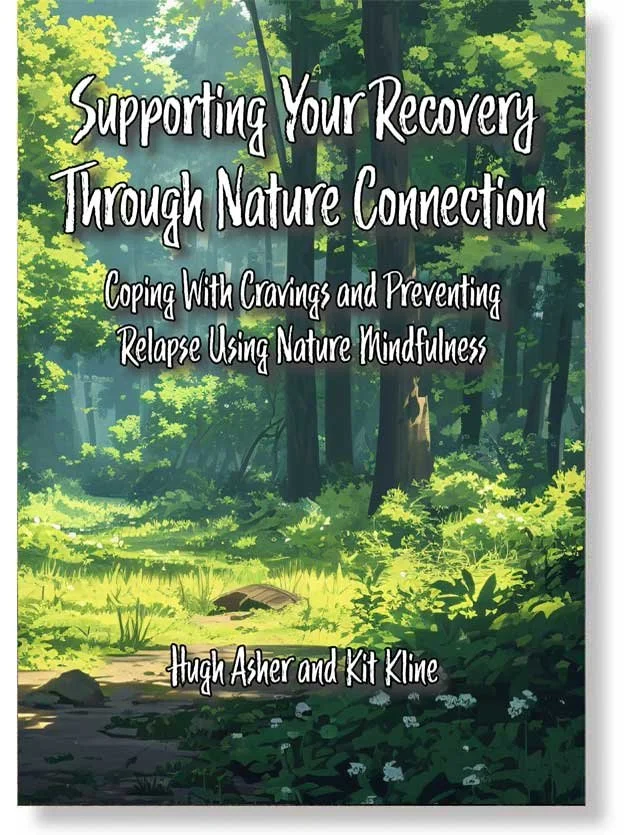








A small collection designed to gently open the door into deeper relationship with the natural world.
This complete set of four Forest Healing booklets brings together practical guidance, reflective ideas, and simple nature connection practices that can be used anywhere — from ancient woodland to a nearby park, garden, or even a single Sit Spot outdoors.
Written to be accessible, grounding, and easy to follow, these booklets offer a pathway into the core practices of Forest Bathing (Shinrin-yoku), Silvotherapy, and everyday nature connection. Rather than asking you to achieve anything, they simply invite you to slow down, notice more deeply, and allow nature to become an active presence in your wellbeing.
Across the four booklets you will explore:
• What Forest Bathing, Silvotherapy, and Nature Connection actually are
• The key benefits of spending mindful time in natural environments
• The practice of the “Sit Spot” and how to develop your own relationship with a chosen place
• Simple, practical Forest Bathing invitations you can try alone or with others
• Ways to bring nature connection into everyday life, even in small moments
Together, they form a gentle introduction to practices that have been shown to support reduced stress, improved mood, greater clarity of thought, and a deeper sense of belonging within the natural world.
These are not academic texts or rigid instruction manuals. They are invitations — encouraging you to step outside, slow your pace, and rediscover the quiet intelligence of trees, weather, and landscape.
Whether you are completely new to nature connection or looking to deepen an existing practice, this collection offers a simple, supportive starting point for building a more intentional and restorative relationship with the living world around you.
A small set of booklets that can change the way you experience even the most familiar patch of nature.
Buy all Four Forest Bathing and Nature-Connection Booklets for £11.00 including FREE P&P within the UK.
Postage to the Rest of the World is £4.