

The Wood Wide Web
First published on the 12th March 2022
Last updated on the 19th August 2023
The Wood Wide Web is a term used to describe the underground network of fungi that connect the roots of trees and other plants in a forest ecosystem. This network of fungi, known as mycorrhiza, is important for the exchange of nutrients and other substances between plants. The fungi help trees and plants access water and nutrients from the soil, and in return, the plants provide the fungi with sugars produced through photosynthesis. The Wood Wide Web is a critical part of the forest ecosystem, helping to support the health and survival of the plants that make up the forest.
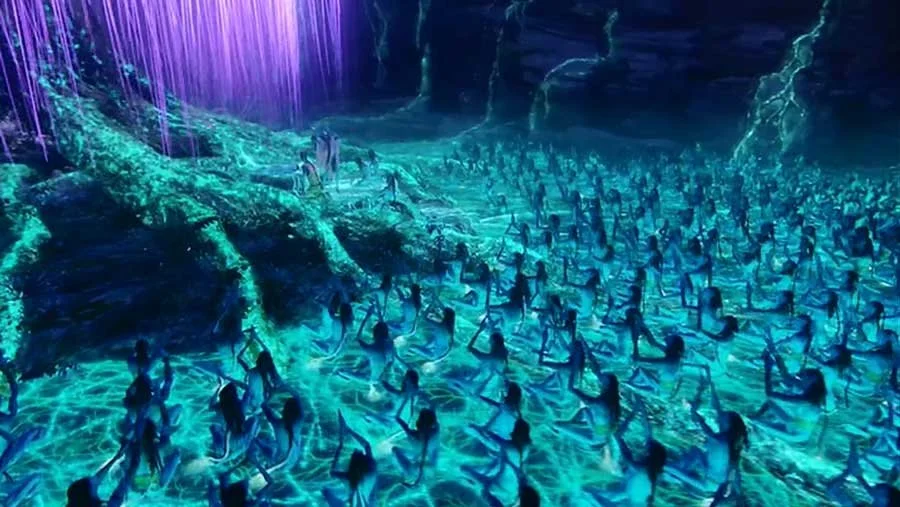
In James Cameron’s film Avatar, the trees and plants of Pandora (an Earth-like habitable extrasolar moon from the Alpha Centauri System) had formed electrochemical connections between their roots that effectively acted like neurons, creating a moon-wide sentient ‘brain’ known to the Na'vi who inhabited Pandora as Eywa. Eywa functions like a huge biological internet in which the trees act as computer servers that store information, and the Na'vi believed that Eywa keeps the ecosystem of Pandora in perfect equilibrium (you can read more about The Environmental Message in ‘Avatar’ here). This might sound far fetched, but it may be closer to reality than we think. Research has shown that beneath every forest and wood there is a complex underground web of roots, fungi and bacteria helping to connect trees and plants to one another. This subterranean social network, nearly 500 million years old, has become known as the ‘Wood Wide Web’.
Whilst the ethos of Forest Bathing is to shift your attention and focus from learning about what something in the forest is to how something in the forest makes you feel, another component of nature-connection is ‘Awe’ and the existence of this Wood Wide Web certainly fills me with awe!
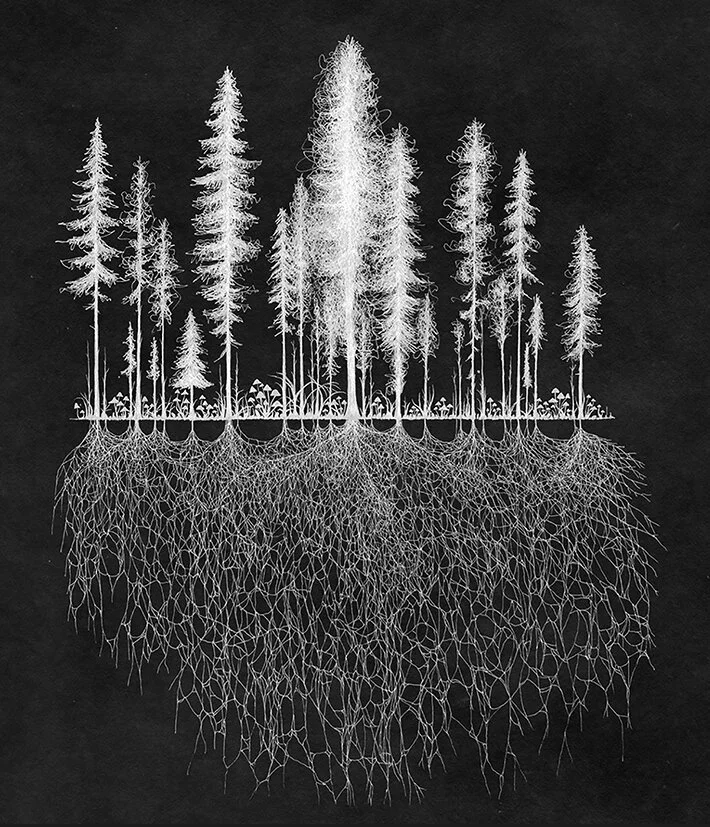
‘Forest’ by Katie Holten - https://www.katieholten.com - featured in https://emergencemagazine.org/feature/forest/
Mychorrhizal Networks
For a long time, fungi were thought to be the enemy of plants and trees, spreading disease and then consuming the trees they killed. However, over the last 30 years or so, a greater appreciation has emerged of the positive, and in many ways essential role that fungi play in the lives of trees and plants. It has been discovered that a network of fungi exists a few centimetres below the forest floor, comprised of super-fine tubes called hyphae (the soil directly under your feet could contain several kilometres of hyphae) that attach themselves to the roots of trees and plants and then form themselves into ‘mycelium’ - long thin fungal filaments comprised of hyphae. These mycelium form a huge mychorrizhal network that interacts with the roots of trees and plants in a symbiotic (mutually beneficial) relationship. ‘Mycelium’ is used to describe the vegetative part of any fungus, consisting of the branching, threadlike hyphae, while ‘mycorrhiza’ and literally means ‘fungus root’ is a biological term to describe the symbiotic relationship between the mycelium of a fungus and the roots of a plant. It is a mutualistic relationship where the tree provides photosynthate for the fungus, because the fungus doesn’t have leaves and as the mycelium grows through the soil it picks up nutrients and water and then transports them back to the tree, and they exchange with each other.
These mychorrizhal networks are thought to connect up to 90% of all land plants. This network connects the trees together, and increases the surface area of the roots, helping the trees or plant to take up water. But this root system is far more complex than just a water pipe, it also facilitates an exchange in which the mycorrhizal network absorbs nutrients such as Phosphorous and Nitrogen from the surrounding soil using enzymes that the trees do not possess, and then provides the trees with these nutrients, as well as water, in exchange for carbohydrates in the form of carbon-based plant sugars.
Photosynthesis
We have heard a lot recently about how trees absorb carbon dioxide, and the reason that they do this is that through photosynthesis the trees can covert the carbon dioxide and water back into oxygen and carbon-based plant sugars that are then transported around the tree, including to the roots where they support the energy-rich process of nutrient uptake and absorption. Photosynthesis requires sunlight and so occurs above ground, out of the reach of the fungal hyphae in the mycorrhizal network, but the trees can exchange these carbon-based sugars with the hyphae for the water and nutrients that the hyphae can provide. Although it was previously thought that that the extent of this network was to enable the hyphae to provide nutrients in exchange for carbon, it has more recently been identified that the network can also be used to transfer these carbon-based sugars from one tree to another so some trees offer food and other trees receive it.
Uploading and Downloading on the Wood Wide Web
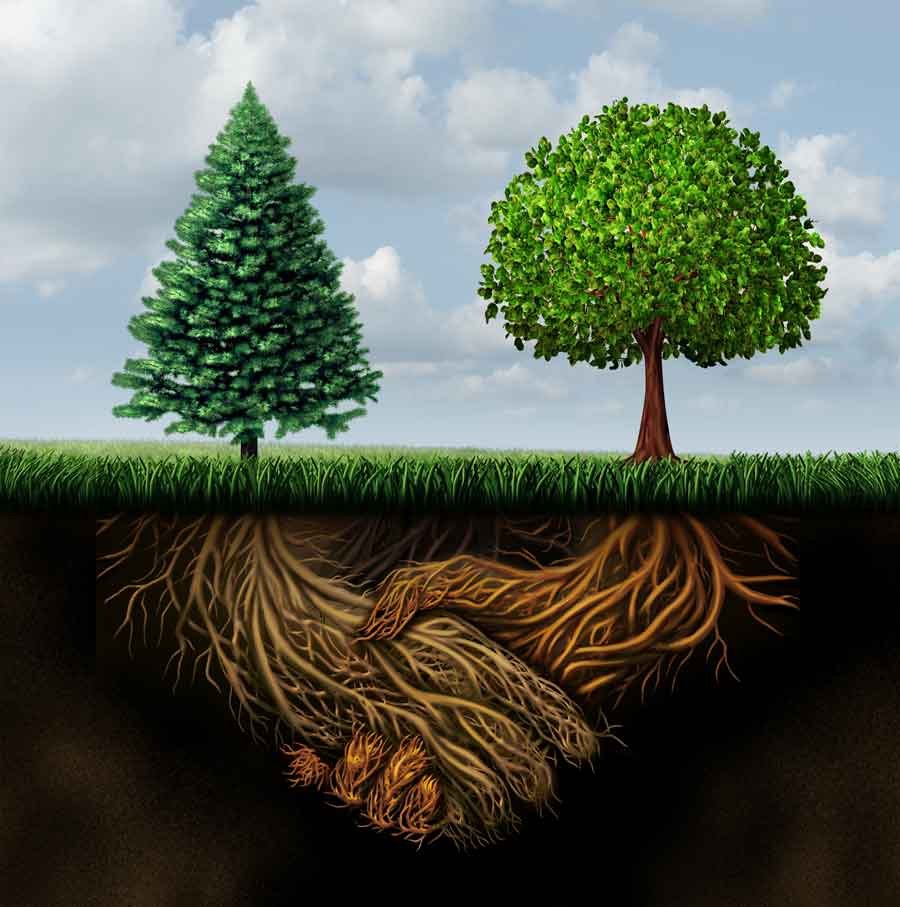
So the Wood Wide Web connects trees and plants together through this underground network, but it doesn’t just link trees and plants of the same species together, it links different species of trees together. German forester Peter Wohlleben (author of 'The Hidden Life of Trees') has identified that rather than acting as competitors, different species of trees often co-operate with each other, in part because trees like cool and moist environments best that can only be achieved by collaboration rather than competition. In this way the individual tree is not nearly as important as the part it plays the wider forest. Forest ecologist Suzanne Simard (The University of British Columbia, Canada) has been observing and investigating the communication and nutrient sharing that occurs between trees for decades. She has found that some trees in fact only thrive when they are in amongst other species. Douglas Fir for example has been found to thrive when in close proximity to Birch trees, but suffers when the Birch trees around it are removed. Birch trees are considered to be a ‘pioneer’ tree, as they are often the first to colonise wet and treeless ground or to heal landscapes disturbed by fire, flood, clear cuts, or storms.
Suzanne Simard describes this relationship in trees as a facilitator relationship, much as we would describe I a friendship if it was a relationship between two people. And much in the same way as friendships exist and function, she has also identified in her research that this facilitator relationship exists in both directions. She has identified and noted that the Birch tree shares more of its carbon with the Douglas Fir than it receives during the months when it has leaves and is at peak photosynthesis, but when it loses it’s leaves, it receives more carbon than it gives (also sharing nitrogen, phosphorous and other chemical signals).
Peter Wohlleben says that he first became aware that there must be a subterranean nutrient exchange system when looking at very old tree stumps that were still alive. He noted that tree stumps can live on for a long time, even without leaves to enable photosynthesis and the production of necessary plant sugars to sustain the tree stump, and concluded that the only possible mechanism was eitherbecause of the mychorrizal network or because its roots are grafted to another nearby tree.
Mother Trees or ‘Hubs’
Suzanne Simard, Peter Wohlleben and other scientists have also modelled the links between trees in forests and have identified that the biggest and oldest trees often act like hubs in a computer network, having the most links to other trees. These are often referred to a Hub Trees or Mother Trees as they often create network connections with younger saplings that are growing in the understory of the forest in order to feed them additional plant sugars if necessary. Saplings that are connected to Mother Trees in this way are shown to be about four times as likely to survive to full size than those that are not connected to a Hub Tree, although it has also been shown that Mother Trees often favour ‘kin seedlings’ that are closely related to themselves, than ‘stranger seedlings’.
Mycoheterotrophs
Mycoheterotrophs are plants that do not contain chlorophyl and consequently are unable to photosynthesise and produce their own nutrients and appear to be totally reliant on the network of mycellium below them for their carbon. Whether they are actually parasitic or just like naughty little computer hackers that take from the network without giving back appears to be up for debate!
Tree Communication Through the Wood Wide Web
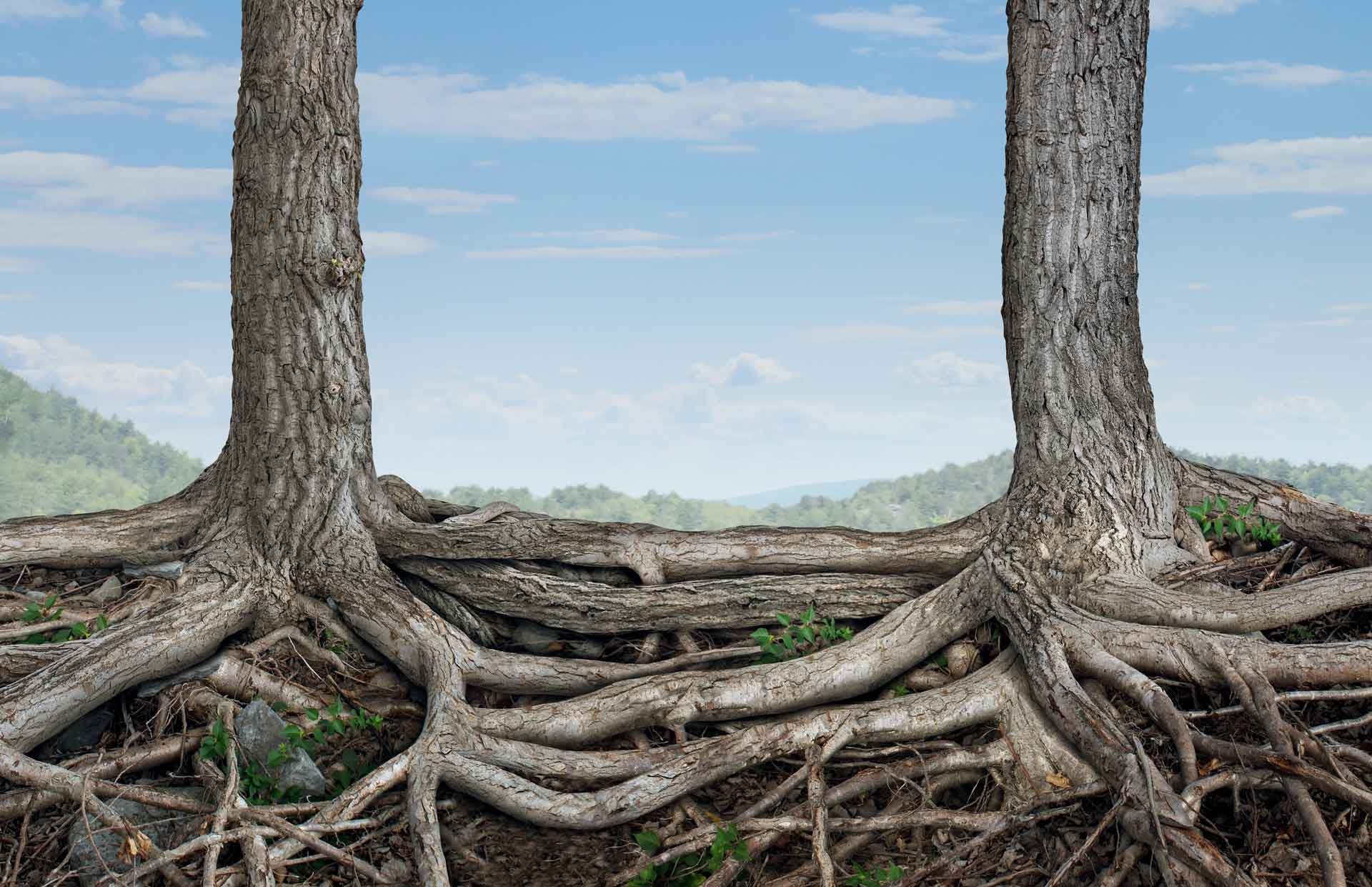
As well as sharing necessary nutrients, the trees in the network can also communicate with each other. For example, when a tree is attacked by insects it has been found that it can flood its leaves with chemical known as phenolics that repel insects, and when a tree detects saliva from animals such as deer on its leaves it can release tannins and other chemicals that give the leaves a bitter taste that makes the leaves less appetising to herbivorous mammals. However, these trees not only engage their own defence mechanisms, they can signal to other trees nearby that there is a threat both through the air (like wifi) and also through the mychorizzla network (like an ethernet cable) so they can start their own defense.
Monoculture Plantations
These findings have implications for the dominant model of ‘monoculture’ plantations of trees with only one or two species of trees, usually Pine, Fir or Spruce. Evidence indicates that monoculture plantations of trees are more susceptible to insect attacks and do not thrive in the way that mixed species forests or plantations do. Simultaneous planting of a single species of tree results in a very different or non-existent underground networks with few Hub Trees. Suzanne Simard describes hub trees as being like the rivets in a aeroplane. You can take out one or two without consequence, but if you take out too many, or don’t have enough, then the wing falls off and the system collapses. So, we really need to stop thinking about trees as individual species and start recognising that they are part of a far larger system.
In many ways, it is amazing to think that it took humanity until 1983 to invent the internet, but nature created its own version about 500 million years ago. And we think that we’re smart!
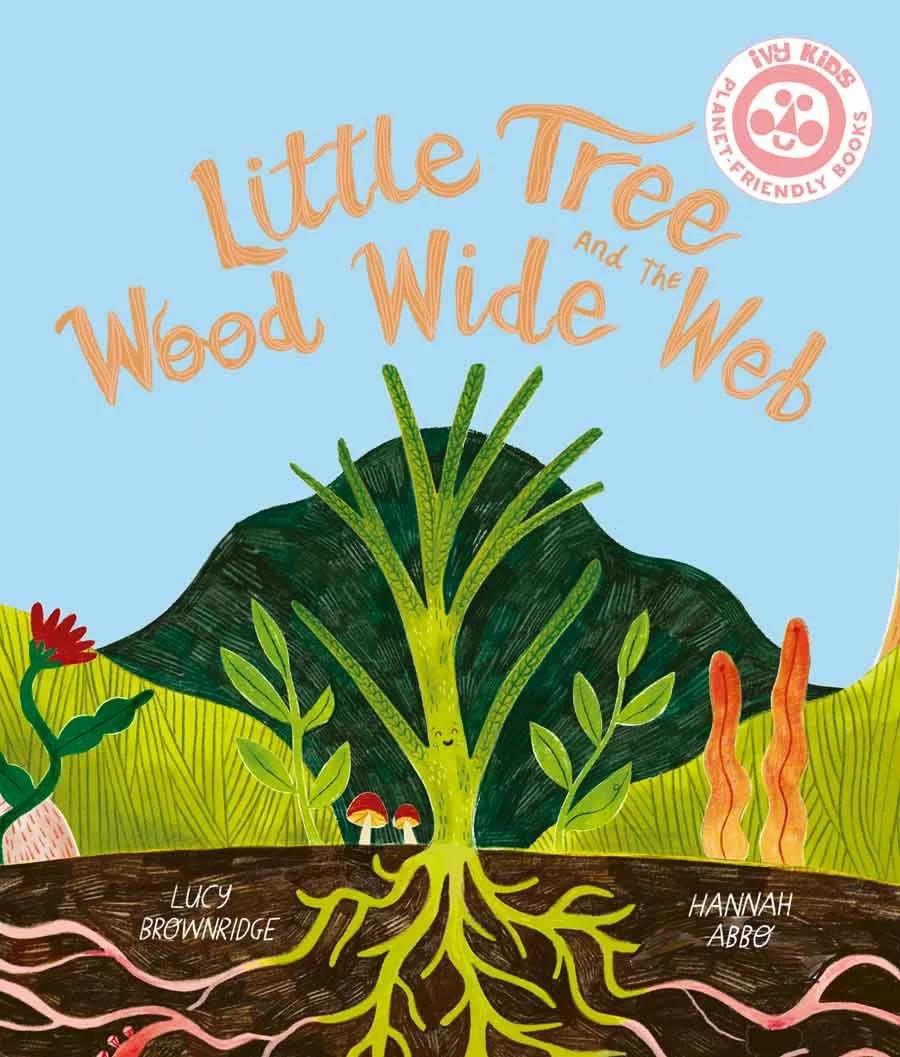
Written by Lucy Brownridge and illustrated by Hannah Abbo.
Little Tree is a fir tree sapling, stretching her first leaves into a dark ancient forest full of huge trees. She feels very lonely, and she can’t reach any light or water. Her worried feeling sinks down to her roots, which, little does she know, are connected to the Wood Wide Web. The fungal network sends her message all over the forest: “Little Tree needs help!”
The message finally reaches a friendly paper birch tree who can help Little Tree in her time of need. And when winter comes and Paper Birch needs help in return, the strong not-so-Little Tree can come to the rescue. Little Tree learns that she is part of a loving community, that there are many ways to care and be cared for, and most importantly that she is not alone. After all, the forest is only as strong as its smallest tree.
This powerful picture book is based on recent research in contemporary science, that trees can communicate distress and danger through underground networks of fungal threads known as the wood wide web.
32 pages.
Suitable for ages 5-7 years.
Postage and Packing is £2 in the UK.

Finding the Mother Tree
An Interview with Suzanne Simard
In this in-depth audio interview, Suzanne Simard—the renowned scientist who discovered the “wood-wide web”—speaks about Mother Trees, kin recognition, and how to heal our separation from the living world.
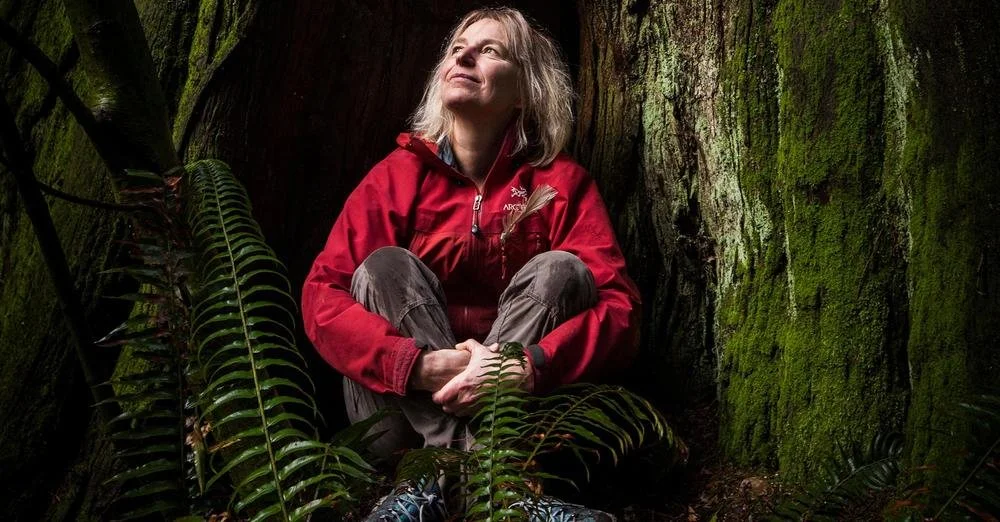
How Trees Talk to Each Other
Suzanne Simard
"A forest is much more than what you see" says ecologist Suzanne Simard. Her 30 years of research in Canadian forests have led to an astounding discovery -- trees talk, often and over vast distances. Learn more about the harmonious yet complicated social lives of trees and prepare to see the natural world with new eyes in the TED Talk below:
Intelligent Trees - The Documentary
Featuring Suzanne Simard & Peter Wohlleben
Trees talk, know family ties and care for their young? Is this too fantastic to be true? Scientist Suzanne Simard (The University of British Columbia, Canada) and German forester and author Peter Wohllebenhave been investigating and observing the communication between trees over decades. And their findings are most astounding. Watch the trailer below or find out more about Intelligent Trees the Documentary here.
If you have enjoyed this article and would like to support what we do by donating £2 or more to buy saplings please follow the link below:

















A small collection designed to gently open the door into deeper relationship with the natural world.
This complete set of four Forest Healing booklets brings together practical guidance, reflective ideas, and simple nature connection practices that can be used anywhere — from ancient woodland to a nearby park, garden, or even a single Sit Spot outdoors.
Written to be accessible, grounding, and easy to follow, these booklets offer a pathway into the core practices of Forest Bathing (Shinrin-yoku), Silvotherapy, and everyday nature connection. Rather than asking you to achieve anything, they simply invite you to slow down, notice more deeply, and allow nature to become an active presence in your wellbeing.
Across the four booklets you will explore:
• What Forest Bathing, Silvotherapy, and Nature Connection actually are
• The key benefits of spending mindful time in natural environments
• The practice of the “Sit Spot” and how to develop your own relationship with a chosen place
• Simple, practical Forest Bathing invitations you can try alone or with others
• Ways to bring nature connection into everyday life, even in small moments
Together, they form a gentle introduction to practices that have been shown to support reduced stress, improved mood, greater clarity of thought, and a deeper sense of belonging within the natural world.
These are not academic texts or rigid instruction manuals. They are invitations — encouraging you to step outside, slow your pace, and rediscover the quiet intelligence of trees, weather, and landscape.
Whether you are completely new to nature connection or looking to deepen an existing practice, this collection offers a simple, supportive starting point for building a more intentional and restorative relationship with the living world around you.
A small set of booklets that can change the way you experience even the most familiar patch of nature.
Buy all Four Forest Bathing and Nature-Connection Booklets for £11.00 including FREE P&P within the UK.
Postage to the Rest of the World is £4.