

Saturday 25th July 2026
Beyond the Five Senses — How Interoception and Proprioception Help Us Reconnect with Nature, Ourselves, and the Quiet Wisdom of the Body
There are some forms of healing that happen in words, and others that happen before words arrive at all.
A walk amongst trees can slow the breath, soften the shoulders, and quiet the mind. But something subtler is often taking place too — the body is beginning to notice itself again. The feet register the ground. The chest rises and falls. The stomach murmurs. The muscles make tiny adjustments. The body, in other words, is speaking. And nature has a way of helping us to listen.
This is where proprioception and interoception meet nature connection. Proprioception is the sense that tells you where your body is in space and how it is moving. Interoception is the sense that helps you notice the body from the inside: hunger, heartbeat, thirst, nausea, temperature, urgency, tension, calm. Together, they shape our experience of being alive in a body. They are part of the deep, often automatic intelligence that allows us to move through the world, sense our needs, and respond to life as it unfolds.
Listening to the Body From the Inside

Interoception is sometimes described as the awareness of the body’s internal signals. It helps us to notice things such as hunger, a racing heart, the need to use the toilet, pain, nausea, thirst, and changes in temperature. It is not merely about registering sensations; it is also about interpreting them and deciding what, if anything, needs to happen next. In that sense, interoception supports both physical balance and emotional life. A fast heartbeat in a dark room may be read as fear. A growling stomach may be read as hunger. The feeling itself is only part of the story — the meaning that we give it matters too.
That is one reason interoception is so important in self-regulation. It helps us understand what our body is asking for before we become overwhelmed by it. When interoception is working well, the body’s messages are more likely to be noticed, recognised and responded to in a helpful way. When it is less clear, those same signals can be confusing, muted, magnified, or misunderstood. People can vary significantly in how easily they detect and interpret internal signals, and but mindfulness practices, breathwork, yoga, meditation and Somatic therapy may help strengthen interoceptive awareness over time.
In everyday life, this can look very ordinary. You realise you are thirsty and reach for water. You notice a knot in the stomach before a difficult conversation and know that your body needs a pause. You feel heat in your face, a tightness in the jaw, or heaviness in the limbs, and begin to sense that something inside you is shifting. Interoception may be subtle, but it is constantly helping us to orient ourselves. It is one of the ways the body keeps us company.
The Hidden Intelligence of Movement
If interoception is the inward sense, proprioception is the sense of position, movement and orientation in space. It is the body’s ability to sense its own position and movements, often automatically or subconsciously, without needing to rely on vision alone. It is what lets you walk without staring at your feet, touch your nose with your eyes closed, stand on a slope and subtly adjust your balance, or catch yourself as the ground changes beneath you.
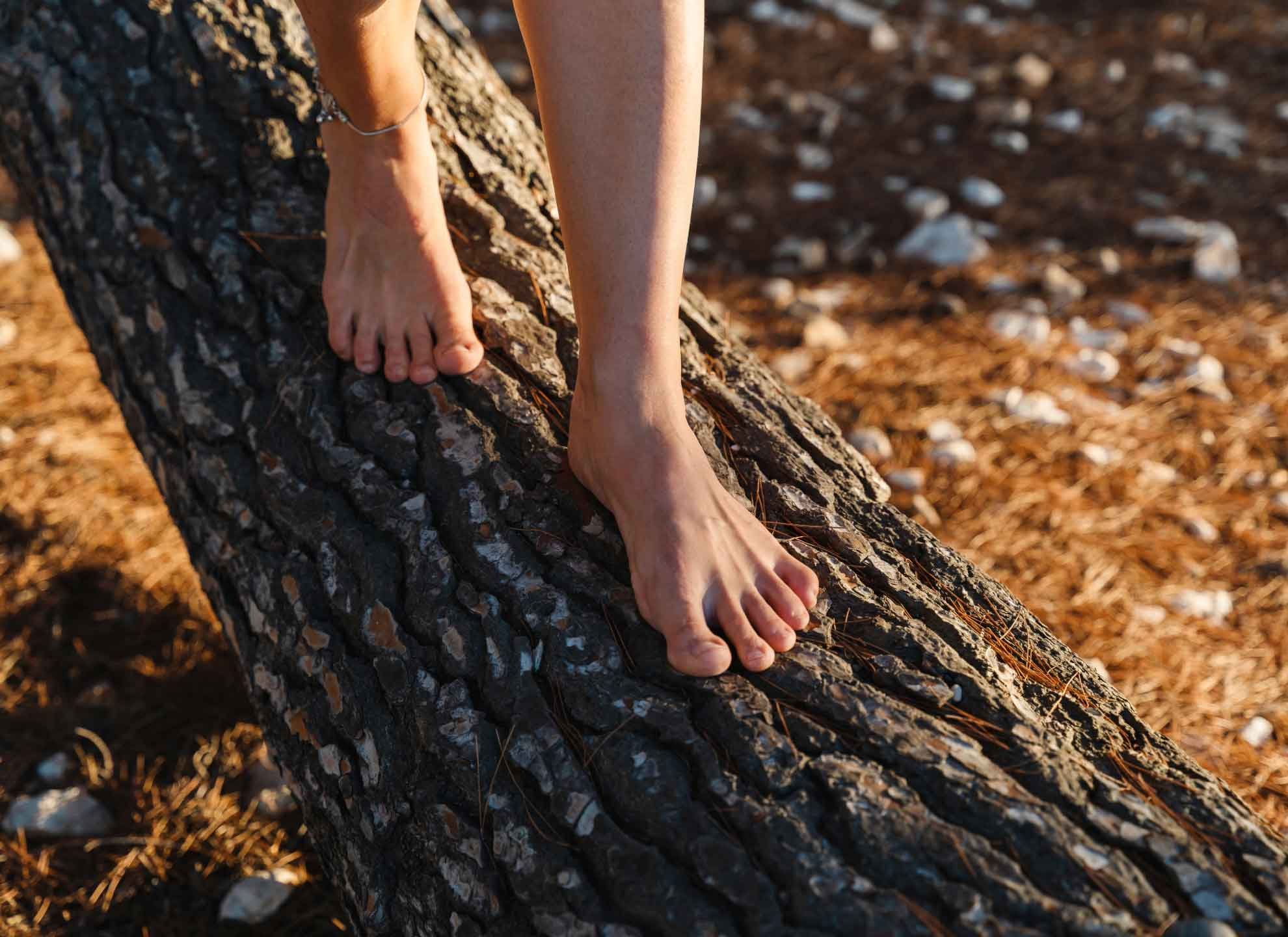
Proprioception is often very subtle. Most of the time we barely notice it because it is working so well. Yet it is essential to balance, coordination, posture and skilled movement. It is also deeply tied to confidence in the body. When proprioception is strong, the body feels inhabited. When it is challenged, movement can feel uncertain, clumsy or effortful. A person may seem to “overthink” movement, but often the body is asking for clearer information, more repetition, or a gentler environment in which to recalibrate.
This is where the cerebellum becomes particularly important, the part of the brain most involved in proprioception. Research on cerebellar function shows that the cerebellum contributes to predictive control — it helps anticipate the sensory consequences of movement, rather than simply reacting after the fact. In other words, it supports the body’s ability to move with a kind of quiet foresight. That is one reason proprioception is so closely linked to automatic, efficient action. The body is not waiting for a conscious instruction for every adjustment — much of the work is happening beneath deliberate thought, and in this way the cerebellum is often seen as the seat of the subconscious mind.
This does not mean the cerebellum is the whole story, or that movement simply ‘bypasses’ thinking in a simplistic way. Rather, it helps to explain why so much of our embodied life is felt as immediate, fluid and pre-reflective. We do not think our way through every posture correction, every step on uneven ground, or every tiny shift that keeps us upright. The body learns, predicts and adapts. And when we are in nature, this intelligence is often gently reawakened.
Why These Senses Matter for Neurodivergent People
Interoception and proprioception are not experienced in exactly the same way by everyone. That matters, especially when we begin talking about neurodivergence. Interoception may be heightened, reduced, or otherwise experienced as more difficult to interpret in neurodivergent people, such as people with Autism and ADHD. In Autism, interoceptive accuracy may be lower, which can make it harder to recognise bodily needs or regulate emotions. In ADHD, noticing bodily signals may be strong, but acting on them may still be difficult.
That does not mean the body is failing. It means the relationship between sensation, attention and action may be differently organised. For some people, the body sends very clear signals but the signals arrive all at once and are hard to sort. For others, the signals are quieter, more delayed, or easier to override. This can affect emotion regulation, hunger and thirst cues, pain awareness, and the ability to sense when rest is needed. It can also influence how safe or overwhelming the world feels.
The Open University’s 2025 publication, Immersing Your Neurodivergent Self in Nature, explores nature, embodiment and interoception through guided Forest Bathing activities. It reports that neurodivergent participants described reduced mental chatter in at least one activity, as well as unexpected connections with nature, reduced concern about social judgement, and, for some, lasting improvements in mood and interoceptive awareness. That is a quietly remarkable finding because it suggests that nature may not merely be relaxing in a general way — it may create conditions in which bodily awareness becomes more accessible and less effortful.
The significance of this matters beyond the research itself. Many neurodivergent people spend a lot of energy navigating environments that are too loud, too bright, too fast, too socially demanding, or too full of competing sensory information. Nature can offer a different kind of setting — one that is slower, richer, less scripted, and often less judgemental. In that kind of space, attention can soften, the body can begin to settle, and when the body settles, awareness sometimes grows.
Nature Connection as an Embodied Relationship
A growing body of nature connection research points to the body as part of our relationship with the living world, not separate from it. A 2024 Frontiers study titled Embodied Earth Kinship found that interoceptive awareness significantly predicted nature connectedness, with secure attachment to nature helping explain the relationship. The study also linked nature connection with wellbeing and pro-environmental behaviour, suggesting that the human-nature bond is not only cognitive or symbolic but also bodily and relational.
This is a powerful idea. It suggests that being close to nature is not only about appreciating scenery or learning facts about ecosystems. It is also about the way the body feels when it is in relationship with the more-than-human world. The breath slows under trees. The shoulders lower. The senses open. The body listens differently. And as interoception becomes more available, the separation between ‘me’ and ‘the natural environment’ can feel less rigid.

This resonates deeply with the philosophy and principles that we hold here at Forest Healing. Nature connection is not simply something we do in nature — it is something we feel with nature. In that sense, interoception can be understood as a doorway. The better we can sense ourselves from the inside, the more room there may be for genuine relationship with the world around us. We are not only observing the forest — we are meeting it through our body.
There is also something wonderfully humbling about this. So much of modern life encourages us to live from the neck up: to think, plan, analyse, compare, judge and rush. Nature invites us back into the body. The body, in turn, reminds us that awareness is not just mental. It is sensory, relational and lived. The forest does not ask us to perform awareness. It asks us to notice.
What Forest Bathing Brings
Forest Bathing, or Shinrin-yoku, is usually described as a slow, intentional immersion in a forest environment, engaging all the senses and deepening our connection with nature. The Forest Therapy Hub describes it as a nature-based practice that can support health and wellbeing, and research shows reductions in stress hormones and blood pressure, as well as improvements in mood, sleep, cardiovascular health, symptoms of anxiety and depression, memory and attention. While the exact mechanisms are still being explored, the overall picture is clear enough — time in woodlands and forests appears to support regulation.
That matters because regulation is not only emotional or cognitive; it is also sensory and bodily. Forest environments offer varied but often gentle input — filtered light, layered sounds, shifting textures, moving air, scent, damp earth, uneven ground, branches, roots and changes in temperature. Unlike the flat, fast stimulation of screens or built environments, nature tends to invite slower processing. That can make it easier to notice subtle sensations without becoming overwhelmed by them.
The Forest Therapy Hub materials on children and nature connection make this especially vivid. They describe children’s sensory systems as being wide open, and note that Forest Bathing for children is not a miniature adult practice but a developmentally attuned experience. The practice is framed as noticing, exploring and restoring rather than hiking, classroom-style learning or survival skills. The emphasis is on curiosity, sensory integration, emotional regulation, attention stability and play. Children often settle quickly into presence when the environment invites it.
This gives us an important clue for adults too. Forest Bathing is not only about being in a place. It is about the quality of attention we bring to the place. Slowing down enough to notice the body is part of what makes the experience therapeutic. It is not a race to complete a route. It is a gentle return to sensation, relationship and enoughness.
Proprioception, Balance and the Living Ground Beneath Us
Proprioception becomes especially obvious when the ground changes. A woodland path asks something different of the body than a pavement does. Roots, stones, slopes, mud, soft moss and uneven stepping places invite constant micro-adjustments. The body has to feel its way forward. The Forest Therapy Hub notes that Forest Bathing with children naturally engages proprioception and balance through walking on roots, gentle climbing and navigating uneven paths, and describes these micro-challenges as supporting motor development and confidence.
This is one reason nature can be so regulating. It asks the body to participate. The body is not merely seated in front of the world — it is negotiating it. That negotiation can restore a sense of embodied competence. A foot finds a stable place on a stone. A hand steadies the body by resting on bark. The body bends, reaches, crouches, rises. Through these simple acts, proprioception is exercised and affirmed. For families, this can be beautifully practical.
There is a lovely truth here: nature does not just calm the nervous system — it educates it. The body learns to trust itself again in relation to a living terrain. That trust can be deeply healing, especially for people who feel disconnected from their bodies, uncertain in movement, or worn down by constant mental strain. Sometimes confidence does not arrive as a thought. Sometimes it arrives as a step that lands safely.
A Gentle Bridge for Children and Adults Alike
Children often meet nature through the body first. They crouch, climb, touch, listen, collect, balance, smell and wander. The Forest Therapy Hub describes children as responding quickly to the multisensory richness of forests, where rhythm, movement and sensory input support calm alertness and playful learning. Adults, by contrast, often need to decelerate deliberately. Forest Bathing can support that slowing down by creating space for attention to soften and senses to widen.
This does not mean adults should try to become childlike in any simplistic sense. It means there is wisdom in rediscovering the spontaneous, curious, embodied intelligence that children often inhabit more naturally. Notice how a child kneels to inspect a leaf, lifts a stick, tests a stone with a foot, or simply stands still to hear birdsong. That is not distraction — it is embodied attention — and embodied attention is exactly the kind of attention that supports interoception and proprioception together.
For neurodivergent adults and children alike, this matters even more. In a world that often rewards speed, compliance and verbal performance, nature offers an alternative. It does not require us to explain ourselves. It allows us to be responsive rather than performative. That shift can reduce pressure and make room for genuine inner noticing. The Open University’s research suggests that guided Forest Bathing may reduce mental chatter and support mood and interoceptive awareness among neurodivergent participants, which points to something more than ordinary relaxation. It points toward embodied inclusion.
What Nature May be Offering the Nervous System
It can be tempting to think of Forest Bathing as a pleasant extra, a luxury, or a soft alternative to ‘real’ wellbeing work. But the research literature suggests something more substantial. Forest bathing science has been associated with lower stress markers, lower blood pressure, improved mood, and benefits to sleep, anxiety, depression, memory and attention. These are not trivial outcomes. They are signs that the body and mind may be shifting into a more supportive state.
That does not mean nature is a cure-all, or that every walk in the woods will feel transformative. Human lives are too complex for that. But it does mean the natural world can be part of the ecology of regulation. It can provide conditions in which the body is easier to inhabit, the mind is less crowded, and sensations are easier to bear. Sometimes that is enough to begin.
This is also why sensory language matters. When we describe a forest only in visual terms, we miss much of what is actually happening. The body knows the forest through smell, pressure, sound, temperature, movement and internal shifts. A path can feel safe or uncertain. A clearing can feel spacious. A breeze can change breathing. A shaded glade can bring relief. Interoception helps us notice these inner responses. Proprioception helps us move through them. Together they make nature connection more embodied, more honest and more complete.
Bringing it into Everyday Life
The good news is that you do not need to go on a week-long retreat to begin listening. Nature connection can start in the simplest of places — a garden, a park bench, a tree you pass on the school run, a damp patch of moss by the path, even the light falling through a window. The point is not the size of the place, but the quality of attention.
You might begin by noticing the body before you even look outward. What does the breath feel like today? Is the jaw soft or held? Are the feet heavy or light? Is there hunger, thirst, fatigue, restlessness, warmth or tightness somewhere? These are interoceptive questions, and they gently invite the body back into consciousness. Then you can notice how the body is standing, walking or resting in space. That is proprioception speaking. Are you leaning? Balanced? Braced? Open?
Once outside, let the environment answer back. Notice where the body relaxes and where it contracts. Feel the ground underfoot. Let the eyes rest on something green. Pause for a moment and listen for the nearest sound, then the farthest. Pick up a natural object and feel its weight, texture and temperature. Step carefully over a root. Stand still and allow the body to settle. None of this has to be dramatic. In fact, the quieter it is, the more the senses may begin to speak.
For children, this might mean a walk that includes touching bark, balancing on logs, collecting sticks or noticing little worlds among the leaves. For families, it might mean sharing a simple body-scan moment together and then moving through the landscape with curiosity. For neurodivergent people, it may mean honouring the space that feels safe, reducing social pressure and letting attention come and go without judgement. Forest Bathing, when thoughtfully offered, can become a setting where the body is allowed to be itself.
A Final Thought
Interoception teaches us that the body is never silent. Proprioception teaches us that the body is never alone. And nature reminds us that awareness does not have to happen in isolation from the living world.
The forest can become a place where the body remembers its own language. The breath deepens. The feet steady. The inner signals come through more clearly. The mind may still be there, busy as ever, but it no longer has to hold everything. Beneath thought, beneath speed, beneath self-consciousness, there is another kind of knowing: a felt sense of being here, now, in relationship with the world.
That is part of the quiet medicine of nature connection. Not a promise of perfection, but an invitation into presence. Not an escape from the body, but a return to it. Not a demand to think differently, but a chance to sense differently. And sometimes, that is where healing begins.
You can download a nature-connection activity related to this article here, or buy some of our booklets —

A small collection designed to gently open the door into deeper relationship with the natural world.
This complete set of four Forest Healing booklets brings together practical guidance, reflective ideas, and simple nature connection practices that can be used anywhere — from ancient woodland to a nearby park, garden, or even a single Sit Spot outdoors.
Written to be accessible, grounding, and easy to follow, these booklets offer a pathway into the core practices of Forest Bathing (Shinrin-yoku), Silvotherapy, and everyday nature connection. Rather than asking you to achieve anything, they simply invite you to slow down, notice more deeply, and allow nature to become an active presence in your wellbeing.
Across the four booklets you will explore:
• What Forest Bathing, Silvotherapy, and Nature Connection actually are
• The key benefits of spending mindful time in natural environments
• The practice of the “Sit Spot” and how to develop your own relationship with a chosen place
• Simple, practical Forest Bathing invitations you can try alone or with others
• Ways to bring nature connection into everyday life, even in small moments
Together, they form a gentle introduction to practices that have been shown to support reduced stress, improved mood, greater clarity of thought, and a deeper sense of belonging within the natural world.
These are not academic texts or rigid instruction manuals. They are invitations — encouraging you to step outside, slow your pace, and rediscover the quiet intelligence of trees, weather, and landscape.
Whether you are completely new to nature connection or looking to deepen an existing practice, this collection offers a simple, supportive starting point for building a more intentional and restorative relationship with the living world around you.
A small set of booklets that can change the way you experience even the most familiar patch of nature.
Buy all Four Forest Bathing and Nature-Connection Booklets for £11.00 including FREE P&P within the UK.
Postage to the Rest of the World is £4.
If you have enjoyed this article and would like to support what we do by donating £2 or more to buy saplings to plant, please follow the link below:



























A small collection designed to gently open the door into deeper relationship with the natural world.
This complete set of four Forest Healing booklets brings together practical guidance, reflective ideas, and simple nature connection practices that can be used anywhere — from ancient woodland to a nearby park, garden, or even a single Sit Spot outdoors.
Written to be accessible, grounding, and easy to follow, these booklets offer a pathway into the core practices of Forest Bathing (Shinrin-yoku), Silvotherapy, and everyday nature connection. Rather than asking you to achieve anything, they simply invite you to slow down, notice more deeply, and allow nature to become an active presence in your wellbeing.
Across the four booklets you will explore:
• What Forest Bathing, Silvotherapy, and Nature Connection actually are
• The key benefits of spending mindful time in natural environments
• The practice of the “Sit Spot” and how to develop your own relationship with a chosen place
• Simple, practical Forest Bathing invitations you can try alone or with others
• Ways to bring nature connection into everyday life, even in small moments
Together, they form a gentle introduction to practices that have been shown to support reduced stress, improved mood, greater clarity of thought, and a deeper sense of belonging within the natural world.
These are not academic texts or rigid instruction manuals. They are invitations — encouraging you to step outside, slow your pace, and rediscover the quiet intelligence of trees, weather, and landscape.
Whether you are completely new to nature connection or looking to deepen an existing practice, this collection offers a simple, supportive starting point for building a more intentional and restorative relationship with the living world around you.
A small set of booklets that can change the way you experience even the most familiar patch of nature.
Buy all Four Forest Bathing and Nature-Connection Booklets for £11.00 including FREE P&P within the UK.
Postage to the Rest of the World is £4.