

Albert Einstein on Nature: Finding Wisdom in the Natural World
Saturday 11th July 2026
"Look deep into nature, and then you will understand everything better."
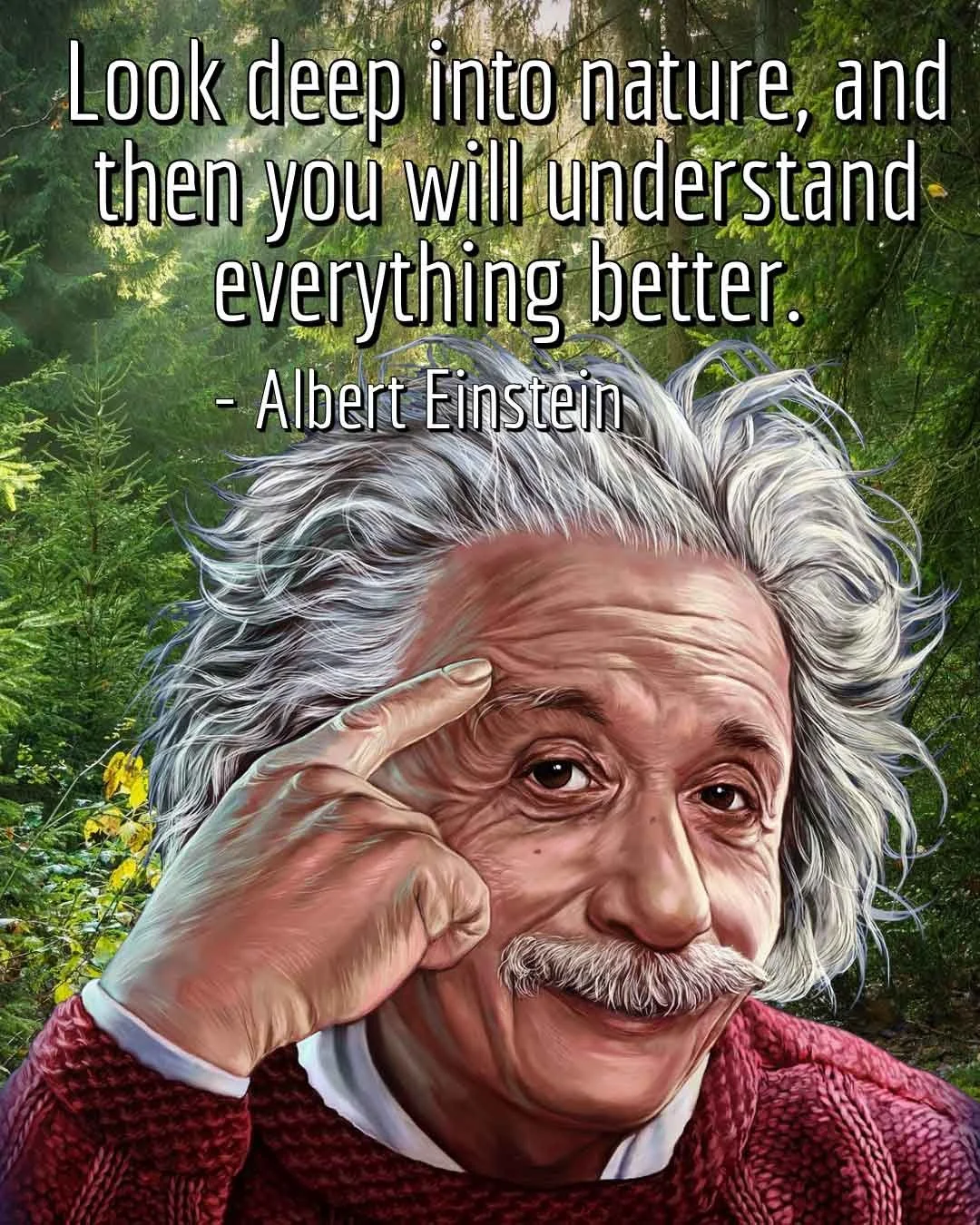
Whether Albert Einstein ever spoke those exact words remains uncertain. Historians have searched for the original source without success, leading many to conclude that the quotation is probably apocryphal. Yet despite its uncertain origins, it captures something profoundly authentic about Einstein's worldview.
Few scientists have inspired such a sense of wonder. Einstein transformed our understanding of space and time, yet he repeatedly reminded us that the greatest discoveries begin not with certainty but with curiosity. The universe, he believed, was infinitely more mysterious than our explanations of it. Perhaps this is why the quotation continues to resonate. It reflects an attitude rather than a statement — an invitation to slow down, to observe carefully, and to recognise that nature is far more than scenery.
For those of us who practise Forest Bathing or seek healing through time among trees, Einstein's perspective may feel surprisingly familiar. Nature does not simply provide answers; it teaches us how to ask better questions.
Did Albert Einstein Really Say "Look Deep into Nature"?
The line “Look deep into nature, and then you will understand everything better” is widely attributed to Albert Einstein, but a primary source for the exact wording has not been identified. Even so, the sentiment fits Einstein so well that it has become one of the most enduring summaries of his outlook on life. Einstein’s life and work were shaped by a profound reverence for the natural world: not nature as decoration, not nature as a romantic escape, but nature as the grand, lawful, mysterious reality that science tries — almost always imperfectly — to understand.
This outlook did not emerge from a quiet academic life removed from the world. Einstein was born in Ulm in 1879, studied in Zurich, and became one of the defining scientific minds of the modern age. He earned the Nobel Prize in Physics for the photoelectric effect, while his broader legacy rests on Relativity, a new understanding of space, time, motion, and gravitation. Yet behind the famous equations was a man who repeatedly returned to the same central idea: the universe is intelligible, and its intelligibility is itself a source of awe.
Einstein's Lifelong Fascination with Nature

Albert Einstein’s fascination with nature began early and never left him. His childhood was marked by quiet curiosity rather than outward brilliance, and later biographies describe him as a child who was slow to speak but deeply observant. At around the age of twelve, he was already captivated by a geometry book, and on the official Einstein biography site, the compass and the geometry book are described as the two early “wonders” that shaped his thinking. Even in adulthood, Einstein returned repeatedly to the same core instinct: that the natural world was not just something to be used or measured, but something to be wondered at.
One of the most famous stories from his childhood concerns a magnetic compass. According to the Einstein website, when his father showed him a compass, the sight of the needle’s invisible obedience to an unseen force left a deep impression on him. That small object became, in effect, his first encounter with the idea that reality contains hidden structures beneath what the eye can immediately see. It is easy to understand why this story has endured: the compass seems to anticipate the whole of Einstein’s later life, in which invisible forces, elegant laws, and hidden order became central to his scientific imagination.
That same sense of wonder appears again and again in Einstein’s own words. In his 1932 “My Credo”, he wrote that “The most beautiful and deepest experience a man can have is the sense of the mysterious”. He continued that this feeling lies at the root of serious work in art, science, and religion. For Einstein, mystery was not a failure of understanding — it was the beginning of it. Nature mattered to him precisely because it resisted simple capture. The more deeply he looked, the more he felt humility rather than mastery. In another formulation, he described nature as “a magnificent structure that we can comprehend only very imperfectly”, a sentence that captures both his admiration for the world and his awareness of human limits.
Einstein’s love of nature was not confined to abstract theory. He was drawn to the outdoors throughout his adult life, and the natural settings he returned to were often places of quiet, water, and open space. The Einstein website says he liked living in Caputh because of “the quiet, the lakes and the magnificent forests”, and that these surroundings encouraged him to take “long and lonely hikes” at any time of year. Elsewhere, Princeton Alumni Weekly notes that Einstein “loved to sail”, including on Lake Carnegie in Princeton, where he would often sail with Johanna Fantova in his later years. Sailing seems to have suited him perfectly: it joined solitude with movement, freedom with discipline, and close attention with the larger rhythms of wind and water.
Walking, too, appears to have been part of the way Einstein thought. In Caputh, the official Einstein website describes his habit of taking long hikes through the surrounding woods and lakeside landscape, suggesting that walking was not merely exercise for him but a way of being receptive to the world. That resonates with his broader intellectual style. Einstein often preferred slow, reflective observation to hurried conclusions, and his life suggests that movement through landscape may have helped him think. The natural world was not separate from his mind; it was one of the conditions that allowed his mind to work freely.
What Einstein seems to have valued most in nature was patterns: the presence of order beneath apparent complexity. His early fascination with geometry already points in this direction, because geometry trains the eye to recognise relationships, proportions, and structures that are not obvious at first glance. That habit of mind matured into physics, where Einstein devoted his life to uncovering the underlying principles that shape motion, light, gravity, and space-time. In that sense, he did not simply love nature as scenery; he loved it as a language. Nature, for Einstein, was intelligible because it was patterned, and it was beautiful because that pattern was not trivial or mechanical but profoundly elegant.
Seen this way, Einstein’s connection to nature was both emotional and mathematical. He found delight in the visible world, but he also sensed that behind its surfaces lay a deeper order waiting to be discovered. That is why so many of his most memorable statements sound less like laboratory notes and more like acts of reverence. He was a scientist, but he was also a witness to mystery. The compass needle, the geometry book, the sailing boat, the long walks, the forest, the lake, the invisible laws governing visible life: all of them belonged to the same spiritual and intellectual landscape. For Einstein, to look deeply into nature was not simply to gather facts. It was to enter a relationship with reality itself.
Nature as a Source of Wonder
Albert Einstein is often remembered for his extraordinary intellect, but perhaps his greatest strength was not intelligence alone. It was wonder. Behind the complex mathematics of relativity and quantum theory was a man who never lost his capacity to be astonished by the natural world. While others saw science as a means of explaining away mystery, Einstein believed that every genuine scientific discovery revealed an even deeper mystery beyond it. The more we understand the universe, the more remarkable it becomes.
One of Einstein's most celebrated and well-authenticated observations captures this beautifully:
"The most beautiful experience we can have is the mysterious. It is the fundamental emotion that stands at the cradle of true art and true science."
He wrote these words in 1930 in his essay The World As I See It, not as a passing reflection, but as the foundation of his philosophy. To Einstein, mystery was not something to eliminate through knowledge. Rather, it was the wellspring from which curiosity, creativity and discovery all flowed. He was not referring to supernatural experiences or esoteric beliefs. Rather, he described a deep awareness that reality is infinitely greater than our capacity to comprehend it. The scientist who stands before the vastness of the cosmos and the person who stands silently beneath the canopy of an ancient oak may experience something remarkably similar: an overwhelming recognition that they are participating in a world far larger than themselves. This perspective stands in striking contrast to much of modern life. We often assume that knowledge diminishes wonder— that once we understand how something works, its magic somehow disappears. Einstein believed exactly the opposite. The more he learned about the universe, the greater became his sense of awe.
He also once wrote:
"He who can no longer pause to wonder and stand rapt in awe is as good as dead: his eyes are closed."
These words carry a quiet challenge. Wonder is not a childish emotion that we outgrow; it is an essential quality of a fully awake life. To lose our capacity for astonishment is, in Einstein's eyes, to lose something profoundly human.
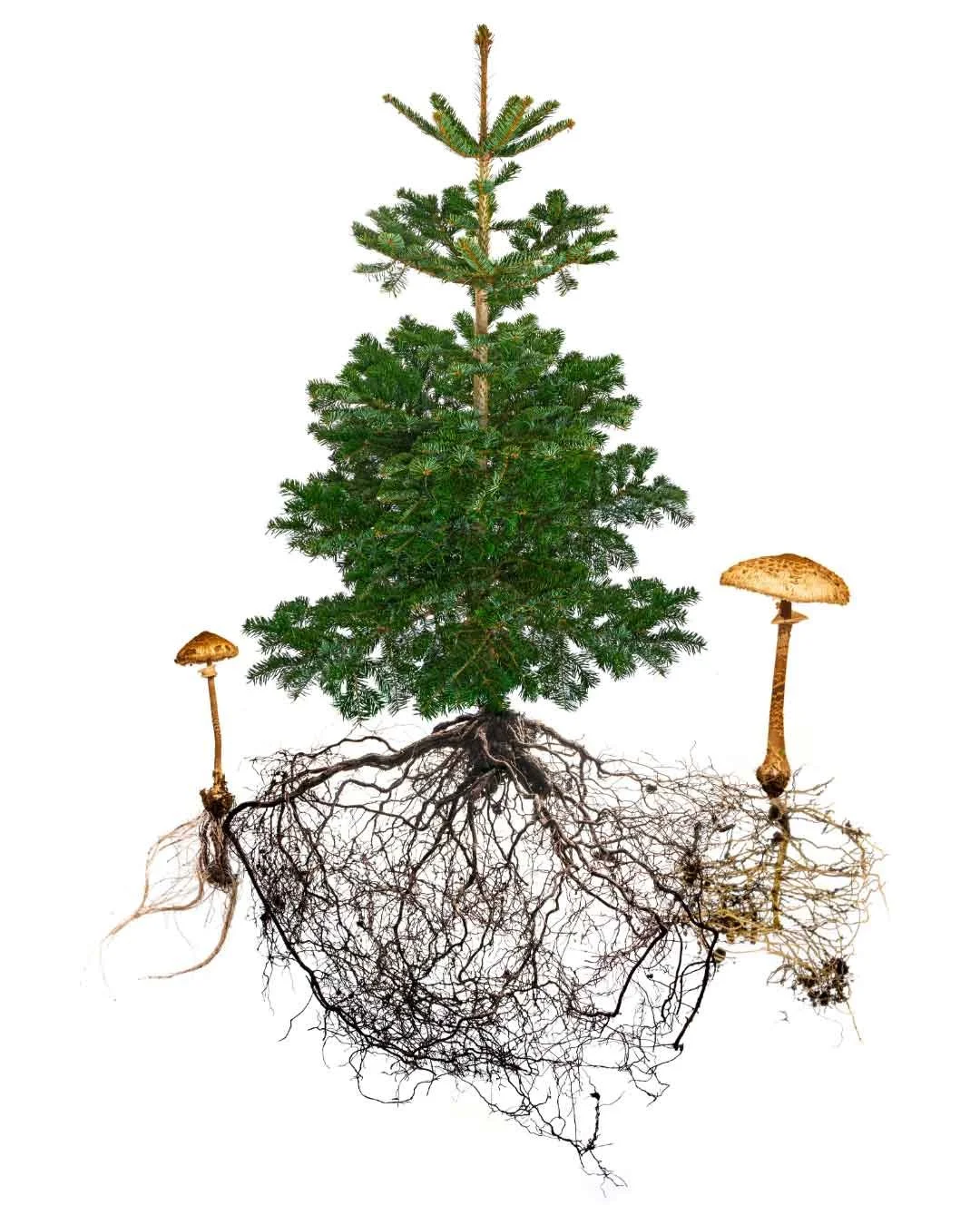
Perhaps nowhere is this more evident than in the natural world. Consider an ancient woodland. At first glance we may simply see trees. Yet closer observation reveals a community of extraordinary complexity — fungi exchanging nutrients through underground networks; birds dispersing seeds across the forest floor; lichens slowly recording decades of clean air; insects pollinating woodland flowers; leaves converting sunlight into the energy that sustains almost every living creature on Earth.
The deeper we look, the less ordinary the forest becomes.
Einstein understood this principle instinctively. Reality was layered. Beneath every visible phenomenon lay hidden relationships waiting to be discovered. Yet he also recognised that our understanding would always remain incomplete. In one of his most profound reflections, he wrote:
"The most incomprehensible thing about the universe is that it is comprehensible."
At first this appears almost paradoxical. Why should it be remarkable that we can understand nature? For Einstein, this was itself one of the universe's greatest mysteries. The mathematical laws governing gravity, light, electricity and motion exist independently of us, yet somehow the human mind is capable of discovering them. This remarkable correspondence between the structure of nature and the structure of human thought filled him with lifelong amazement. And he never regarded this as something to take for granted. Instead, it inspired profound humility.
And this sense of humility has become increasingly relevant in our own age. Modern culture often celebrates mastery. We measure, analyse, classify and control. Technology encourages us to believe that every question has an answer waiting to be found.
Nature offers a gentler lesson. A forest does not reveal itself all at once. No matter how often we return to the same woodland, something new appears. The changing light after rain. The first unfurling of fern fronds in spring. The intricate geometry of frost on fallen leaves. The quiet resilience of an old beech tree that has weathered centuries of storms. Wonder is renewed not because the forest changes completely, but because our attention deepens. This is one of the great insights shared by both Einstein and the practice of Forest Bathing. Neither asks us to accumulate more information.
Both invite us to cultivate a different quality of attention. Forest Bathing does not ask, "How quickly can you identify this tree?" Instead, it asks, "What do you notice?"
Einstein approached the universe with much the same question. His discoveries were born not from rushing towards answers but from lingering with questions that others overlooked. He looked carefully at ordinary phenomena — a beam of light, a falling object, the ticking of a clock — and allowed himself to wonder whether reality might be stranger, and more beautiful, than anyone had previously imagined.
Perhaps this is why his philosophy continues to resonate so deeply with those who seek connection in nature. Wonder is not opposed to knowledge. Wonder is what gives knowledge its direction. Every scientific breakthrough begins with someone noticing something that does not quite fit their expectations. Every meaningful encounter with nature begins when we set aside our assumptions long enough to experience the living world afresh.
Einstein understood that the universe could never be reduced to equations alone. Mathematics could describe its astonishing order, but not the feeling evoked by recognising that order.
Likewise, ecology can explain how a forest functions, yet explanation alone cannot replace the quiet experience of standing beneath towering trees, listening to birdsong carried on the wind, or watching shafts of morning light filter through the canopy.
Knowledge tells us what is happening. Wonder reminds us why it matters.
Perhaps that is Einstein's greatest gift to us. He teaches that understanding does not begin with certainty, but with reverence. The deepest discoveries are made not by those who believe they already know, but by those who remain curious enough to keep looking, humble enough to accept mystery, and patient enough to let nature reveal herself in her own time.
In this sense, every walk in the woods becomes more than recreation. It becomes an opportunity to practise the very quality that Einstein believed lay at the heart of both science and wisdom: the willingness to look closely, to ask quietly, and to remain joyfully astonished by the world around us.
The Universe Is Simpler Than We Think—Yet More Mysterious Than We Imagine
To many people, Albert Einstein's work seems impossibly complicated. Space-time, relativity, curved geometry and the behaviour of light all appear to belong to a world far removed from everyday experience. Yet Einstein himself was searching for something remarkably simple. He believed that beneath the bewildering complexity of the universe lay an elegant order. Nature, he was convinced, was not chaotic. It was coherent. The challenge was not that the universe lacked simplicity, but that human beings had not yet learned to recognise it.
Throughout his scientific career, Einstein sought the underlying principles that unite seemingly unrelated phenomena. His theory of Special Relativity showed that space and time are not separate entities but aspects of a single fabric. His General Theory of Relativity revealed that gravity is not an invisible force pulling objects together, as Isaac Newton had described it, but the curvature of space-time itself caused by mass and energy. Ideas that had once seemed disconnected became expressions of a deeper unity.
For Einstein, this search for unity was never simply an intellectual exercise. It reflected his confidence that nature possesses an inherent intelligibility. He once wrote:
"Nature shows us only the tail of the lion. But there is no doubt in my mind that the lion belongs to it even if he cannot at once reveal himself because of his enormous size."
It is a wonderfully evocative image. We catch glimpses of reality rather than the whole of it. What we observe is real, but it is only part of a far greater picture whose full beauty remains hidden from view. Einstein understood that scientific theories are not the universe itself. They are our best attempts to describe patterns that already exist within nature. Each discovery reveals another thread in an intricate tapestry, while reminding us that the tapestry itself extends far beyond our current understanding.
This conviction shaped one of his most enduring beliefs: that the laws of nature are astonishingly consistent.
Whether light travels across a laboratory or across a distant galaxy, the same underlying principles apply. The apple falling from a tree and the orbit of the Moon are not governed by different sets of rules. Nature does not invent new laws for different places or different moments. Instead, an elegant consistency runs through the cosmos, binding together phenomena that once appeared unrelated.
Einstein found this deeply beautiful. In his words:
"The eternal mystery of the world is its comprehensibility."
That statement deserves to be read slowly. The mystery is not merely that the universe exists. The mystery is that it can be understood at all. Somehow, the same mathematical relationships describe the movements of planets, the bending of light around stars, the behaviour of atoms and the expansion of the universe. Beneath extraordinary diversity lies remarkable coherence. Yet Einstein never mistook simplicity for reductionism. Finding deeper laws did not make the universe less mysterious. Quite the opposite. Each elegant explanation uncovered new questions. Every apparent solution revealed another horizon still waiting to be explored.
The closer we look, the richer reality becomes.
This is one reason Einstein never lost his humility. He believed that every scientific achievement represented only a partial glimpse into an immeasurably greater whole. Our understanding grows, but so too does our awareness of how much remains beyond our reach. There is something profoundly reassuring about this perspective. It suggests that complexity is not always confusion. Sometimes complexity is simply the visible expression of deeper simplicity. Nature often works in this way. From a distance, an ancient woodland may appear almost impossibly intricate. Thousands of species coexist within a single ecosystem. Trees exchange nutrients through fungal networks hidden beneath the soil. Birds disperse seeds across the landscape. Insects pollinate woodland flowers. Mosses, lichens, fungi, mammals and microorganisms each play their part in an intricate web of relationships that has evolved over countless generations. The forest is alive with interactions too numerous for any individual to observe. Yet beneath this astonishing richness lies a remarkable order. No one manages the woodland. No central authority instructs the roots where to grow or tells fungi which trees to support. No conductor directs the dawn chorus or choreographs the emergence of spring leaves. Instead, the forest unfolds through countless relationships governed by the same natural principles that have shaped life on Earth for millions of years.
Scientists continue to uncover the extraordinary sophistication of these ecological systems. Research into mycorrhizal fungi, plant communication, nutrient cycling and forest ecology has revealed levels of cooperation and interdependence that previous generations could scarcely have imagined. Each new discovery reminds us that nature is not becoming more complicated. Rather, our appreciation of its hidden coherence is becoming more refined.
This echoes Einstein's lifelong search. He was never looking for complexity for its own sake. He was searching for the elegant patterns that give rise to complexity. The equations of physics and the ecology of a forest belong to different scientific disciplines, yet both invite us to ask the same question: what deeper relationships give rise to what we see?
Perhaps this is one of the reasons forests have such a profound effect upon us.
When we sit quietly beneath an ancient oak, we are surrounded by an immeasurably complex living community. Every leaf, root, fungus, insect and bird participates in relationships that stretch far beyond our immediate perception. We understand only a fraction of what is taking place around us, yet we instinctively sense that nothing exists in isolation. The oak does not stand apart from the woodland. It belongs to it. Just as the woodland belongs to the wider landscape, the landscape to the climate, the climate to the planet, and the planet to the unfolding story of the universe itself. Einstein spent his life revealing that reality is woven together more intimately than we had imagined.
Modern ecology tells a remarkably similar story. The more deeply we explore the natural world, the less we encounter isolated objects and the more we discover relationships. Perhaps that is one of nature's greatest lessons. Beneath life's apparent complexity lies an astonishing simplicity: everything belongs.
The deeper we look, the more clearly we begin to see that the universe is not a collection of separate things, but a living tapestry of connections — beautifully ordered, endlessly unfolding, and still filled with mysteries waiting to be discovered.
The Science of Awe
For Albert Einstein, wonder was not a pleasant distraction from serious thought—it was the very beginning of it. Today, a growing body of scientific research suggests that he may have been right.
Over the past two decades, psychologists and neuroscientists have become increasingly interested in the emotion of awe: that feeling we experience when confronted by something vast, beautiful or beyond our usual frame of reference. While awe can be inspired by music, art or acts of human kindness, the natural world remains one of its most reliable sources. Research now suggests that these moments of wonder are not merely enjoyable; they appear to have measurable benefits for both body and mind.
Studies have found that spending time in nature can improve mental wellbeing, reduce stress, restore our ability to concentrate after mental fatigue, and help us feel more connected to both other people and the living world around us. Forest Bathing research has also demonstrated reductions in stress hormones, improvements in mood and changes in physiological markers associated with relaxation and reduced inflammation.
Perhaps most intriguingly, experiences of awe appear to shift our attention away from ourselves. Researchers have found that awe can reduce self-focused thinking while increasing compassion, generosity and a sense of belonging to something larger than our individual lives. Rather than making us feel insignificant, awe often helps us feel more deeply connected—to one another, to nature and to the wider web of life.
This growing evidence echoes one of Einstein's deepest convictions: that understanding begins with humility. The more deeply we appreciate the beauty and complexity of the universe, the less isolated we feel within it.
If you would like to explore the research in greater depth—including the neuroscience of awe, its effects on attention, inflammation, compassion and nature connectedness—you may enjoy my companion article, "The Science of Awe: How Forest Bathing Changes the Brain, Body and Spirit."
Looking Deeper into Nature Today
Whether or not Albert Einstein ever uttered the words, "Look deep into nature, and then you will understand everything better" they capture something essential about the way he lived. His greatest lesson is not really about relativity, quantum physics or elegant mathematical equations.
It is about attention.
Einstein possessed an extraordinary ability to remain with a question long after most people had stopped asking it. He noticed what others overlooked. He was willing to sit with uncertainty, trusting that patient observation would eventually reveal patterns hidden beneath the surface. In many ways, this is not only the practice of a great scientist; it is also the practice of deep nature connection. The forest rewards the same quality of attention. Every woodland is alive with stories waiting to be noticed:
The changing texture of bark as a tree matures.
The intricate geometry of a fern unfurling after spring rain.
The rich fragrance released from damp earth following a summer shower.
Birdsong echoing through the canopy, each call occupying its own place within an unseen chorus.
The almost imperceptible journey of sunlight as it moves across moss-covered stones throughout the day.
A spider's web, illuminated by morning dew, revealing an engineering masterpiece that existed unnoticed only moments before.
None of these things demands our attention. They simply wait for it.
Modern life, however, has trained us to look quickly rather than deeply. We skim headlines instead of reading carefully. We photograph landscapes rather than inhabiting them. We search for answers before we have fully encountered the question.
Our attention has become fragmented.
The forest asks something different of us.
It invites us to slow down. Not because slowness is inherently virtuous, but because many of nature's most profound lessons cannot be hurried. An ancient oak does not reveal its story in a passing glance. It invites us to linger. The broad trunk bears the scars of storms survived decades ago. Lichens quietly map the quality of the air. Moss softens one side of the bark where shade and moisture have shaped its growth. Cavities in old branches provide homes for birds, bats and insects. Roots stretch unseen beneath our feet, intertwined with fungal networks that exchange water, nutrients and chemical signals with neighbouring trees.
The longer we remain, the more the tree seems to change. Of course, it is not really the tree that has changed. It is our perception. This may be one of Einstein's greatest insights.
Reality is always richer than our first impressions. The universe is not shallow, and neither is a forest. The more carefully we observe, the more we realise how much we had previously overlooked.
Forest Bathing is built upon this simple principle. It is not about acquiring expert knowledge or identifying every species we encounter. Instead, it cultivates a way of seeing that is patient, curious and open to surprise. It reminds us that understanding often begins not with explanation, but with presence.
Perhaps this is why time in nature so often leaves us feeling refreshed.
It is not simply because we have escaped the demands of everyday life.
It is because, for a little while, we begin to experience the world as Einstein did — with curiosity instead of assumption, with humility instead of certainty, and with wonder instead of haste.
The forest has never stopped teaching.
The seasons continue their ancient rhythm.
Leaves still unfold towards the light each spring.
Woodlands quietly recycle life into life through decay and renewal.
Birds continue to sing at dawn whether anyone is listening or not.
The invitation has always been there.
We have simply become distracted.
To look more deeply into nature, then, is not necessarily to discover hidden secrets unavailable to anyone else. More often, it is to rediscover what has been patiently waiting in plain sight all along. The gift is not that the forest becomes extraordinary. It is that, through sustained attention, we gradually realise it always was. Perhaps the greatest tribute we can pay to Einstein is not merely to admire his discoveries, but to cultivate the quality that made them possible.
To become a little more curious.
A little more patient.
A little more willing to wonder.
The next time you step beneath the canopy of a woodland, resist the urge to walk with a destination in mind. Instead, pause. Breathe. Allow your gaze to settle on a single tree. Notice its colours, its textures and the countless lives it supports. Listen without trying to identify every sound. Let your questions remain unanswered for a while. You may not leave with a new theory of the universe. But you may leave with something just as valuable: a renewed appreciation that the world is infinitely richer than we usually allow ourselves to see.
And perhaps that is what it truly means to look deeply into nature.
Final Thoughts
Whether or not Einstein ever uttered the words, "Look deep into nature, and then you will understand everything better”, he lived as though he believed them. He trusted that beneath the apparent complexity of the universe lay an elegant order waiting to be discovered — not through haste, but through careful observation and enduring curiosity.
Forest Bathing offers much the same invitation. It asks us not to conquer nature or even fully understand it, but to enter into a relationship with it. The forest becomes less a place to visit and more a teacher whose lessons unfold slowly over seasons and years.
We may never discover the hidden equations that govern the cosmos as Einstein did. Yet each time we pause beneath an old tree, breathe deeply, and allow ourselves to become fully present, we participate in the same spirit of inquiry that guided one of history's greatest minds. We begin to understand — not everything, perhaps — but enough to live more gently, more attentively, and more fully within the living world.
If you have enjoyed this article and would like to support what we do by donating £2 or more to buy saplings to plant, please follow the link below:



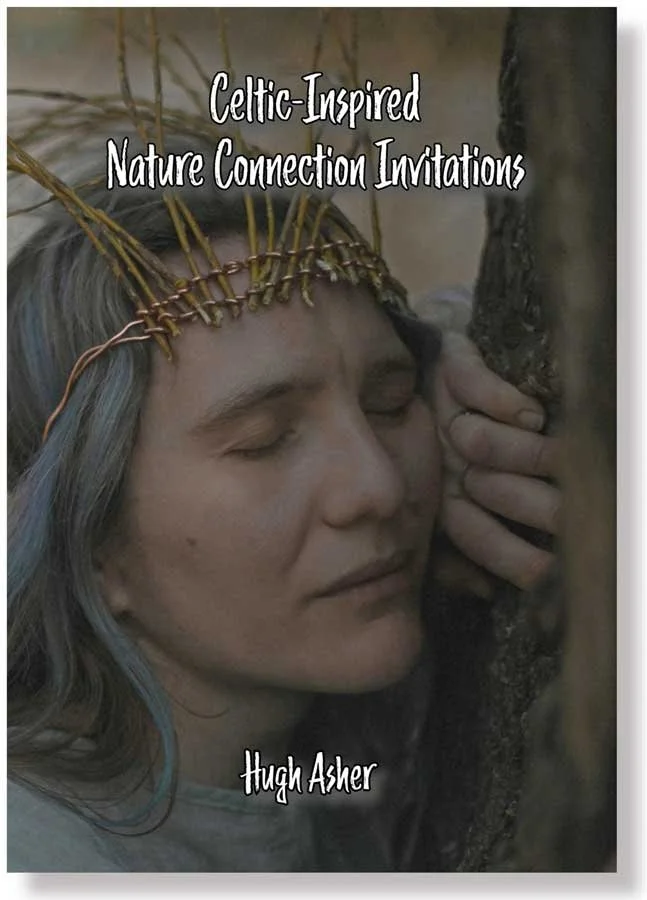






















A small collection designed to gently open the door into deeper relationship with the natural world.
This complete set of four Forest Healing booklets brings together practical guidance, reflective ideas, and simple nature connection practices that can be used anywhere — from ancient woodland to a nearby park, garden, or even a single Sit Spot outdoors.
Written to be accessible, grounding, and easy to follow, these booklets offer a pathway into the core practices of Forest Bathing (Shinrin-yoku), Silvotherapy, and everyday nature connection. Rather than asking you to achieve anything, they simply invite you to slow down, notice more deeply, and allow nature to become an active presence in your wellbeing.
Across the four booklets you will explore:
• What Forest Bathing, Silvotherapy, and Nature Connection actually are
• The key benefits of spending mindful time in natural environments
• The practice of the “Sit Spot” and how to develop your own relationship with a chosen place
• Simple, practical Forest Bathing invitations you can try alone or with others
• Ways to bring nature connection into everyday life, even in small moments
Together, they form a gentle introduction to practices that have been shown to support reduced stress, improved mood, greater clarity of thought, and a deeper sense of belonging within the natural world.
These are not academic texts or rigid instruction manuals. They are invitations — encouraging you to step outside, slow your pace, and rediscover the quiet intelligence of trees, weather, and landscape.
Whether you are completely new to nature connection or looking to deepen an existing practice, this collection offers a simple, supportive starting point for building a more intentional and restorative relationship with the living world around you.
A small set of booklets that can change the way you experience even the most familiar patch of nature.
Buy all Four Forest Bathing and Nature-Connection Booklets for £11.00 including FREE P&P within the UK.
Postage to the Rest of the World is £4.