

What is ‘Holding Space’ (and can trees or nature do this for us)?
Saturday 26th September 2026
There is something rather special about the expression holding space. It suggests that sometimes we do not need somebody to tell us what to do, give us advice, solve our problems or make our pain disappear. Sometimes what we need most is simply for somebody to remain alongside us while we experience whatever it is that we are experiencing.
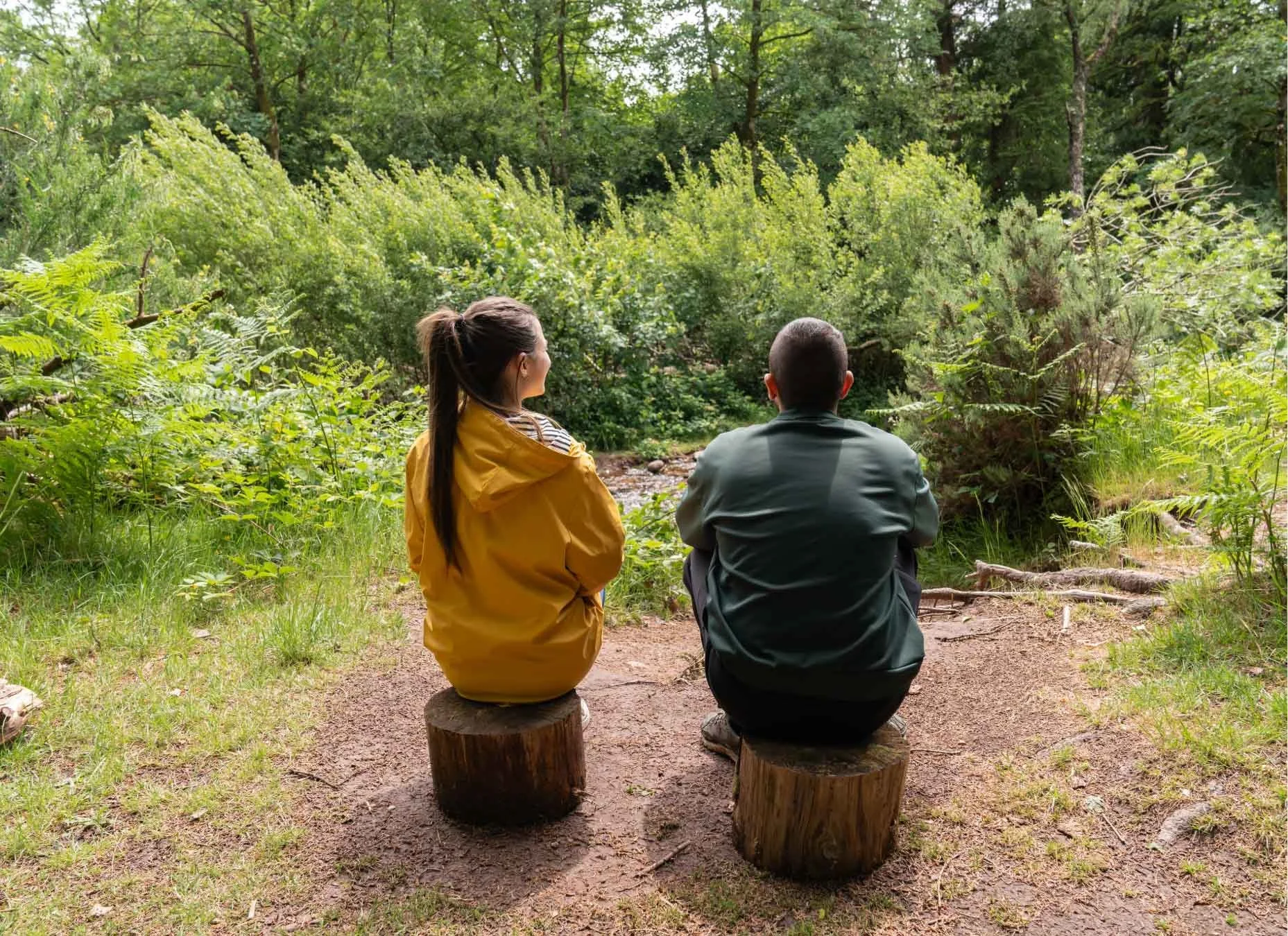
A friend might sit with us while we cry without trying to stop our tears. A therapist might listen to a difficult story without rushing to interpret it. A parent might stay close to a frightened child without telling them that there is nothing to be afraid of. In each case, something important is being offered — you do not have to go through this moment completely alone, and you do not have to become different before I am willing to stay with you.
The phrase ‘holding space’ has become increasingly common in therapeutic and caring relationships and settings over the last few years. Contemporary understandings of the term describe it as ‘being present, compassionate and supportive without attempting to fix the person or control the outcome’. Heather Plett, whose writing has done much to popularise the expression, describes it as accompanying another person through uncertainty without judgement, inadequacy or an attempt to determine where their journey should lead.
There is also a deeper psychological idea that sits alongside this. In psychoanalytic thinking, D. W. Winnicott developed the concept of a “holding environment” — a sufficiently secure environment in which an emotionally vulnerable person can experience feelings that might otherwise become overwhelming. The American Psychological Association still describes a therapeutic holding environment in broadly this way – as a therapeutic space that allows someone to deal with potentially overwhelming feelings.
And this is where I become particularly interested in the potential for nature to ‘hold space’ for us, because what if the holding does not always have to come from another human being? What if sometimes the thing that holds us is the woodland around us? What if a tree can provide a kind of space in which something inside us can settle, emerge, be witnessed or simply be – without the tree asking us to explain ourselves?
This is not to suggest that a tree is a therapist. It is not. Nor does it mean that walking into a forest is a substitute for appropriate professional support when that support is needed. But there may be something important happening when we experience nature not simply as a backdrop to therapy, but as a participant in our emotional lives.
What Does It Actually Mean To ‘Hold Space’?
Holding space is sometimes confused with listening, but it is more than simply hearing somebody's words. Imagine telling somebody about a painful experience and they immediately begin giving you solutions:
“You should…”
“Have you tried…”
“At least…”
“You need to…”
Even when the advice is well intentioned, something can happen to the conversation. The centre of gravity moves away from your experience and towards the other person's desire to change it — sometimes referred to as the ‘righting reflex’.
Holding space asks something different. It asks us to stay with the person rather than immediately moving towards fixing the problem. That might involve listening carefully, tolerating silence, reflecting what we are hearing, acknowledging difficult emotions and allowing the other person to retain ownership of their experience. The person holding space does not have to agree with every interpretation or endorse every action. Rather, they create enough psychological room for the other person to explore what is happening without being immediately judged, corrected or pushed towards an outcome.
This is closely related to ideas found within person-centred approaches to helping, particularly empathy, acceptance and genuineness. There is also an element of non-doing, and this is probably the part of holding space that can be hardest for us. Most of us are accustomed to doing things to problems. We fix. We explain. We advise. We distract. We reassure. We cheer somebody up. We attempt to make the uncomfortable moment comfortable. Holding space requires us to tolerate the possibility that nothing needs to be done right now.
A person might need to cry.
They might need to be angry.
They might need to sit in silence.
They might not know what they feel yet.
They might need to tell the same story several times.
They might simply need somewhere they can stop pretending that everything is fine.
Holding space therefore involves a certain degree of trust. We trust that the person we are listening to has an inner process of their own, and we do not have to manufacture the answer for them. Heather Plett's account of the practice places particular emphasis on releasing attachment to the outcome and learning to remain present with uncertainty and discomfort.
That idea has a surprisingly strong resonance with nature and nature-connection practices.
Nature Does Not Rush To Fix Us
One of the remarkable things about being in nature is that nature does not generally ask us to explain ourselves.
The oak does not ask why we are sad.
The river does not ask whether we have made the right decision.
The hill does not tell us that we should be over it by now.
The woodland does not become uncomfortable because we have started crying.
Of course, this is partly poetic language. Trees are not conscious therapists sitting quietly beside us, and we should not turn metaphor into biology. Yet the experience of being in the presence of the natural world can still be just as psychologically meaningful. A person sitting beneath an old tree may experience a profound sense that there is nothing they have to perform.
There is no expectation to be interesting.
No expectation to be productive.
No expectation to be cheerful.
There is simply the tree, the weather, the ground beneath us, the sounds around us and our own experience unfolding within that setting.
Perhaps this is one of the reasons nature can feel so accepting — it does not provide acceptance through words. It provides an environment in which the usual pressures of social performance can sometimes become quieter.
The Forest Creates Room Around Our Thoughts
Another important aspect of holding space is that it creates psychological room. When another person listens to us without immediately intervening, we may begin to hear our own thoughts differently. Thoughts that have been racing around our heads can become more distinguishable from one another. Feelings that have been suppressed or confused can become easier to recognise.
Nature appears capable of doing something remarkably similar.
Attention Restoration Theory, developed by Rachel and Stephen Kaplan, proposes that certain environments, such as nature, can replenish attention that has become fatigued by the demands of sustained directed attention. Natural environments often provide what the researchers describe as “soft fascination” — things that gently capture our attention without demanding all of it. Think about sitting beside running water.
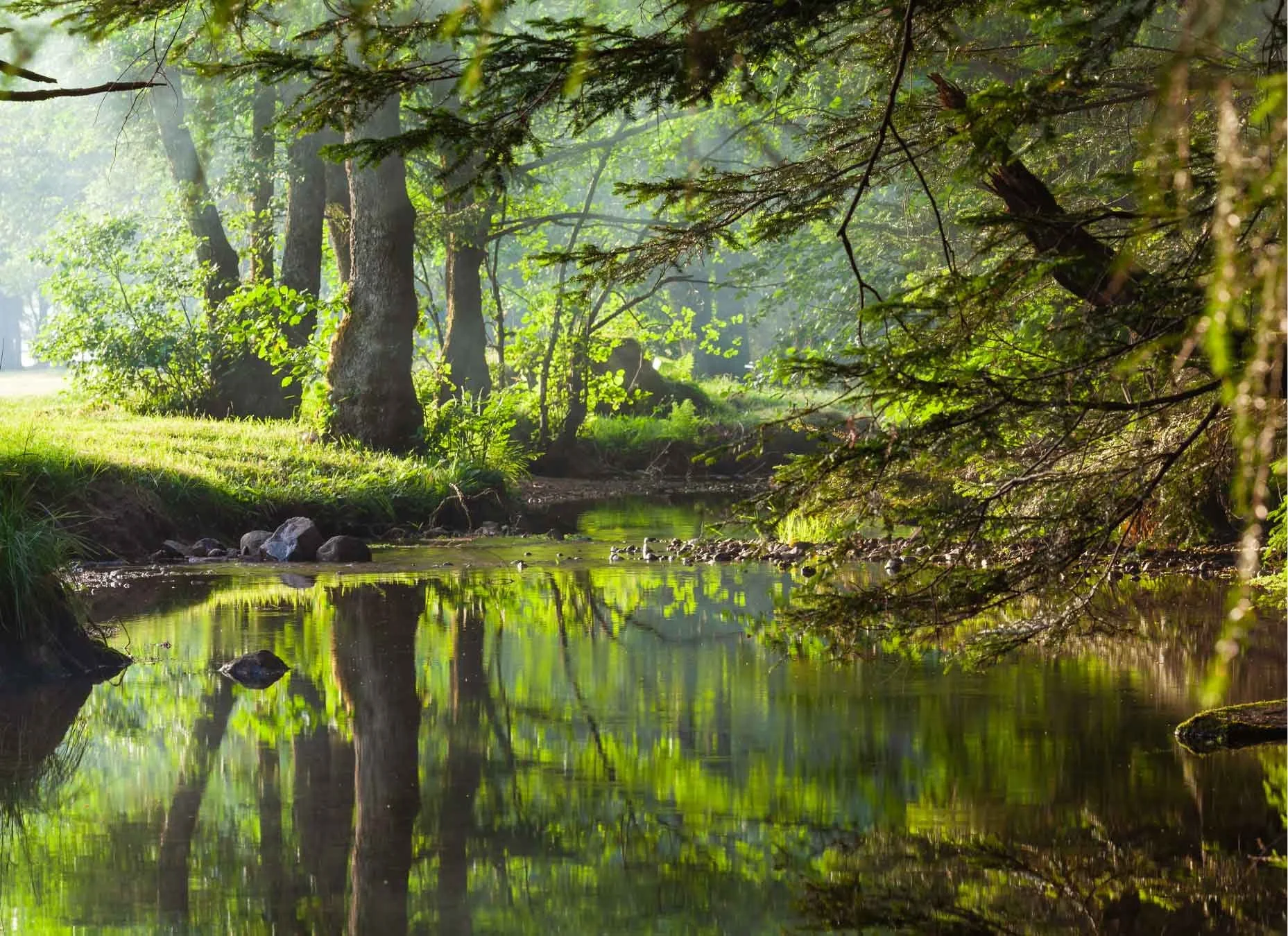
You watch the current.
A leaf moves.
A bird appears and disappears.
Clouds pass overhead.
The wind moves through the canopy.
These things are interesting enough to occupy part of our attention, but they do not necessarily consume it. There is still some mental space left, and that mental space matters.
It may allow thoughts to arise without us deliberately searching for them.
It may allow a memory to surface.
It may allow an emotion to be noticed rather than immediately suppressed.
It may simply allow the mind to stop doing so much.
This is particularly interesting in relation to holding space because a good holding environment does not merely give someone somewhere to talk. It gives them enough safety and room to experience what is already there. Nature may sometimes provide that room without anybody having to say a word.
Nature and Emotional Regulation
There is now a growing body of research examining the relationship between nature and emotion regulation.
A 2024 systematic review examined 27 studies concerned specifically with nature and emotional regulation. Overall, the authors found predominantly positive relationships between nature-related experiences and emotion regulation, including reductions in rumination and worry and increased use of adaptive strategies such as mindfulness and cognitive reappraisal. They also emphasised that the research remains heterogeneous and that better-designed studies are needed.
This is important because it gives us a more grounded way of talking about what we sometimes experience intuitively in nature. We do not necessarily have to claim that “the forest heals us”. We can instead say that natural environments may help create conditions in which our own emotional regulation becomes easier.
That is a subtle but important difference. The forest does not necessarily do the emotional work for us, but it may help create the conditions in which we can do some of that work ourselves.
A study published in Proceedings of the National Academy of Sciences in 2015 offers an intriguing example. Participants who walked in a natural environment showed reduced self-reported rumination compared with those who walked through an urban environment, alongside reduced activity in the subgenual prefrontal cortex, a brain region associated with patterns of negative self-talk and thought.
That does not prove that every walk in a forest will calm every person, but it does suggest that the natural environment itself can influence processes that are relevant to emotional wellbeing. In other words, something can happen before the practitioner or therapist says anything at all.
Perhaps Trees Hold Space Partly Through Their Stillness
Here the power of trees to hold space becomes particularly interesting. A forest is not simply “nature” — it has a particular character. Trees are rooted. They persist. They grow slowly. They change with the seasons while remaining recognisably themselves. A woodland can feel simultaneously alive and deeply still. For somebody whose inner life feels chaotic, that contrast can be powerful.
The tree is not rushing.
The tree is not demanding an answer.
The tree does not appear to need us to hurry.
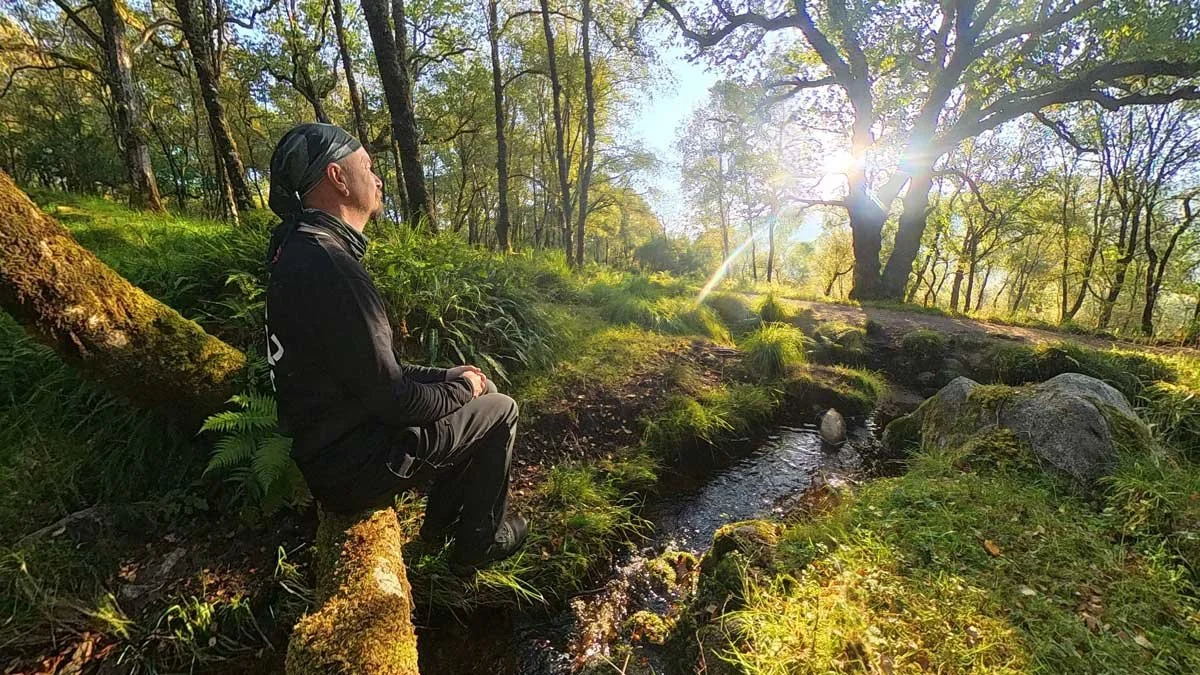
Even the simplest act of sitting against a tree’s trunk can change our experience.
The bark has texture.
The ground offers resistance.
The temperature of the tree is different from the temperature of our body.
The smell of leaves and soil surrounds us.
We hear movement above and all around us.
This is not merely “thinking about nature”. We are physically situated within a living natural environment. From a Forest Healing perspective, this matters because our relationship with nature can involve far more than looking at something pleasant.
We should touch.
We should listen.
We should smell things.
We should feel the ground beneath us.
We should notice the temperature, wind, moisture, movement and texture.
We should become aware of our bodies again.
And that can provide another form of holding.
The Ground Can Hold Us Physically
Perhaps the most literal form of nature's holding is also the simplest — when the ground supports our weight. When we sit beneath a tree, we no longer have to hold ourselves entirely upright. We can lean against the trunk. We can allow our body to be supported by something outside ourselves. There is an obvious physical reality here, but there is also a psychological metaphor that many people experience very strongly.
I can let something else hold me for a while.
For someone who has spent a long time feeling responsible for everything – work, family, relationships, recovery, survival, other people's emotions – the experience of physically surrendering some of that effort can be surprisingly powerful. We are not solving anything. We are simply allowing ourselves to be supported. Perhaps this helps explain why people sometimes spontaneously describe nature in language that sounds almost relational.
“I felt safe there.”
“This tree feels like an old friend.”
“I come here when I don't know what else to do.”
“I can breathe here.”
“I feel like this place knows me.”
Scientifically, we need to be careful about turning these experiences into claims about what the tree itself is consciously doing. Experientially, however, we should not dismiss them simply because they are metaphorical. The relationship a person forms with a place can be psychologically real even when the other side of the relationship is not a human mind.
Nature Can Become a Witness
There is another dimension of holding space that I find especially interesting. Sometimes what we need is not advice or even conversation. We need a witness. There is something deeply human about wanting some part of our experience to have existed in the presence of something else.
We might return to a particular place after a bereavement.
We might sit on the same bench after a relationship ends.
We might stand beside a river after receiving difficult news.
We might climb the same hill when life has changed.
Over time, the place becomes woven into our story.
The tree might have been there when we were heartbroken.
It might have been there when we were frightened.
It might have been there when we finally felt hopeful again.
The tree has not “remembered” these events in the human sense. Yet because we remember them in relation to the tree, the tree becomes part of the continuity of our experience. In this sense, nature can become a kind of witness. And unlike a human witness, the tree does not become tired of hearing the story.
It does not compare our grief with somebody else's.
It does not tell us when we have had enough.
It simply remains part of the landscape in which we experienced it.
For some people, that continuity can be profoundly comforting.
The Healing Power of “Being Away”
One of the characteristics of restorative environments identified in Attention Restoration Theory is being away. This does not necessarily mean travelling to a remote wilderness. It can mean experiencing psychological distance from the routines, responsibilities and mental patterns that normally surround us. A small patch of woodland can therefore become a “different world” without requiring us to disappear into the Scottish Highlands. The usual environment reminds us who we are expected to be, but the forest may give us a brief experience of simply ‘being’.
We can leave the computer behind.
Put the phone away.
Stop answering messages.
Walk without needing to achieve anything.
Sit without needing to produce anything.
For somebody experiencing emotional overload, this can be enormously important. Holding space requires room, and sometimes the first thing we need is physical room in which psychological room can emerge.
Nature Can Hold Us Without Requiring Disclosure
There is another potential advantage to nature that is often overlooked.
Sometimes we are not ready to talk.
Perhaps we cannot find the words.
Perhaps we do not trust another person enough yet.
Perhaps the story is too painful.
Perhaps talking about it makes it feel more real.
A traditional therapeutic relationship requires a degree of interpersonal engagement. For many people this is deeply beneficial. For others, especially at particular moments, simply being in the presence of another human being can itself feel demanding. But nature does not make demands or require disclosure.
We can go into the woods carrying a secret and come home still carrying it.
We do not have to name the emotion.
We do not have to explain what happened.
We can simply walk.
And paradoxically, because there is less pressure to disclose, some things eventually become much easier to acknowledge.
The person who could not say “I am grieving” may find themselves crying beside a stream.
The person who cannot articulate their anger may walk much faster than usual and eventually realise how furious they are.
The person who has been saying “I'm fine” for months may sit beneath a tree and discover that they are exhausted.
Nothing has been extracted from them — they have simply been given enough space for something to emerge.
Nature Can Hold Space Independently of the Practitioner
This is, perhaps, the most interesting question for me in relation to this article. Can trees hold space independently of the therapeutic practitioner? I think the answer depends upon what we mean by “hold”.
A tree cannot listen to us in the conventional sense.
It cannot recognise cognitive distortions.
It cannot help us formulate goals and a plan going forwards.
It cannot quite encourage and motivate us in the way a skilled practitioner can.
It cannot challenge us, provide professional boundaries or intervene when we are in danger.
So if we mean therapeutic holding in the clinical sense, then no — a tree is not a therapist. But if we mean providing an environment that permits presence, emotional experience, reflection, regulation and a temporary release from social demands, then there is a much stronger case.
Indeed, a 2024 systematic review of nature within mental health services identified several themes that are highly relevant here, including nature as a therapeutic tool, nature as a safe space, changes in the power relationship between the practitioner and the service user, and the influence of outdoor settings on therapeutic relationships. The authors concluded that nature may be used as an alternative or complementary setting for mental health care, while also emphasising the need for further robust research.
I’d also like to draw your attention something very important contained in this research. It does not necessarily place the therapist at the centre of every beneficial process. It reinforces that the setting itself matters greatly. The physical environment can change what happens between people – but it can also change what happens within the person, and that opens up an intriguing possibility. Perhaps the practitioner is sometimes not the person who “holds” the client. Perhaps the practitioner helps the client find somewhere that they can be held. Rather than seeing nature as a tool that a practitioner applies to a person, we can begin to see the forest as part of a wider therapeutic relationship. The practitioner brings knowledge, presence, observation, facilitation and professional responsibility. The person being supported brings their own experience, history, agency and capacity to discover meaning. And nature brings something else. Something more. Something greater.
It brings weather.
Seasonal change.
Sound.
Texture.
Movement.
Stillness.
Light.
Darkness.
Growth.
Decay.
Uncertainty.
Beauty.
And perhaps most importantly, something that is not us. We can become very trapped inside our own narratives, but the forest is a reminder that the world is much larger than our thoughts.
A birch tree is still putting out new leaves.
A fungus is continuing to break down dead wood.
A stream is continuing towards the sea.
A raven is calling across the valley.
A storm is approaching.
None of these things are happening because of our problems, and yet, paradoxically, noticing them can sometimes help us hold our problems differently.
Holding Space May Also Mean Holding Uncertainty
There is another quality that trees can teach us particularly well — uncertainty. Human beings often seek certainty and closure.
We want to know what will happen.
We want to know whether the relationship will survive.
Whether the illness will improve.
Whether we will recover.
Whether tomorrow will be easier.
Holding space does not necessarily provide those answers. It allows uncertainty to exist without immediately filling it with reassurance or prediction. And nature is full of uncertainty.
We do not know when the next storm will come.
We do not know which seed will germinate.
We do not know exactly how a particular tree will respond to another dry summer.
We do not know what will appear around the corner on a woodland path.
Yet nature offers a living demonstration that uncertainty and life coexist.
Winter does not promise Spring on our timetable, but in its own time.
Trees do not hurry their growth because we are impatient.
A forest does not demand certainty before allowing itself to continue becoming what it is.
For someone struggling with uncertainty, this may offer a gentler way of experiencing the unknown.
But Nature Cannot Hold Space for Everybody, All of The Time
It is important for us not to over-romanticise this. Nature is not universally calming.
A dark woodland may feel frightening.
A remote landscape can feel isolating.
Cold, rain, steep ground, insects, unstable terrain or encounters with wildlife can create genuine stress.
For some people, previous experiences, trauma, disability, sensory sensitivities, cultural associations or concerns about safety may make particular natural settings uncomfortable or inaccessible. The systematic review as a therapeutic place also identified risks and barriers alongside benefits, reminding us that outdoor settings are not automatically therapeutic for everyone.
A nature-connected approach therefore needs to be responsive rather than prescriptive. The question is not: “How can I get this person to feel better in nature?”. Instead it might be “What relationship with nature feels possible and supportive for this person, in this moment?”
Perhaps it is a woodland.
Perhaps it is a garden.
Perhaps it is sitting beside a window listening to rain.
Perhaps it is caring for a houseplant.
Perhaps it is watching birds from a bench.
Perhaps it is a beach.
Perhaps it is a particular tree.
The most appropriate holding environment is the one that best fits that person.
Sometimes The Tree Does Less – and Therefore Gives us More
I have recently said that, reflecting on my nature connection work with people in recovery, it feels like the less I ‘do’ the more effective that I feel that I am in supporting change. Exploring this further, I find that one of the most beautiful paradoxes of holding space is that its effectiveness can come from not doing very much.
We live in a culture that often equates helping with action. But sometimes the most supportive thing another person can do is remain present while we find our own way through an experience. Nature can offer an even purer version of this. Take a tree for example — the tree does almost nothing in relation to us.
It stands.
It grows.
It responds to the weather.
It sheds leaves.
It makes space for birds and fungi and insects.
It participates in the living system around it.
And meanwhile we sit beneath it.
Perhaps we breathe a little more slowly.
Perhaps our thoughts become less crowded.
Perhaps we cry.
Perhaps we remember something.
Perhaps nothing happens at all.
And that last possibility matters too.
We do not always need our time in nature to produce an insight.
We do not always need a breakthrough.
We do not need to emerge from the forest transformed.
Sometimes it is enough to have spent half an hour somewhere in which we were not required to be anything other than ourselves.
A Different Understanding of Healing
Modern healthcare has understandably placed enormous value on skilled professionals, evidence-based interventions and effective treatments. But human beings have always been influenced by the environments in which they live.
The field of health geography has long used the concept of therapeutic landscapes to explore why particular places can contribute to experiences of health and wellbeing. The concept recognises that the therapeutic character of a place can emerge through an interaction between its physical environment, social relationships, meanings and cultural associations. This is important because it moves us away from the idea that healing happens exclusively inside a treatment relationship.
Sometimes the room matters.
Sometimes the relationship matters.
Sometimes the journey to the appointment matters.
Sometimes the view from the window matters.
And sometimes the place where the conversation happens becomes part of the conversation itself. Nature may therefore be more than a setting for therapeutic work. It may be one of the things making that work possible.
So, Can Trees Hold Space For Us?
Perhaps the best answer is not in quite the same way that another human being can — but perhaps in a way that is uniquely their own.
A therapist can listen.
A friend can reassure us.
A trusted person can sit beside us and communicate, through their presence, “I am here with you.”
A tree cannot do these things in the human sense.
But the tree can stand beside us without needing anything from us.
It can provide physical support.
It can surround us with sensory richness.
It can offer soft fascination and opportunities for reflection.
It can help us step away from the demands of everyday life.
It can become associated with important moments in our lives.
It can provide continuity through changing circumstances.
And natural environments can influence the processes involved in stress and emotional regulation, sometimes without deliberate therapeutic instruction. Perhaps, then, we should think less about whether trees can replace a therapist and more about what becomes possible when human and more-than-human forms of support work together. The therapist does not have to be the source of every healing experience. The practitioner might instead help someone discover a relationship with a place, a tree, a landscape or the wider living world that they can return to long after the therapeutic session has ended. And this is where nature can become particularly empowering, because once we learn that a woodland can help us settle, that sitting beside water can give our thoughts room, or that leaning against a tree can help us feel grounded, the resource does not belong to the therapist. It belongs to us.
We can return tomorrow.
Or next week.
Or in the middle of the night when everything feels too much.
We can find our tree.
We can sit down.
We can breathe.
And nobody needs to tell us what to feel, and perhaps that is one of the quietest gifts nature offers us.
Not an answer.
Not a solution.
Not a cure.
Just somewhere to be while we find our own way.
And sometimes, that is exactly what holding space is.
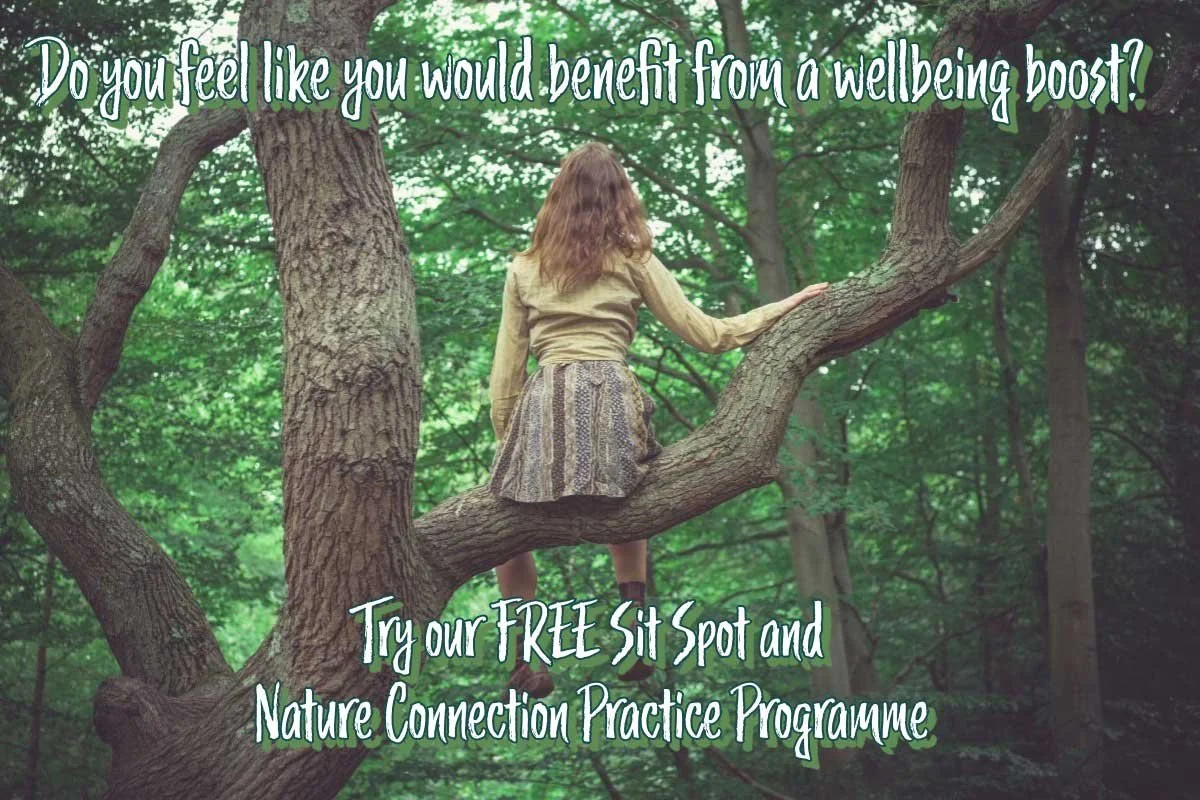
Nature Connection Invitation















If you have enjoyed this article and would like to support what we do by donating £2 or more to buy saplings to plant,
please follow the link below:



We are accustomed to thinking about time in terms of hours, days and years. We remember birthdays, anniversaries and seasons. We think about what happened last week, what we might do next month, perhaps what we hope to achieve over the next few years.
But standing beside a Neolithic monument can stretch the imagination in a completely different direction. Suddenly, fifty years seems very small. A hundred years is barely a moment. A thousand years feels strangely close.