

The Winter Solstice In Ancient Scotland
16th December 2025
Next Sunday (December 21st 2025) marks the Winter Solstice this year (and most years, although it is on the 22nd December about every fourth year) and thus the shortest day and the longest night. The Solstices, the Equinoxes, and the Quarter Days (see below) have long been significant days in ancient cultures.
The Winter Solstice, the shortest day and longest night of the year, is believed to have held particularly profound significance in Neolithic and Celtic Culture. It marked the Sun’s gradual return to strength, symbolising renewal, hope, and the triumph of light over darkness. In Celtic spirituality, the Solstice was not only a turning point in the year but also a time when the veil between the physical and spiritual worlds was believed to be thin, allowing for communication with ancestors and spirits. This reverence is physically expressed in many ancient sites across Scotland, where standing stones and burial mounds are aligned with the Sunrise or Sunset on the Solstice, serving as both time markers and sacred spaces of transformation.
The Celtic Quarter Days
The Quarter Days fall between the Equinoxes and Solstices and in Celtic Cultures were called Imbolc (usually from sunset on Tuesday 1st February to sunset on Wednesday 2nd February as the Celtic Day began and ended at sunset); Beltaine, the Gaelic May Day Festival on 1st May, marking the start of Summer; Lughnasadh (also known as Lùnastal or Lunasdal) on 1st August marking the start of the Harvest season; and Samhain (from sunset on 31st October to sunset on 1st November here in Scotland in 2022 marking the end of the harvest season). Samhain also marked the start of the Celtic New Year.
The Celts and Their Relationship to Nature
The ancient Celts had a profound relationship with nature, and their spiritual beliefs were deeply tied to the cycles of the Sun and Moon, and the changing seasons. The Celts perceived the Winter Solstice as a time of rebirth, as it marked the Sun’s slow return to power following the climax of winter and the symbolic ‘death’ of the old year. Despite the darkness, the Winter Solstice also hinted at the beginning of a new cycle, as the days would slowly begin to lengthen afterward. This shift from darkness to light was deeply meaningful to a culture that depended on seasonal cycles for agriculture and survival. The Celts saw life and death as part of a continuous cycle, and the Winter Solstice reflected this duality. The gradual return of the sun after the longest night held promises of warmth, food, and life, themes that resonated strongly in Celtic myth and symbolism. Across Celtic lands, Winter Solstice celebrations were thus imbued with gratitude for the Sun’s return and an acknowledgment of the mysteries of death and rebirth. They celebrated it with feasts, bonfires, and rituals to honour the rebirth of the Sun and the Earth’s renewal. It was a time for introspection, letting go of the past year’s hardships, and setting intentions for the year ahead.
The Solstices, Stone Circles and Burial Cairns
This reverence for the natural world is evident in ancient cultures through their use of sacred geometry and astronomical alignments at ritual sites. Many of these sites, including standing stones and burial mounds, have features that align with key points of the Solar and Lunar cycles and highlight their importance in spiritual life.
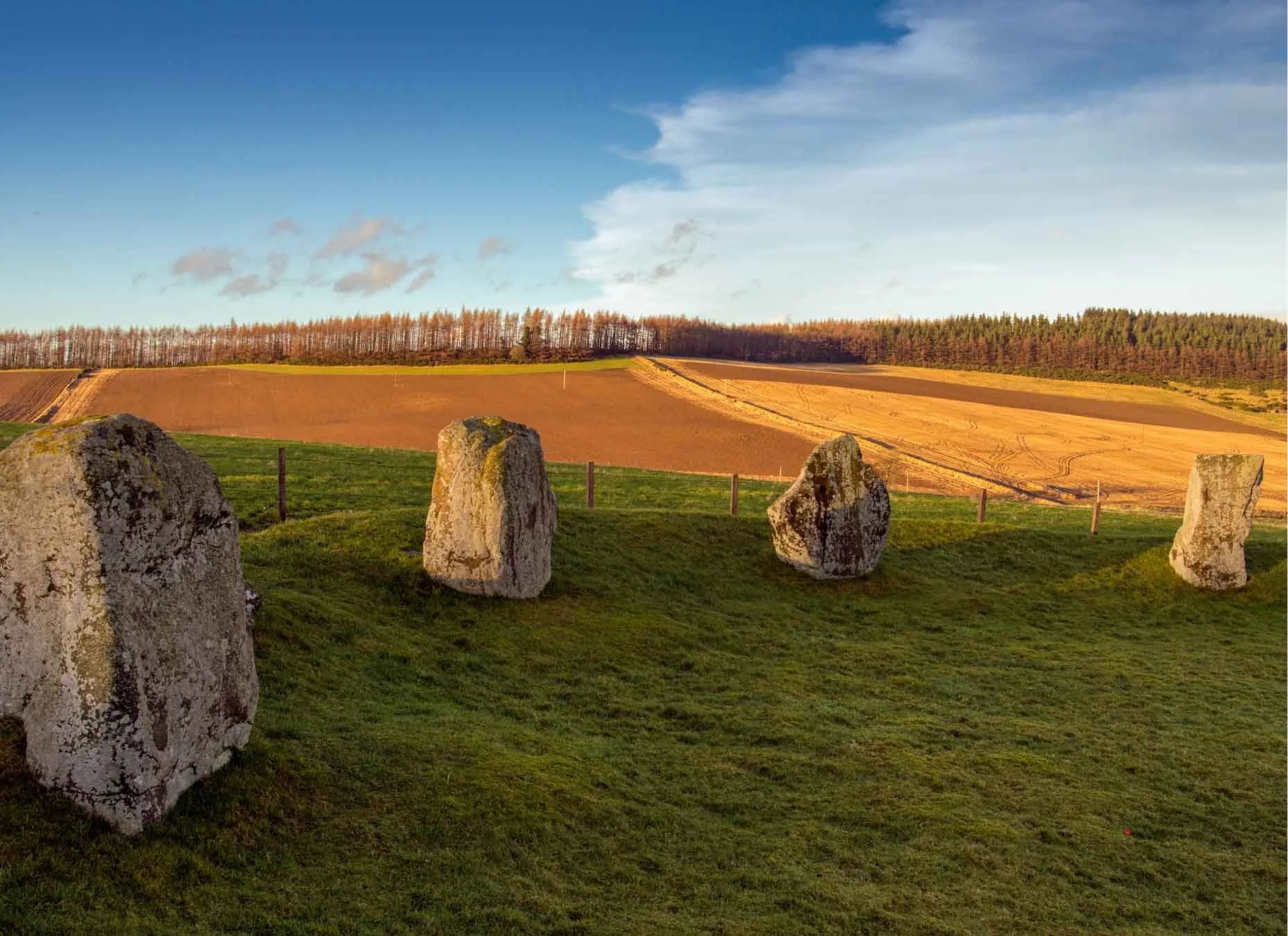
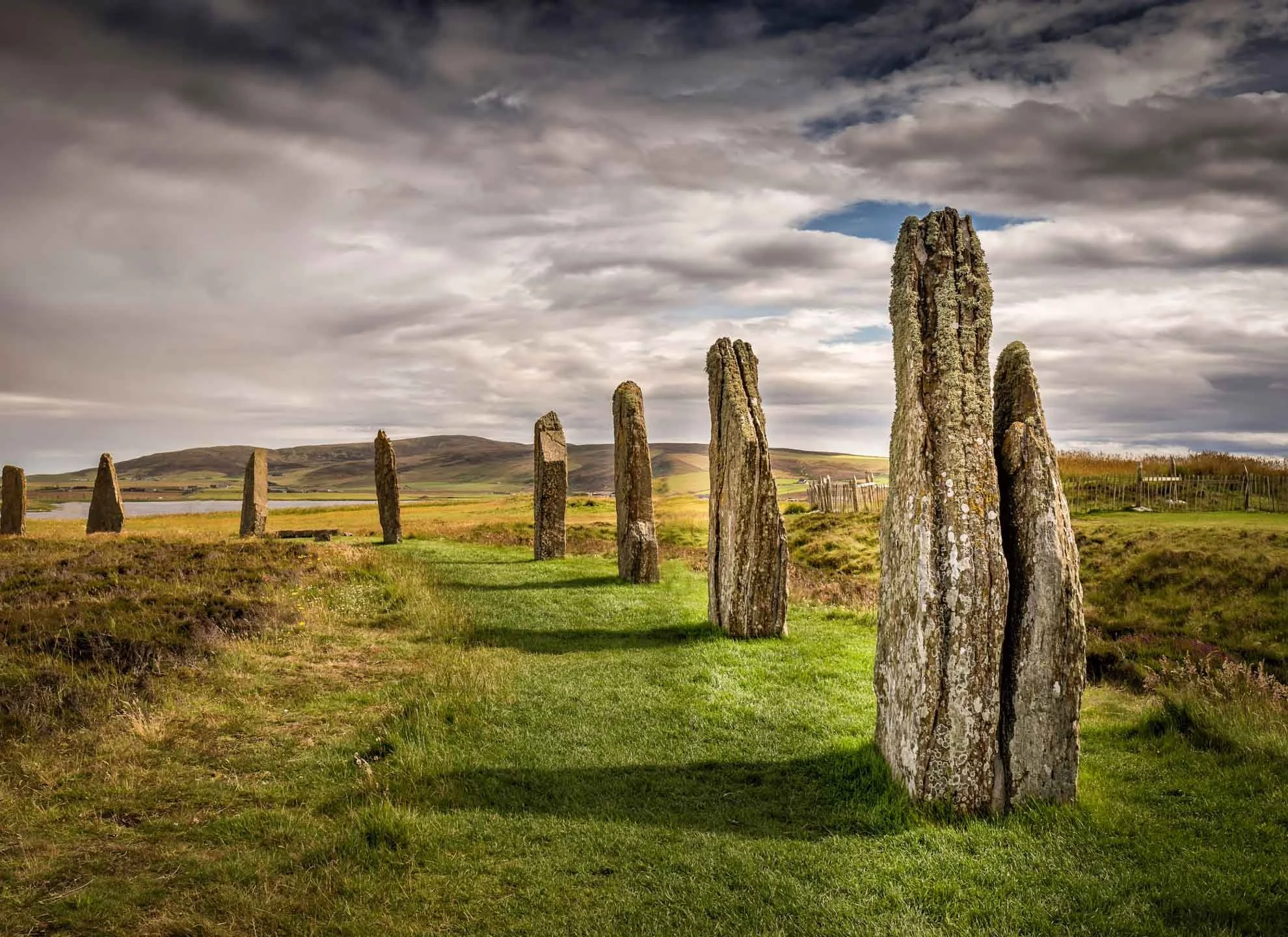
Standing stones, or megaliths, are a prominent feature in Celtic and other prehistoric cultures. These structures, often associated with the earlier Neolithic peoples of the British Isles but still significant to the Celts, served as calendars and observatories, tracking important celestial events like the Solstices and Equinoxes. They were erected in various configurations, including single stones, circles, and alignments, with purposes that often extended beyond mere aesthetic appeal. While the exact reason for the construction of these stones is lost to time, many scholars believe they served as ceremonial markers, places of worship, and timekeepers. But one key role of standing stones in particular, was to track solar and lunar cycles, and numerous sites have alignments that mark the Winter Solstice sunrise or sunset.
Standing Stones and Winter Solstice Alignments
The Callanish Stones
The Callanish Stones on the Isle of Lewis in the Outer Hebrides were believed to have been erected between 2,900 and 2,600 BCE and comprise a stone circle of 13 stones, 12 metres wide, with a monolith in the middle standing nearly 5 metres tall. Radiating out are five rows of standing stones, with two parallel rows running 80 metres north-northeast and three running East, South and West to form a rudimentary Celtic Cross. They are aligned with various movements in the solar system, and the main circle is aligned with the Winter Solstice sunset. This alignment may well have held spiritual importance, symbolising the death of the old year with the setting Sun, followed by the Sun’s renewal. The Celts may have seen this interplay of light and shadow as a reminder of life’s cyclical nature, inspiring rituals of renewal and rebirth.
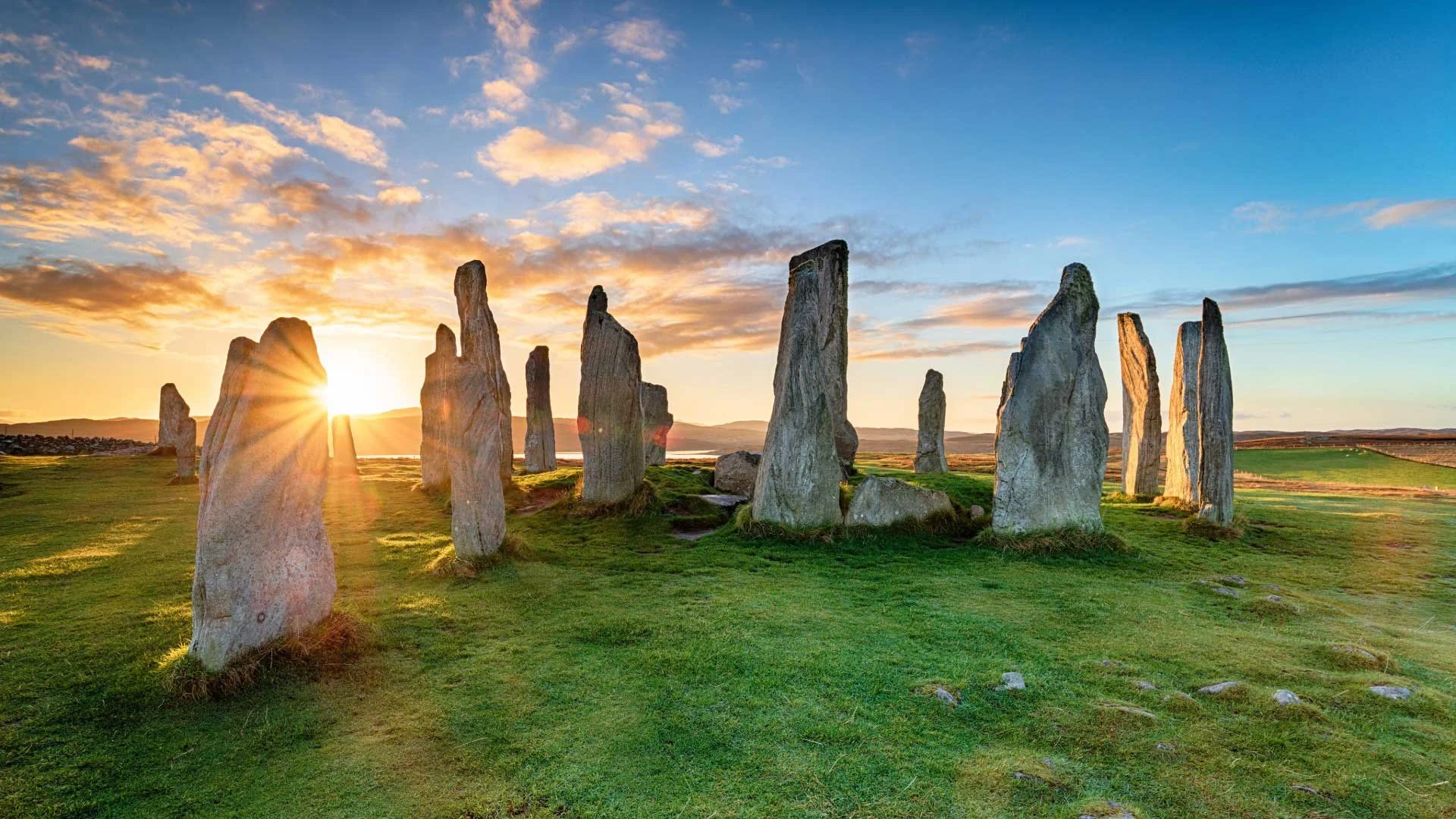
Sunrise at the Callanish Stones
Burial Mounds: Portals to the Spirit World
In addition to the standing stones, ancient burial mounds (or cairns) across the ancient world also often align with the Winter Solstice. These burial mounds, such as Maeshowe, showcase how the Celts linked the rebirth of the Sun with concepts of the afterlife and ancestral veneration. The Celts, who inherited burial mounds such as Maeshowe as part of their cultural landscape, likely interpreted this phenomenon as a sign of the sun reviving the spirits within, linking the rebirth of the Sun with concepts of the afterlife and ancestral veneration.
Beyond this, in Celtic mythology, burial mounds and cairns were often viewed as portals or doorways to the ‘Otherworld’ — the mystical realm of spirits, gods, and the deceased. During the Winter Solstice, the line between these worlds was believed to become thin, and the dead could more easily commune with the living. Burial mounds therefore became places for rituals, where offerings might be left, and prayers spoken, asking for guidance, protection, and blessings for the coming year.
Maeshowe
Maeshowe on Orkney (a howe, derived from the Old Norse Haugr, is a naturally occurring hill or an artificially created mound, such as a barrow) is a Neolithic chambered burial cairn built around 3,000 to 2,700 BCE. It comprises dry stone walls with four tall standing stones buttressing a corbelled roof, a roof constructed of stone slabs that progressively overlap each other to create a vaulted dome, to create a room nearly 5 meters square and almost 5 meters high (although the present roof is a 1910 reproduction). Off this main room are three side rooms each roofed with a single slab. Near the external end of the passageway is carefully dressed and pivoted stone that can be used to seal the chamber from the inside, suggesting this was a place of great ritual importance to the people who built it. Once built, the rooms and passageway would have been covered in layers of clay and turf, to create the mound shape that we see today. Interestingly, a dragon has been carved into one wall of the main chamber, alongside other runic inscriptions believed to have been left by a band of Viking who sheltered from a storm in the cairn in the 12th Century.
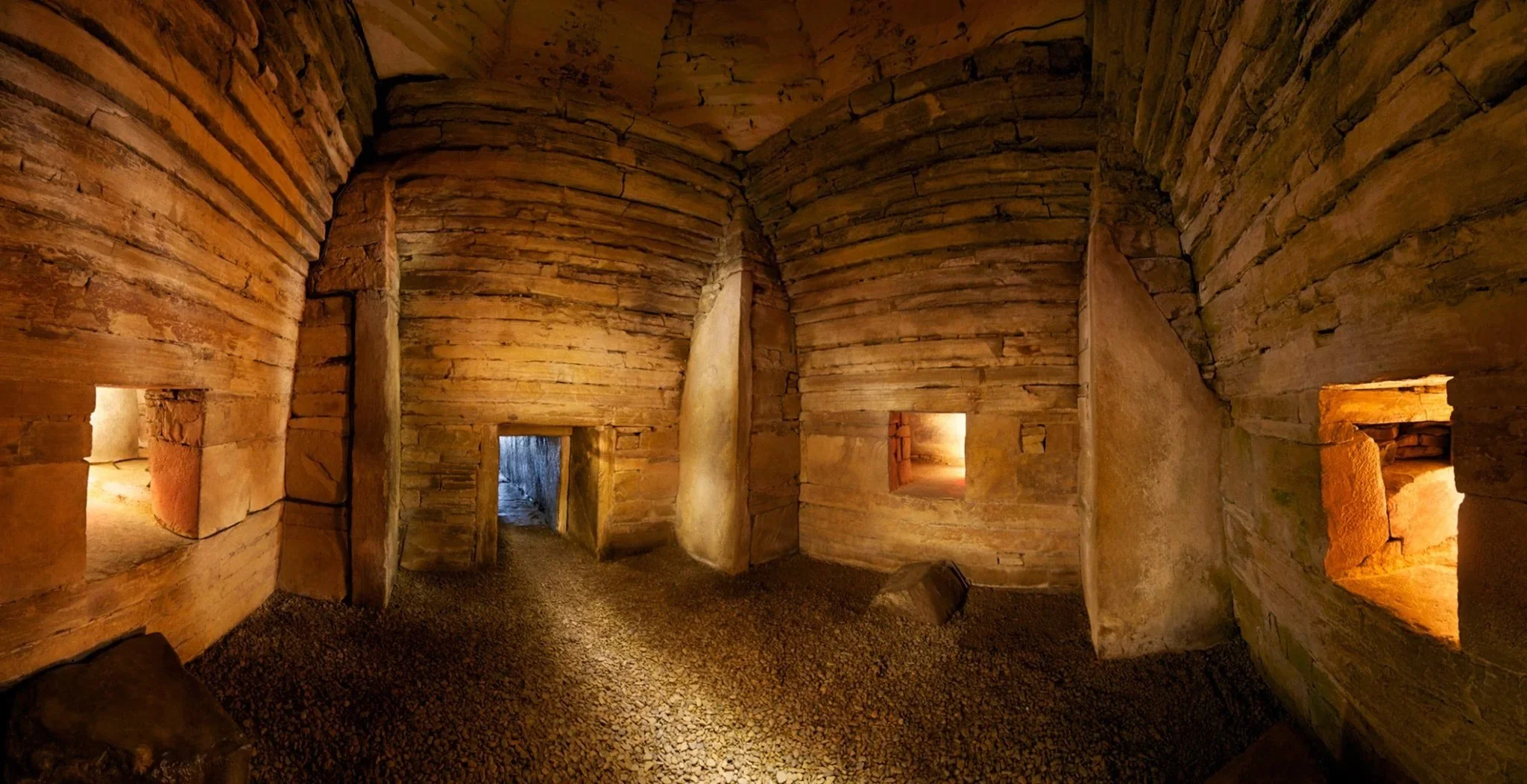
From late November until mid-January, about 3 weeks either side of the Winter Solstice, the sun shines down the 11 meter long passageway and into the chamber at sunset, lighting up the back wall and then creeping back. The setting sun aligns perfectly with the entranceway on the Winter Solstice suggesting that this was by design rather than by accident. It is believed that the Winter Solstice and the rays of sunlight down the passageway signified a period when the spirit world and the physical world were most closely connected. It was thought that they believed their ancestors’ spirits, resting within these ancient mounds, gained new energy with the return of the Sun. This connection to the ancestors during the Winter Solstice may have emphasised the belief that death was not the end but part of an eternal cycle of life, and also a sign that the darkest days were over for another year.
A nearby monolith, the Barnhouse Stone, lies in a direct line between the cairn entrance and the setting sun on the Winter Solstice. There is evidence that that there were standing stones in the vicinity of the cairn, that are no longer there, but that conceivably may have aligned with other celestial events.
Final Thoughts
Activities such as this may seem simple to us now, but they marked the start of humanity in this area creating a concept of time and way of marking and predicting the passing of time and the changes of the seasons. This would have been important as humanity progressed from being nomadic hunter-gatherers to more settled farmers and enabled them to plant their crops at the most suitable times. The Celts viewed the Winter solstice as a pivotal moment, representing the triumph of light over darkness, and this duality was central to their spiritual beliefs. The darkness preceding the solstice symbolised introspection, the death of the old year, and an immersion into the mysteries of the ‘otherworld’. The return of the light, conversely, represented renewal, hope, and the promise of a new year. In this way the Winter Solstice reminds us of the continuity of life and the power of natural cycles. For the Celts, this period of renewal was a bridge between past and future, the dead and the living, darkness and light. Their spiritual understanding of the solstice, embedded in the standing stones and burial mounds that still exist today, leaves us with a timeless message of transformation, hope, and resilience. Through standing stones, burial mounds, and ritual observances, the Winter Solstice continues to embody the Celts’ profound respect for the rhythms of nature and the enduring spirit of life. In a modern world where such connections to the natural world are often diminished, these ancient practices remind us of the enduring human need to find meaning in the cycles of the Earth and the heavens. While we may never fully understand all the symbolic meanings of these sites, their alignments continue to inspire awe, connecting us to ancient wisdom and humanity’s shared reverence for the cosmos.
If you have enjoyed this article and would like to support what we do by donating £2 or more to buy saplings to plant, please follow the link below:











A small collection designed to gently open the door into deeper relationship with the natural world.
This complete set of four Forest Healing booklets brings together practical guidance, reflective ideas, and simple nature connection practices that can be used anywhere — from ancient woodland to a nearby park, garden, or even a single Sit Spot outdoors.
Written to be accessible, grounding, and easy to follow, these booklets offer a pathway into the core practices of Forest Bathing (Shinrin-yoku), Silvotherapy, and everyday nature connection. Rather than asking you to achieve anything, they simply invite you to slow down, notice more deeply, and allow nature to become an active presence in your wellbeing.
Across the four booklets you will explore:
• What Forest Bathing, Silvotherapy, and Nature Connection actually are
• The key benefits of spending mindful time in natural environments
• The practice of the “Sit Spot” and how to develop your own relationship with a chosen place
• Simple, practical Forest Bathing invitations you can try alone or with others
• Ways to bring nature connection into everyday life, even in small moments
Together, they form a gentle introduction to practices that have been shown to support reduced stress, improved mood, greater clarity of thought, and a deeper sense of belonging within the natural world.
These are not academic texts or rigid instruction manuals. They are invitations — encouraging you to step outside, slow your pace, and rediscover the quiet intelligence of trees, weather, and landscape.
Whether you are completely new to nature connection or looking to deepen an existing practice, this collection offers a simple, supportive starting point for building a more intentional and restorative relationship with the living world around you.
A small set of booklets that can change the way you experience even the most familiar patch of nature.
Buy all Four Forest Bathing and Nature-Connection Booklets for £11.00 including FREE P&P within the UK.
Postage to the Rest of the World is £4.