

The Six Logical Levels of Change: How Nature Connection Can Support Lasting Transformation
Saturday 3rd October 2026
There are many different ways of thinking about change.
Sometimes change begins with a decision — I need to do something differently. Sometimes it begins with a change in circumstances — we move house, change jobs, end a relationship, begin recovery, take up a new activity or simply decide that we cannot continue living quite as we have been. And sometimes something deeper happens. We begin to see ourselves differently. Perhaps we discover that we are capable of something we had previously believed was beyond us. Perhaps an experience changes what we value. Perhaps we develop a sense that our life has a different direction or meaning.
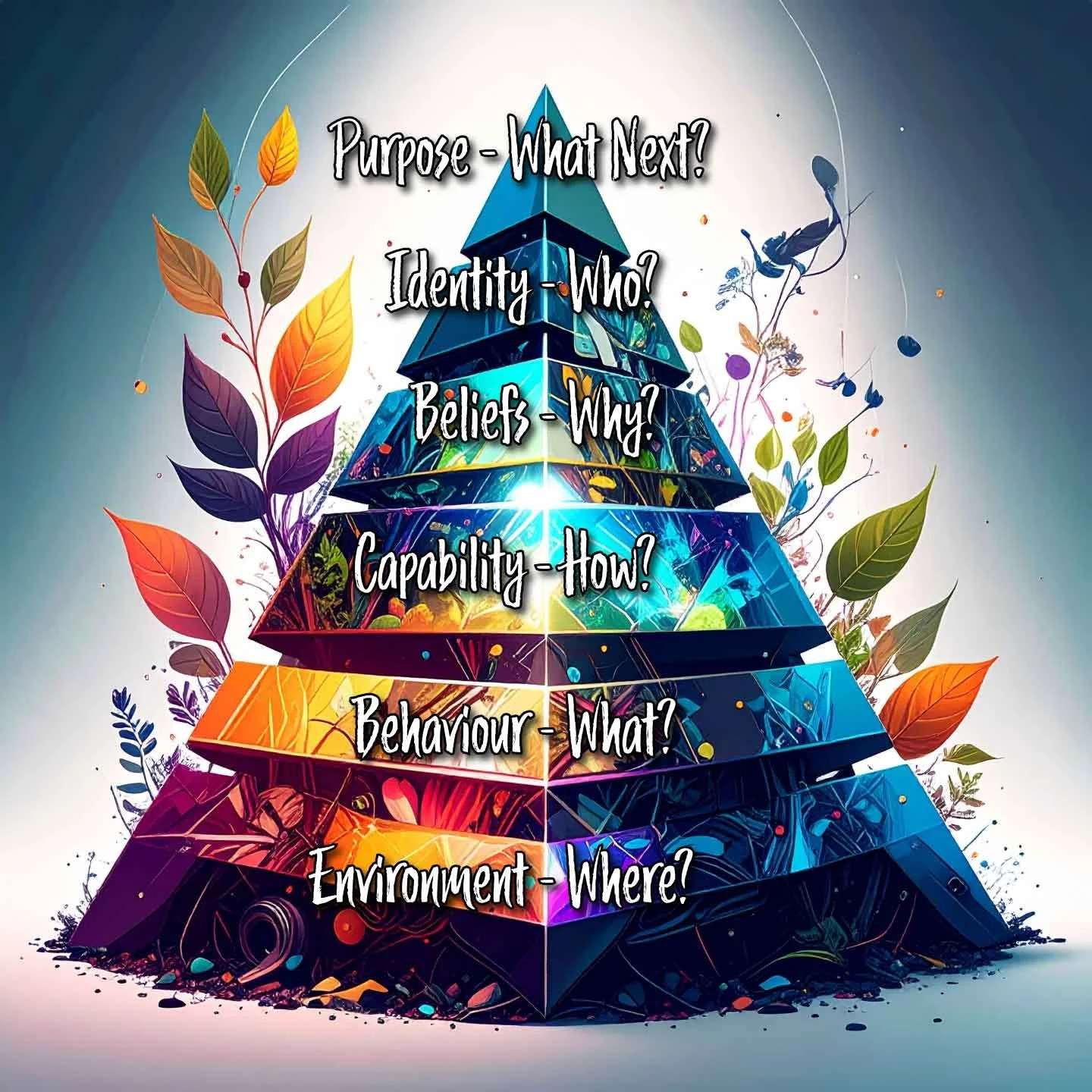
This is where Robert Dilts’ six logical levels of change, developed within the Neuro-Linguistic Programming (NLP) model, provides an interesting framework for thinking about personal transformation. Dilts proposed a hierarchy consisting of environment, behaviour, capabilities, beliefs and values, identity, and spirituality or purpose. His own description of the model was influenced by Gregory Bateson’s work on logical levels of learning, although Dilts developed his own representation of how different levels can influence one another. The model is usually represented as a pyramid, with environment at the bottom and spirituality or purpose at the top.
The idea is simple: change can occur at different levels, and changes at deeper (or higher) levels may influence what happens at the levels below them.
It is, however, worth being clear about what this model is — and what it is not. The term neurological levels can make the model sound as though there are six scientifically established layers of the brain. There is no evidence for that interpretation. These are better understood as a conceptual framework for exploring human experience and change. More broadly, there is still limited scientific evidence for the use of NLP as a model within clinical health interventions, with a systematic review of experimental studies finding little evidence that NLP interventions in clinical settings in and of themselves improve health outcomes. But, that does not mean that every idea associated with NLP is without value. There is a much stronger evidence base for its use in personal development, and many of its practices overlap with much more established approaches such as goal-setting, reframing, modelling and reflective work. The useful question, therefore, is not “Does NLP prove that this is how change works?” but rather “Can Dilts’ six levels give us a helpful way of understanding how nature connection might support change?” and I believe they can.
Further, when we look at these different levels through the lens of nature connection, something rather beautiful emerges. Nature may not only influence what we do, but also where we do it, what we are capable of, what we believe, who we understand ourselves to be, and what we feel we belong to.
The Six Levels at a Glance
Before exploring each level, it is useful to see the basic structure.
Environment — Where am I? What surrounds me?
Behaviour — What am I doing?
Capabilities — How am I doing it? What skills and resources do I have?
Beliefs and Values — Why does this matter? What do I believe? What do I value?
Identity — Who am I?
Spirituality or Purpose — What am I part of? What is my life in service of?
These questions move from the relatively observable world around us towards progressively more personal questions about meaning and belonging — and this is where nature connection becomes especially interesting.
We often talk about spending time in nature as though the important thing is simply exposure. Go for a walk. Sit under a tree. Visit the woods. Get some fresh air. Yet nature connection is about more than simply being physically present in a natural environment. A growing body of research distinguishes nature contact from nature connectedness — the subjective sense of relationship, belonging and connection with the natural world. Higher nature connectedness is associated with greater wellbeing, meaning in life and life satisfaction, while other research has found a strong relationship between nature connection and pro-environmental behaviour.
So perhaps the transformational question is not simply “How much time do I spend in nature?” but “What nature-connection activities do I engage in and what happens to me, and to my relationship with the world, when I do?”
This is where the six levels offer a fascinating map.
1. Environment — Changing Where Change Can Happen
Environment is the most obvious level. It concerns the physical and social circumstances in which we live — where we spend our time, what surrounds us, who we are with, and the cues and opportunities present in our everyday lives.
This matters because environments are not neutral. A person surrounded by noise, screens, traffic, deadlines and constant notifications experiences a very different set of possibilities from someone sitting beside a loch, walking through woodland or tending a garden. Nature can therefore support change simply by changing the environment in which our experience takes place.
There is very good evidence that contact with nature is associated with benefits to health and wellbeing. A large study involving almost 20,000 adults in England found that people reporting at least 120 minutes of recreational nature contact during the previous week were more likely to report good health and higher wellbeing than those reporting no contact. The study was observational, however, so it does not show that 120 minutes of nature causes better wellbeing or that this is a universal therapeutic prescription.
The significance of environment goes deeper than scenery, though.
A woodland creates and offers different opportunities from a busy office — opportunities for movement, exploration, noticing, resting and interacting.
A beach invites walking, collecting, watching tides and gazing at horizons.
A garden invites nurturing and tending.
A mountain invites patience, preparation, physical effort and attention to conditions.
Even the smallest patch of urban nature can alter the possibilities available to us.
For somebody trying to make a change in their life, this can be important. Instead of asking, “How do I make myself feel differently?” we might ask “What environment makes the change I want easier to experience?”
Perhaps somebody trying to reduce alcohol use discovers that going for an evening walk gives them a different environment in which to experience difficult feelings. Perhaps someone struggling with rumination discovers that sitting beside moving water interrupts the repetitive pattern of thought. Perhaps someone who feels isolated finds that a community garden offers both natural surroundings and human connection.
The environment does not magically solve the problem, it simply changes the conditions in which the person is meeting it.
And sometimes that is where change begins.
2. Behaviour — Changing What We Actually Do
The second level is behaviour — probably the most immediately visible form of change.
We walk instead of staying indoors.
We notice rather than scroll.
We breathe more slowly.
We touch the bark on a tree.
We watch the birds.
We spend ten minutes sitting quietly on a log.
We start gardening.
We walk to work.
We begin taking a regular lunchtime nature break.
These behaviours may appear small, but repeated small behaviours can become patterns, and nature connection is particularly well suited to behavioural change because nature provides endless invitations to do something different. One of the distinctive features of a Forest Bathing invitation, for example, is that it does not necessarily ask people to achieve anything. Instead, the invitation might be to notice a predominant colour, follow a sound, touch the surface of a tree, observe movement in the landscape or simply pause.
This creates a different behavioural repertoire from our habitual ways of rushing, consuming, solving and producing. and research supports the broader idea that experiences of nature are associated with behaviour change. A 2024 meta-analysis found a consistent positive association between experiences of nature and pro-environmental behaviour across a range of actions, including conservation volunteering, recycling, energy conservation and green purchasing. Nature connection therefore has the potential to create a particularly interesting feedback loop:
We spend time in nature → we behave differently → we experience nature differently → our relationship with nature deepens → new behaviours become more natural.
And because behaviour is something we can actually practise, it provides a bridge between intention and lived experience. We do not have to wait until we feel transformed before acting differently.
Sometimes the action comes first.
3. Capabilities — Discovering What We Are Capable Of
The third level concerns capabilities — our skills, strategies, resources and ways of responding. This is an important distinction. Knowing that we should behave differently is not the same as being able to do so.
Someone may sincerely want to manage stress differently but have no experience of recognising the early signs of overwhelm.
Someone may want to connect with nature but feel that they “don't notice anything”.
Someone may want to spend more time outdoors but lack confidence navigating, dressing appropriately for the weather or choosing an accessible route.
Nature connection can become a surprisingly rich environment for capability development.
We can learn to pay attention.
We can learn to slow down.
We can learn to distinguish sounds.
We can develop observational skills.
We can become more comfortable with silence.
We can learn to walk with greater awareness of our surroundings.
We can develop practical outdoor skills.
We can learn how weather, seasons, tides, plants, animals and landscapes behave.
And perhaps most importantly, we can develop confidence in our own capacity to meet experience rather than immediately escape from it. A Forest Bathing invitation such as “Find somewhere to sit and notice what changes over the next ten minutes” may look extremely simple, yet the capability being practised may be increasing your attention span.
Another invitation might involve noticing our bodily sensations while walking — the capability being developed may be awareness.
A difficult climb may require pacing, decision-making, perseverance and adapting to changing circumstances.
A gardening activity may cultivate patience, observation and nurturing.
Over time, these capabilities can begin to generalise.
We discover:
I can slow down.
I can tolerate not knowing.
I can be uncomfortable without immediately reacting.
I can pay attention.
I can recover.
I can learn.
Nature does not necessarily give us these abilities, rather, it can provide a context in which we practise them.
4. Beliefs and Values — Changing What We Think Matters
Here we reach a deeper level, our behaviour is often influenced by what we believe and what we value. A person might perhaps believe:
I don't have time to stop.
Rest is lazy.
I am only worthwhile when I am productive.
Nature is somewhere you visit at weekends.
I am not an “outdoors person”.
I need to be in control.
These beliefs can quietly organise an extraordinary amount of our lives, but nature can challenge some of them.
A forest does not care how productive we have been today.
A tree grows according to seasons rather than deadlines.
A river takes the shape of the landscape through which it moves.
A woodland contains decay, renewal, competition, cooperation, stillness and growth simultaneously.
When we spend enough time paying attention, nature can become more than a backdrop — it can become a source of alternative ways of seeing. This is particularly important within our Forest Healing approach, because the relationship with nature need not be framed as “nature is here to fix me.” There is another possibility which is that “I am part of this living world.”
That is a very different belief.
Research into nature connectedness often describes it as involving a psychological sense of relationship with the natural world. Higher nature connectedness is consistently associated with pro-environmental behaviour, and recent meta-analytic work also finds associations with wellbeing and meaning in life. This suggests that connection can influence both how we experience ourselves and what we feel matters. Values can shift too.
Perhaps we begin to value slowness.
Attention.
Reciprocity.
Stewardship.
Interdependence.
Wonder.
Belonging.
A person who once thought of a woodland simply as “somewhere to walk the dog” may begin to think of it as a community of living beings. A person who regarded a tree as scenery may begin to recognise it as an organism, habitat, neighbour and participant in a wider ecological system. And that change in perception can matter, because when something becomes meaningful, our behaviour towards it often changes.
5. Identity — Changing the Answer to “Who am I?”
Identity may be the most fascinating of the six levels. We all carry stories about ourselves.
I am anxious.
I am not very adventurous.
I am someone who always gives up.
I am practical, not spiritual.
I am not good at meeting new people.
I am an outsider.
I am a busy person.
These statements can become so familiar that they begin to feel like facts rather than stories. But one of the most powerful possibilities of nature connection is that it can offer us different experiences of ourselves. Imagine someone who has always thought “I'm not an outdoors person.”
They begin with a ten-minute walk.
Then they learn to identify a few trees.
Then they discover a favourite place.
Then they begin walking regularly.
Then they join a group.
Then, one Autumn morning, they realise they are deliberately planning their week around being outside. Something has changed, and not simply their behaviour. Their identity. They may now think “I am someone who belongs outdoors.” Or perhaps
“I am someone who notices.”
“I am someone who takes care of places.”
“I am someone who can find my way.”
“I am someone who knows how to slow down.”
“I am someone who feels connected to the living world.”
This is important because identity can organise behaviour, and once we begin to see ourselves as a particular kind of person, certain behaviours can become expressions of who we are rather than tasks we are forcing ourselves to perform. A person who says, “I should go for a walk” is having a very different experience from someone who thinks “Walking outside is part of who I am.”
The evidence base around nature connection is not evidence for Dilts’ hierarchy itself, but it does support the idea that people's psychological relationship with nature is associated with important aspects of wellbeing and behaviour. A 2025 meta-analysis of 70 studies found positive associations between nature connectedness and wellbeing, meaning in life and life satisfaction.
There is also increasing interest in environmental identity – the extent to which nature forms part of a person's sense of self. Research in this area is developing, but it provides an intriguing bridge between the psychological idea of identity and our relationship with the wider living world. From a Forest Healing perspective, this may be one of the most profound forms of change — moving from visiting nature to belonging to nature.
6. Spirituality and Purpose — What Am I Part Of?
At the highest level, Dilts describes spirituality, mission or purpose. The terminology varies, and “spirituality” does not have to mean religion — it can simply refer to our sense of belonging to something larger than ourselves.
What am I part of?
What matters enough to give my life direction?
Who or what do I serve?
What contribution do I want to make?
For some people, nature connection opens these questions very naturally.
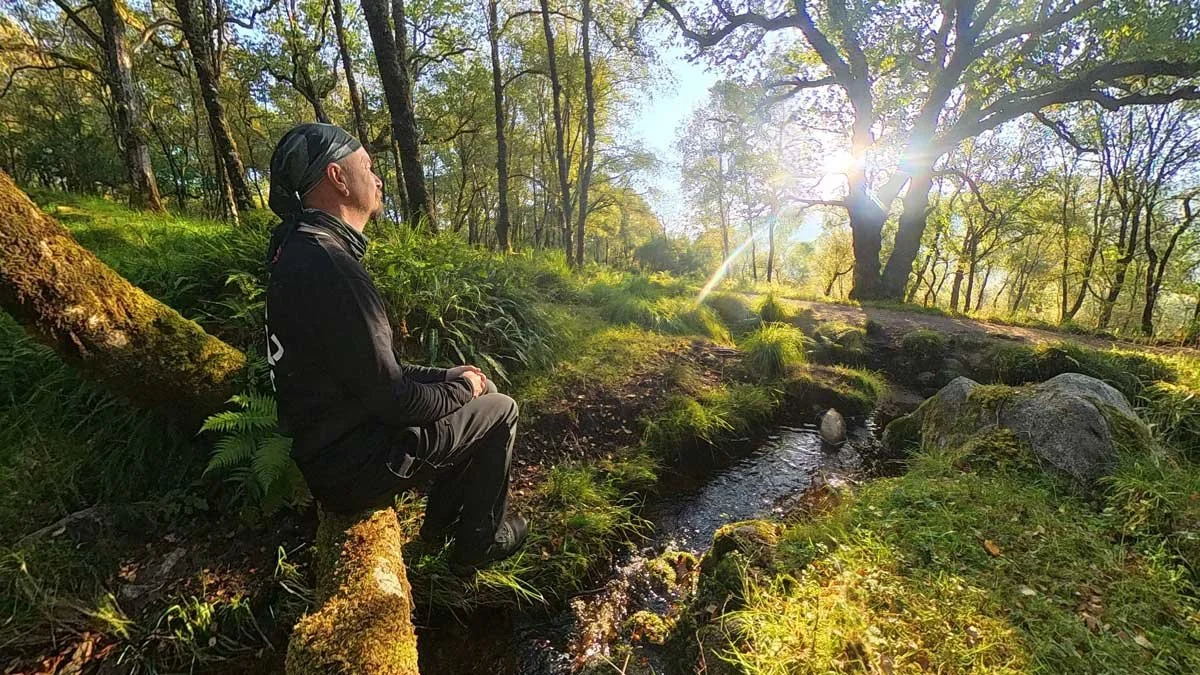
A person sitting beneath an old tree may begin thinking not about productivity, but about time.
A walk through ancient woodland may evoke questions about generations.
Watching seasonal change can remind us that our own lives exist within much larger cycles.
Seeing damaged habitats can evoke grief, responsibility or a desire to contribute.
Working together to restore a woodland can transform “nature” from something we consume into something we participate in.
This connects strongly with the evidence linking nature connectedness to pro-environmental behaviour. A meta-analysis of 37 samples involving more than 13,000 people found a significant positive association between connection to nature and pro-environmental behaviour. Another meta-analysis found a strong association between nature connection and pro-environmental behaviour in correlational research, while noting that experimental evidence was smaller and more uncertain. In other words, connection does not necessarily make us suddenly saintly environmentalists, but it may change what we perceive as important. When the natural world becomes our world, protecting it can become an expression of belonging rather than an abstract obligation. And this takes us back to reciprocity. Instead of “What can nature do for me?” we begin asking “What is my relationship with nature?” And eventually perhaps “What is my part in caring for this living world?”
That is a very different kind of change.
The Levels Are Not Really Separate
Although we have explored six distinct levels, real life does not divide itself so neatly. The most interesting thing about the model may actually be the relationships between the levels.
Imagine somebody who begins walking in a local woodland.
At the environment level, they are now spending time somewhere different.
At the behaviour level, they are walking, stopping, noticing and breathing differently.
At the capability level, they are learning to pay attention and regulate their pace.
At the belief level, they begin to question the idea that rest is unproductive.
At the identity level, they begin to think of themselves as someone who belongs outdoors.
At the purpose level, they begin to feel a responsibility towards the place they have grown to love.
And then something interesting happens. The change also works backwards.
Because now that person values nature, they may choose an environment that keeps them close to it.
Because nature matters to them, they behave differently.
Because they behave differently, they continue developing capabilities.
Because those capabilities grow, their beliefs are reinforced.
Because their identity has changed, those behaviours feel increasingly natural.
The process becomes circular rather than linear and this is one reason I find that the model works particularly well alongside a nature-connection approach. We are not simply trying to persuade somebody to do more nature. We are creating opportunities for a relationship to develop.
Nature Connection as a Catalyst Rather Than a Cure
There is another important distinction here. We should be careful not to turn the six logical levels into another promise that nature can magically transform every aspect of somebody's life.
It cannot.
Nature connection is not a substitute for appropriate medical, psychological, social or practical support. Beyond this, there are considerable differences between different forms of nature-based activity, populations and outcomes. The research around nature connection is encouraging, but it is also developing. A recent review of nature and wellbeing has highlighted some of the conceptual difficulties in the field, particularly around the fact that researchers sometimes talk about people and nature as separate entities while simultaneously using “nature connection” to describe a relationship in which people understand themselves as part of nature. That tension is worth embracing rather than avoiding, as nature does not simply cause us to change, rather our changing relationship with nature changes the context in which we experience ourselves, and that is a more subtle proposition.
A tree does not tell us what to become.
A woodland does not give us instructions.
A river does not offer a ten-step programme for personal growth.
Instead, nature can provide experiences through which we discover something for ourselves.
We notice.
We feel.
We practise.
We question.
We remember.
We belong.
And from those experiences, change can emerge.
A Forest Healing Way of Using the Six Levels
The model can also become a practical reflective exercise.
Rather than asking someone simply “What do you want to change?” we might take them outside and explore six questions.
Environment:
What kind of place helps you feel most yourself? What changes when you are here?
Behaviour:
What do you naturally do differently in this place?
Capability:
What are you learning to do, notice or tolerate when you spend time in nature?
Beliefs and values:
What is this place teaching you about what matters to you?
Identity:
Who are you when you are here? Is that different from the person you believe you have to be elsewhere?
Purpose:
What do you feel part of here? What might you want to contribute to?
These questions can be explored while walking, sitting beside water, lying beneath a tree, tending a garden or simply noticing a small patch of urban nature. The important thing is that there is no requirement to produce the “right” answer. The purpose is exploration and this is very congruent with the Forest Healing ethos of helping people to help themselves. We do not have to tell somebody what nature means, we can invite them to discover what it means to them.
Perhaps the Deepest Change is a Change in Relationship
There is something else that becomes visible when we place nature connection alongside Dilts’ model. The six levels are often described in terms of changing the individual, but nature connection invites us to question that individualistic emphasis.
Perhaps the deepest transformation is not “How can I become a better version of myself?”
Perhaps it is “How can I change my relationship with the world of which I am already a part?”
That subtle shift can alter all six levels.
The environment becomes somewhere we belong rather than somewhere we visit.
Behaviour becomes participation rather than consumption.
Capabilities become ways of relating rather than simply skills.
Beliefs become grounded in interdependence.
Identity expands beyond the isolated individual.
Purpose becomes connected with something larger than ourselves.
And perhaps this is where the six levels become especially meaningful, because ultimately, nature connection may not be about using nature as a tool for changing people. It may be about creating the conditions in which people can rediscover a relationship that was there all along.
A relationship with place.
With season.
With other species.
With the more-than-human world.
And, perhaps, with themselves.
Looking at Change Differently
We often begin change at the level of behaviour.
I need to exercise more.
I need to spend less time on my phone.
I need to get outdoors.
I need to sleep better.
These are perfectly reasonable intentions. But sometimes behaviour does not stick because something deeper is asking to be explored.
Perhaps our environment does not support the change.
Perhaps we lack the necessary capabilities.
Perhaps an old belief is getting in the way.
Perhaps our identity is still tied to the behaviour we are trying to leave behind.
Perhaps we have lost a sense of meaning or belonging.
Dilts' six logical levels provide one way of asking Where is this change really happening?
Nature connection provides another question What happens when we allow the natural world to become part of that process?
We might discover that nature can influence every level.
It can change the places in which we spend our time.
It can invite different behaviours.
It can help us practise new capabilities.
It can challenge old beliefs and awaken new values.
It can contribute to a changing sense of identity.
And it can remind us that our lives are connected to something much larger than ourselves. Perhaps lasting change does not always begin with trying harder. Perhaps sometimes it begins by stepping outside, becoming quiet for a while, and allowing our relationship with the living world to show us another possibility. And perhaps, somewhere between the roots beneath our feet and the life unfolding around us, we begin to change.
Not because a tree has told us who to become.
But because, in its presence, we have remembered that we are part of something alive.
Final Thoughts
Dilts’ Six Logical Levels offer us an interesting way of looking beyond the obvious question of “What do I need to change?” and towards the deeper questions of “What needs to change around me, within me, and perhaps in my relationship with the world?”
Nature connection can potentially touch all of these levels.
A woodland can change our environment. It can invite different behaviours. It can help us develop new capabilities such as attention, awareness and patience. It can challenge our beliefs and awaken new values. It can become part of our identity and, ultimately, remind us that we belong to something larger than ourselves.
Perhaps, then, nature's greatest gift is not that it changes us directly, but that it creates the space in which change becomes possible. We step outside with one way of seeing ourselves and the world, and sometimes return seeing things just a little differently. And sometimes, that small shift is where transformation begins.
Nature Connection Invitation
Walking Through the Six Levels of Change
Find a natural place where you can walk slowly and safely for around 20 to 30 minutes. This could be a woodland, park, riverside, beach, garden or even a small patch of nature close to home.
You do not need to solve anything during this activity. There are no right answers. Simply allow the natural world to become the setting for a little curiosity about your own life. As you walk, pause at six different points and spend a few minutes with each of the following questions.
1. Environment — Where am I?
Look around you.
Notice the qualities of this place: the light, sounds, smells, textures, weather and movement.
Ask yourself “What is it about this environment that affects how I feel?”
Notice whether your body or mind feels different here compared with your usual surroundings.
2. Behaviour — What am I Doing?
Become aware of what you are actually doing.
Are you walking quickly or slowly? Looking down or looking around? Listening? Touching? Stopping? Breathing differently?
Ask yourself “What am I doing differently here, simply because I am in nature?”
There is no need to change anything. Just notice.
3. Capabilities — What am I Learning?
Think about the abilities you are using or developing.
Perhaps you are becoming better at noticing small details, tolerating silence, finding your way, slowing down, paying attention to your senses or sitting with your thoughts.
Ask yourself “What am I becoming more capable of when I spend time in nature?”
Stay with whatever answer emerges.
4. Beliefs and Values — What Matters to Me?
Choose something in the natural world that catches your attention: a tree, bird, stream, plant, stone or patch of moss.
Ask yourself “What does my response to this tell me about what I value?”
You might find yourself thinking about care, freedom, beauty, resilience, connection, simplicity, wildness or reciprocity.
You might also notice an old belief that no longer feels quite right.
5. Identity — Who am I Here?
Now consider yourself as part of this place rather than simply someone visiting it.
Ask yourself “Who am I when I am here?”
Perhaps you are more curious, peaceful, adventurous, observant, playful or simply more yourself.
See whether there is a part of you that appears in nature which you would like to bring more fully into everyday life.
6. Purpose — What am I Part Of?
Finally, widen your attention beyond yourself.
Look at the living landscape around you and consider the countless relationships taking place: trees and fungi, flowers and pollinators, water and soil, birds and plants, sunlight and leaves.
Ask yourself “What am I part of, and what might I want to contribute to?”
There is no need to come up with a grand life purpose.
Perhaps your answer is simply to care for a particular place, spend more time outside, help another person discover nature, protect something you love, or live with a little more awareness of your connection to the living world.
Returning
When you have finished, take a few quiet minutes simply to sit or stand and notice the place around you.
Rather than analysing what you have discovered, ask one final question — “What is one small change I could carry from this place into the rest of my life?”
It might be a behaviour, a new way of looking at yourself, a value you want to honour or simply a commitment to spend a little more time in relationship with the natural world.
Then, before you leave, pause for a moment and notice the place once more.
You have not simply visited nature.
For these few minutes, you have allowed yourself to be part of it.
You can download this Nature Connection as a PDF here.


















If you have enjoyed this article and would like to support what we do by donating £2 or more to buy saplings to plant,
please follow the link below:



When therapeutic interactions move outside of the ‘consulting room’ and into nature, something interesting seems to happen. Nature can create a shared space where we walk alongside one another, notice the world together, and sometimes discover that healing becomes less about what one person does to another and more about how two people can explore things together.