

Saturday 14th November 2026
I have been exploring the benefits of breathwork practices over the last couple of years, especially ‘conscious connected breathwork’, and a few weeks ago a new documentary film was released called ‘Air Hunger’. Part of it looked at emerging research into breathwork-induced altered states and I was reminded of the concept of ‘Oceanic Boundlessness’ — positive, euphoric experiences of ego-dissolution, derealisation, and depersonalisation most commonly described into psychedelic therapy research. This inspired me to think about and explore whether nature-connection activities such as Forest Bathing might be able to provide opportunities for experiences that resemble aspects of oceanic boundlessness, without requiring the intense physiological or pharmacological changes associated with psychedelic substances or certain forms of breathwork.
Beyond the Boundaries of the Self
Have you ever been standing in a forest, perhaps beneath the enormous canopy of an ancient tree, when something rather unexpected happens? For a few moments, the usual chatter of your thoughts seems to quieten. Your attention moves away from the familiar concerns of everyday life, and you become totally absorbed in the world around you. You might feel an extraordinary sense of peace, a deep appreciation for being alive, or even a feeling that the boundaries separating you from the natural world have somehow softened. Or perhaps you have experienced something similar beside the sea, watching the movement of the waves, beneath an enormous night sky, or while walking through a landscape that seems to stretch endlessly towards the horizon. At such moments, our ordinary sense of ourselves can feel rather different. Instead of experiencing the world as something separate from us, we may feel part of something much larger.
Although these experiences are difficult to describe, psychologists and neuroscientists have begun investigating a phenomenon that offers an interesting way of understanding them called oceanic boundlessness. The term might initially sound rather abstract, perhaps even a little mystical. Yet it has a specific meaning within contemporary research into altered states of consciousness. It describes experiences characterised by a sense of unity, interconnectedness, emotional openness, blissfulness and a weakening of the usual boundaries between ourselves and the wider world.
Oceanic boundlessness has attracted considerable attention in psychedelic research, particularly studies investigating the subjective effects of psilocybin, the psychoactive compound found in certain species of mushrooms. Researchers have also begun exploring how similar experiences can arise through non-pharmacological approaches, including particular forms of breathwork. But what does this have to do with spending time among trees?
I think there is a fascinating connection worth exploring. Forest Bathing, or Shinrin-yoku, encourages us to slow down, become more receptive to our surroundings and experience the forest through our senses rather than simply treating it as somewhere to merely walk through. In doing so, we may sometimes encounter moments of awe, absorption, unity and self-transcendence that bear a striking resemblance to some of the experiences described in research into oceanic boundlessness.
This does not mean that walking in a forest is equivalent to taking a psychedelic substance, nor that Forest Bathing necessarily produces an altered state of consciousness in the technical sense. Rather, it invites us to consider whether certain qualities of nature connection might allow us to experience a different relationship with our sense of self.
Perhaps, in the most profound moments, we discover that we are not simply visiting nature. We are part of it.
What Is Oceanic Boundlessness?
The expression oceanic feeling has an interesting history in psychology and psychoanalysis. It originated in a correspondence between the French writer Romain Rolland and Sigmund Freud during the late 1920s. Rolland described an experience of eternity, limitlessness and unity with the universe, which he felt was at the heart of many religious and spiritual experiences. He referred to it as an oceanic feeling because of its resemblance to an immense, seemingly boundless expanse in which the distinction between the individual and the wider world becomes less pronounced.
Freud subsequently explored this idea in his 1930 book Civilisation and Its Discontents. However, he was rather sceptical of Rolland's interpretation, suggesting that the feeling might represent a regression towards an earlier developmental state in which the infant has not yet established a clear psychological distinction between itself and the external world.
Other thinkers, including Carl Jung, offered more positive interpretations of experiences involving the dissolution of ordinary ego boundaries. Rather than necessarily representing psychological regression, they could be understood as opportunities for transformation, creativity and encounters with deeper aspects of the psyche. These early discussions established an enduring question — what happens when our ordinary sense of being a separate, independent individual temporarily gives way to a feeling of belonging to something much greater? Contemporary neuroscience has returned to this question, although using a somewhat different vocabulary.
In his 2025 paper, Oceanic States of Consciousness – An Existential-Neuroscience Perspective, Human-Friedrich Unterrainer explores the phenomenon through an interdisciplinary combination of psychoanalysis, existential philosophy, affective neuroscience and psychedelic research. Unterrainer describes oceanic states of consciousness as experiences involving ego dissolution, unity and timelessness. He considers how these experiences might be understood through changes in the organisation of brain activity, the relationship between emotional and cognitive processes, and our fundamental sense of identity.
Importantly, he also recognises that these experiences can have more than one possible outcome. A loosening of the boundaries of the self may be experienced as deeply meaningful, creative and liberating, but it can also be disorientating or psychologically destabilising. The surrounding circumstances and the individual's capacity to make sense of what has happened are therefore important considerations.
This is a useful starting point because it moves us away from thinking about oceanic boundlessness as simply feeling happy, relaxed or spiritually elevated. It is a more profound alteration in how we experience ourselves and our relationship with the world.
Understanding the Altered States of Consciousness Rating Scale
To investigate these experiences scientifically, researchers need ways of describing and measuring what people actually experience.
One of the most influential instruments is the Altered States of Consciousness Rating Scale, developed through the work of Adolf Dittrich and subsequently refined by other researchers. The scale has evolved through several versions. The original APZ questionnaire identified three principal dimensions of altered consciousness:
Oceanic Boundlessness.
Dread of Ego Dissolution.
Visionary Restructuralisation.
The later Five-Dimensional Altered States of Consciousness questionnaire (5D-ASC) expanded this framework to include two additional dimensions: auditory alterations and vigilance reduction.
The 5D-ASC provides researchers with a structured way of investigating subjective experiences that might otherwise be difficult to describe or compare. It is particularly useful because altered states can arise through different circumstances, including psychoactive substances, particular breathing techniques and other non-pharmacological approaches.
1. Oceanic Boundlessness
This is the dimension that interests us most in this article.
Oceanic Boundlessness describes positively experienced changes in the ordinary sense of self. These can include feelings of unity, emotional openness, blissfulness, spiritual experience, insightfulness and a sense of separation from the usual boundaries of the body or individual identity.
Someone experiencing oceanic boundlessness might describe feeling connected to everything around them, experiencing an overwhelming sense of love or acceptance, or feeling that the distinction between themselves and the wider world has temporarily disappeared.
2. Dread of Ego Dissolution
Not all experiences involving changes to the sense of self are positive.
Dread of Ego Dissolution describes the more frightening or distressing side of losing one's ordinary sense of identity or control. This can involve anxiety, feelings of disintegration, confusion, fear or an overwhelming sense that the familiar self is disappearing.
It is important to distinguish this from oceanic boundlessness itself. Although the experiences can overlap, they are not interchangeable.
3. Visionary Restructuralisation
This dimension involves changes to the way we perceive and interpret reality. It can include vivid imagery, altered perceptions of meaning, unusual associations, symbolic experiences and the feeling that familiar things have acquired an entirely different significance.
4. Auditory Alterations
This dimension describes changes in auditory perception, such as unusual sounds, altered sound qualities or changes in the way sounds are experienced.
5. Vigilance Reduction
This refers to changes in ordinary alertness and awareness, including reduced mental activity, changes in attention and experiences resembling dreamlike or deeply absorbed states.
The 5D-ASC is not a diagnostic tool, and a high score does not necessarily indicate a beneficial or transformative experience. Rather, it provides researchers with a way of mapping different aspects of consciousness.
There is also an expanded eleven-dimensional version, the 11D-ASC, which divides the experiences into more detailed subcategories. Within its oceanic boundlessness dimension, for example, researchers can distinguish between experiences of unity, spiritual experience, blissful states, insightfulness and disembodiment.
This is particularly interesting when considering nature connection. We might reasonably wonder whether certain experiences during Forest Bathing share some of these characteristics, especially unity, insightfulness, emotional openness and a reduced preoccupation with the individual self.
However, the fact that two experiences share some descriptive characteristics does not mean they are necessarily the same psychological or neurological phenomenon.
Psychedelics, Psilocybin and the Neuroscience of Oceanic Boundlessness
Much of the recent scientific interest in oceanic boundlessness has emerged from psychedelic research. Psilocybin, which is converted in the body into the active compound psilocin, interacts primarily with serotonin receptors, particularly the 5-HT2A receptor. These receptors are involved in regulating a variety of cognitive, emotional and perceptual processes. When researchers investigate the effects of psilocybin, one of the things they often encounter is a profound alteration in the way people experience themselves and their surroundings.
Participants sometimes describe feelings of unity with the universe, a loss of the usual distinction between themselves and other people, profound emotional experiences and a sense that familiar boundaries have become less rigid.
These accounts are remarkably similar to some of the descriptions associated with oceanic boundlessness.
Brain Connectivity and the Experience of Unity
An especially interesting contribution to this field came from a 2024 study by Mortaheb and colleagues, entitled Dynamic Functional Hyperconnectivity After Psilocybin Intake Is Primarily Associated With Oceanic Boundlessness. The researchers used advanced 7-tesla functional magnetic resonance imaging (fMRI) to investigate changes in brain activity following psilocybin administration.
The study involved 49 healthy participants, of whom 22 received psilocybin and 27 received a placebo. The researchers found that psilocybin was associated with widespread increases in functional connectivity across the brain. More specifically, they identified recurring periods of unusually high connectivity between different brain regions.
When these changes were compared with participants' reported subjective experiences, the researchers found that the increased likelihood of entering these hyperconnected patterns was particularly associated with oceanic boundlessness, and secondly with visionary restructuralisation. This is an interesting finding because it suggests a relationship between the way different parts of the brain communicate and the subjective experience of unity, interconnectedness and altered self-perception.
It is worth being careful about what this means, though. The study identified an association between particular patterns of brain connectivity and reported experiences. It does not establish that hyperconnectivity alone causes oceanic boundlessness, or that the same neurological processes necessarily occur during other experiences of unity. Nevertheless, the findings offer a valuable insight into the relationship between brain function and our ordinary sense of self.
Beyond the Psychedelic Experience — Transformations in Consciousness
Psychedelics are not the only route through which people experience profound changes in their perception of themselves and the world though. Throughout human history, experiences of unity, transcendence and altered self-awareness have been associated with religious contemplation, meditation, music, dance, ritual, creative expression and encounters with the natural world.
Some of these experiences might be understood as altered states of consciousness, while others are more accurately described as self-transcendent emotions, moments of absorption or experiences of awe. And the boundaries between these categories are not always straightforward. For example, a person who becomes completely absorbed in playing music might temporarily lose awareness of their ordinary self-consciousness (sometimes referred to as a ‘Flow State’. Someone meditating may experience a profound sense of interconnectedness. A person standing on a mountain summit might feel that their usual concerns have become insignificant in comparison with the immense landscape surrounding them.
These experiences are not necessarily identical, but they can share certain characteristics.
The Relationship Between Awe and Self-transcendence
A particularly useful concept here is awe. Awe is often experienced when we encounter something that seems vast, extraordinary or beyond our existing understanding. It might be an enormous mountain range, the night sky, a powerful waterfall, the intricate organisation of a living ecosystem or simply the extraordinary complexity of a tree.
Psychologists Dacher Keltner and Jonathan Haidt have proposed that awe typically involves two important characteristics — perceived vastness and a need for accommodation. Perceived vastness does not necessarily mean physical size. Something can be vast because of its complexity, significance or capacity to challenge our existing understanding. Accommodation describes the process through which we adjust our mental frameworks to make sense of something that does not easily fit into our existing assumptions.
In other words, awe can interrupt our familiar ways of thinking.
It can make us feel small, but not necessarily insignificant. Instead, we might experience a sense of belonging to something much greater than ourselves. Research by Piff and colleagues, published in 2015, explored the relationship between awe, the small self and prosocial behaviour. Across five studies involving 2,078 participants, the researchers found that awe was associated with a reduced emphasis on individual concerns and increased prosocial behaviour. Interestingly, one of their experiments involved participants standing in a grove of tall eucalyptus trees. Compared with a control condition, those experiencing the towering trees subsequently demonstrated greater helping behaviour and reduced feelings of entitlement. This provides a particularly interesting connection between the experience of awe and our relationship with trees. Perhaps the experience of standing beneath something so much larger and older than ourselves can help place our individual lives within a wider context.
The Transformative Potential of Boundlessness
A further contribution comes from Argyri and colleagues' 2026 paper, Learning from Boundlessness: Epistemic Shifts Towards a Holistic Worldview Following Psychedelic Experiences. The researchers investigated whether profound psychedelic experiences were associated with lasting changes in how people understood themselves, other people and the wider world. Their mixed-methods study involved 90 individuals who identified as having experienced significant and lasting changes following psychedelic use.
They identified three broad themes within participants' accounts:
Expanded awareness and openness to complexity.
Dissolution of societal and natural boundaries.
Increased prosociality, compassion and acceptance of difference.
The researchers also found that the vastness and connectedness dimensions of recalled awe were positively associated with participants' perceived sense of overlap between themselves and others. Many participants described a greater appreciation of interconnectedness, increased compassion and a willingness to consider perspectives outside their previous worldview.
However, it is important to recognise the exploratory nature of the research. Participants were recruited specifically because they had experienced significant changes following psychedelic use, so the findings cannot tell us how frequently these outcomes occur in the wider population. Nor can the study establish that the psychedelic experience alone caused the subsequent changes. Some participants also described challenging or distressing experiences, highlighting the importance of integration and appropriate support.
Nevertheless, the research raises an important question. Could experiences that temporarily loosen our familiar sense of identity help us develop a more holistic understanding of our place within the world? It is a question that has considerable relevance to nature connection.
Breathwork and Oceanic Boundlessness
Another particularly interesting area of research concerns breathwork.
Breathing is something we do continuously, usually without giving it much conscious attention. Yet the rhythm, depth and pace of our breathing can influence our physiological state, emotional regulation and experience of ourselves. Different breathing practices have been used for centuries within contemplative, religious and therapeutic traditions. Contemporary breathwork approaches range from gentle diaphragmatic breathing and slow-paced breathing to more intensive techniques involving continuous, deeper or accelerated breathing. And some of these approaches have been associated with more naturally achieved altered states of consciousness.
Conscious Connected Breathing
Conscious connected breathing is one particular technique that has attracted scientific interest. It generally involves continuous breathing without the usual pause between inhalation and exhalation. Some approaches encourage deeper or faster breathing, although the precise methods vary. A 2024 study by Bahi and colleagues, Effects of Conscious Connected Breathing on Cortical Brain Activity, Mood and State of Consciousness in Healthy Adults, investigated the effects of this technique in 20 healthy participants. Following a single 45-minute breathing session, participants completed the 11D-ASC questionnaire alongside mood assessments and EEG measurements.
The researchers observed changes in brain activity and mood, including reductions in several negative mood measures. They also found that participants' reported experiences contained characteristics associated with mystical-type experiences. Of particular interest were the oceanic boundlessness subscales, including unity, blissfulness, spiritual experience, insightfulness and disembodiment.
The researchers noted similarities between the reported subjective experiences and those documented in studies involving medium to high doses of psilocybin. However, the study was small and did not include a control group, so these findings should be regarded as preliminary.
New Research into Breathwork and Altered Consciousness
The evidence has developed further with a 2026 exploratory study by researchers investigating what they called the Airways to Alteration (A2A) trial. Published in Frontiers in Psychology, this study compared a single session of high-ventilation conscious connected breathing with a body-scan meditation session. Twenty-four healthy adults participated. Importantly, the participants already had experience of conscious connected breathing and had no history of adverse reactions to it.
The researchers found significantly greater scores in the breathwork group for oceanic boundlessness and visionary restructuralisation, alongside greater reported mystical-type experiences and emotional breakthrough. At a follow-up approximately one week later, the breathwork group also reported greater psychological insight and behavioural change than the meditation group.
These findings are particularly interesting because they provide some of the first controlled experimental evidence directly examining breathwork-induced altered states using measures commonly employed in psychedelic research. Nevertheless, the investigators emphasised that this was a preliminary study rather than a definitive assessment of therapeutic effectiveness. Its small sample, participants' previous experience and other methodological limitations mean that further research is necessary.
It is also important to recognise that intensive breathwork is not necessarily suitable for everyone. Rapid or deep breathing can reduce carbon dioxide levels in the blood and produce dizziness, tingling, changes in perception and other physical effects. Such practices should not be confused with gentle, natural breathing during a Forest Bathing experience.
What Does Breathwork Tell Us About Nature Connection?
There is an interesting common thread running through research into psychedelics and breathwork. Both suggest that changes in the way we experience our bodies, attention and ordinary sense of self can sometimes be accompanied by feelings of unity, emotional openness and interconnectedness. Yet Forest Bathing offers us a rather different starting point. Instead of deliberately changing our physiology through intensive breathing or altering neurotransmitter activity through pharmacological means, Shinrin-yoku encourages a gradual shift in attention towards the living environment.
Might this provide another route towards some of the qualities associated with oceanic boundlessness? To explore that possibility, we need to look more closely at what happens when we spend time in nature.
Forest Bathing and the Softening of Self-Boundaries
Forest Bathing, or Shinrin-yoku, originated in Japan during the early 1980s and involves intentionally immersing ourselves in a natural environment through our senses. It is not simply a walk in the woods, although walking may form part of the experience. Rather, the intention is to slow down, become attentive to the surrounding environment and develop a more receptive relationship with the forest. We might spend time noticing the different shades of green, listening to birdsong, feeling the texture of tree bark, observing the movement of leaves or simply sitting quietly beneath a tree. There is no particular destination to reach and no requirement to achieve anything, and this shift away from goal-directed activity is important.
Much of our everyday experience is organised around the individual self. We think about our responsibilities, relationships, achievements, worries and plans. Our attention is frequently directed towards what we need to do next, or what has already happened. Even when we are outdoors, we can remain mentally preoccupied with these concerns. But Forest Bathing encourages us to develop a different kind of attention. Instead of constantly placing ourselves at the centre of our experience, we begin to notice the wider environment and the countless relationships taking place within it.
A tree is no longer simply an object that we pass on our walk. We might begin to notice its relationship with the soil, fungi, insects, birds, surrounding vegetation, rainfall and changing seasons. The forest itself becomes something to participate in rather than something to observe from a distance. This does not automatically dissolve our sense of self. However, it may encourage a subtle change in our perspective, in which the distinction between ourselves and the surrounding environment becomes less psychologically important.
From Observing Nature to Belonging to Nature
One of the central ideas within nature connection research is that our relationship with the natural world involves more than simply spending time outdoors. Nature connectedness describes the extent to which people experience themselves as emotionally, cognitively and psychologically connected to the living world.
It is possible to spend considerable time outdoors while still experiencing nature as something separate from ourselves. Equally, a relatively brief experience can sometimes create a profound sense of belonging.
Consider sitting beneath an old oak tree.
Initially, you might notice its branches, leaves and rough bark. Then perhaps your attention moves towards the smaller details — the moss growing along its trunk, the insects moving across the bark, or the birds using its branches.
You might begin to imagine the years of growth and seasonal change it has experienced.
Gradually, the tree becomes less like an individual object and more like a participant in an enormous network of relationships.
The soil beneath your feet, the air you breathe, the water circulating through the landscape and the living organisms around you are all part of the same ecological system.
And so are you.
This is an important philosophical distinction. We are not separate observers of nature who occasionally establish a connection with it. We are biological organisms embedded within the same ecological processes that sustain every other form of life. Forest Bathing can help us experience that understanding rather than simply think about it.
Awe in the Natural World
Awe may be one of the most important links between oceanic boundlessness and nature connection. Natural environments offer countless opportunities to encounter vastness, complexity and extraordinary beauty. We might experience awe when standing beneath ancient trees, looking across a mountain landscape, watching a murmuration of starlings or observing the intricate patterns of a spider's web.
Importantly, awe does not always require dramatic scenery. A small mushroom emerging from the forest floor can inspire an extraordinary sense of wonder when we pause long enough to appreciate its existence.
Research by Ng and colleagues, published in the Journal of Environmental Psychology in 2023, examined how learning about nature might promote nature connectedness. Their research suggested that developing knowledge and appreciation of the natural world could increase feelings of awe, which in turn were associated with greater nature connectedness. Interestingly, the researchers found that the relationship was particularly relevant when people engaged meaningfully with opportunities to learn about the natural environment. This suggests that becoming more attentive to the complexity and wonders of nature may deepen our emotional relationship with it.
We begin to see more, understand more and appreciate how much exists beyond our immediate concerns.
The Small Self and the Greater Whole
The idea of the small self is particularly relevant here. When we experience awe, our individual concerns may temporarily seem less important. We do not necessarily lose our identity, but we may become less preoccupied with it.
Imagine standing in an ancient woodland surrounded by enormous trees.
You become aware of the immense timescales involved in the life of the forest. The trees may have witnessed generations of people come and go, while the woodland itself has been shaped by countless interactions between living organisms and the wider environment.
Your own life suddenly feels like a small part of a much larger story, yet this does not have to be a depressing or diminishing experience. Quite the opposite. We might experience gratitude for being part of something so extraordinary. The sense of being a separate individual with personal problems and responsibilities temporarily gives way to an appreciation of belonging.
This is one of the reasons why awe can be such a powerful experience. It allows us to feel small without necessarily feeling insignificant. And perhaps this is where some of the parallels with oceanic boundlessness become particularly compelling.
Can Forest Bathing Induce Oceanic Boundlessness?
This is perhaps the most interesting question raised by the relationship between these different fields of research. Could the sensory immersion, attentional changes and feelings of interconnectedness experienced during forest bathing sometimes resemble the oceanic boundlessness reported in psychedelic and breathwork studies? I think there are several reasons why this is a worthwhile possibility to investigate.
1. A change in the ordinary sense of self
One characteristic of oceanic boundlessness is a reduced emphasis on the individual self. During Forest Bathing, we may experience something similar in a more gradual and less dramatic way. As we become absorbed in the surrounding environment, our attention moves away from autobiographical thinking and towards immediate sensory experience. We might become so engaged in listening to the wind through the trees that we temporarily stop thinking about ourselves as separate individuals having an experience. Instead, there is simply the sound, the movement of the leaves and the sensation of being present.
This is not necessarily ego dissolution in the psychedelic sense. However, it may involve a temporary reduction in self-referential thinking and an increased sense of participation in the surrounding world.
2. A sense of unity and interconnectedness
Another important characteristic of oceanic boundlessness is unity. People sometimes describe feeling that everything is connected, or that the distinction between themselves and the wider universe has disappeared. Forest Bathing may provide opportunities to experience a more grounded form of this interconnectedness. As we develop awareness of ecological relationships, we begin to recognise ourselves as participants in a living system rather than independent individuals standing outside it. The smell of the forest, the oxygen we breathe, the microorganisms beneath our feet and the water moving through the landscape all become reminders of our biological interdependence.
This can be more than an intellectual understanding. Sometimes, the experience of sitting quietly in a woodland, breathing naturally and noticing the extraordinary activity taking place around us can produce a powerful emotional sense of belonging.
3. Blissfulness and emotional openness
Oceanic boundlessness is also associated with positive emotional experiences, including blissfulness, acceptance and emotional openness. Forest Bathing is not necessarily an intensely pleasurable experience, and we should not expect it to be. However, research into Forest Therapy has repeatedly identified improvements in aspects of psychological wellbeing, including stress and anxiety.
A 2026 systematic review and meta-analysis examining 25 studies involving 1,876 participants found that Forest Therapy was associated with reductions in psychological stress, depressive symptoms and anxiety. The researchers did highlight substantial differences between studies and limitations in the quality of some evidence, so the findings should be interpreted cautiously. Nevertheless, they support the broader argument that intentional time spent in natural environments can have meaningful psychological benefits, and it is possible that, for some people, these experiences may include moments of profound emotional openness, gratitude or contentment.
4. Timelessness and absorption
Another characteristic sometimes associated with oceanic experiences is altered perception of time. When we become deeply absorbed in something, we may temporarily lose our usual awareness of the passage of time. This happens during creative activities, music, meditation and other experiences involving sustained attention.
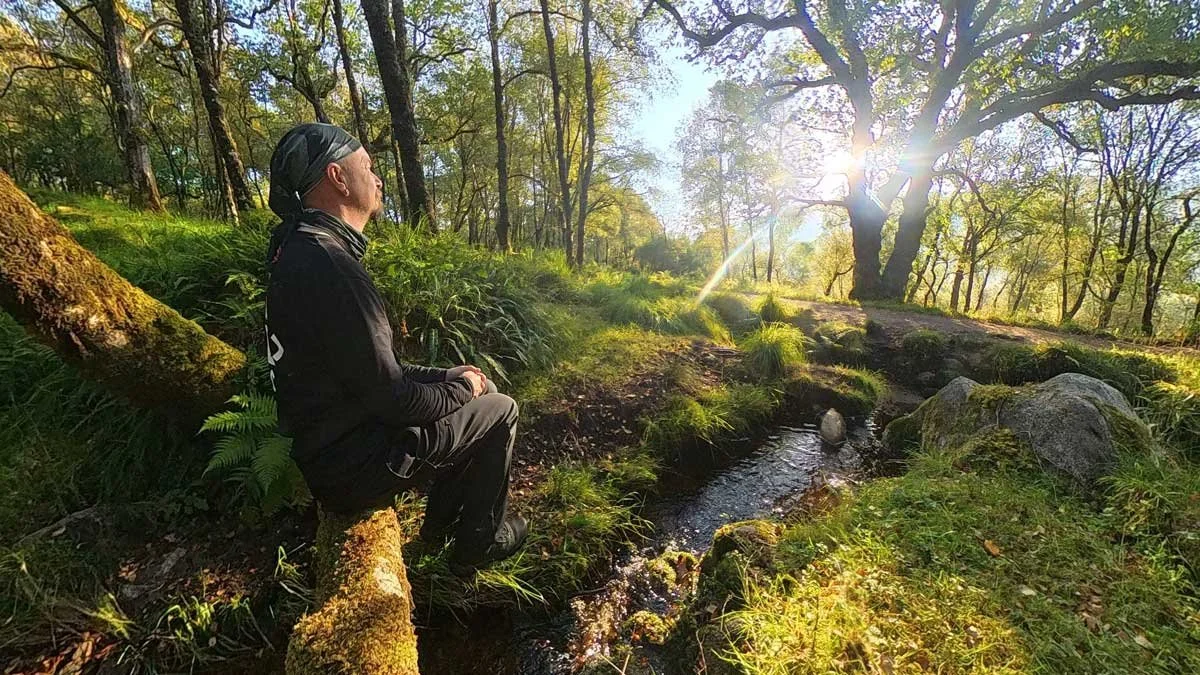
Forest Bathing can offer similar opportunities. Perhaps you sit beside a stream, watching the water move around stones. After a while, you realise that you have been there for much longer than you imagined. Your attention has become absorbed in the movement of water, the sounds around you and the subtle changes in light. The usual mental awareness of schedules, tasks and responsibilities has temporarily receded.
This kind of absorption may not constitute an altered state in the clinical or psychometric sense, but it can represent a meaningful change from our ordinary mode of consciousness.
5. Insightfulness and a broader perspective
Oceanic boundlessness can also involve experiences of insightfulness. Participants in psychedelic studies sometimes report a sudden change in their understanding of themselves, their relationships or their place in the world.
Forest Bathing may offer opportunities for reflection and insight, although usually in a quieter and less dramatic form. When we step away from the demands of everyday life, we create space to consider things from a different perspective. A problem that seemed overwhelming might begin to feel more manageable. We might recognise an emotional response that we had previously overlooked, or gain a new appreciation of something that had become familiar. Sometimes, simply experiencing the natural world without needing to control, organise or achieve anything can remind us of alternative ways of living.
We begin to recognise that life is not solely about productivity, individual achievement or constant movement.
There is value in simply being.
Nature Connection as a Different Route Towards Self-Transcendence
It is worth emphasising that the parallels discussed above are not an argument that Forest Bathing produces the same neurological or psychological changes as psychedelic substances or intensive breathwork. These practices are different, and the research has not yet demonstrated that they produce equivalent altered states.
However, they may sometimes share certain experiential characteristics. Perhaps the most useful way of understanding this is through the idea of self-transcendence. Self-transcendence describes experiences in which our attention and sense of identity extend beyond our immediate personal concerns. We might become more aware of our relationship with other people, the natural world, humanity or something that we perceive as greater than ourselves.
This does not require the disappearance of our individual identity. Indeed, self-transcendence might be better understood as an expansion of perspective rather than an abandonment of the self. We remain ourselves, but we experience our identity within a wider context.
This is particularly important when considering the possible contribution of nature connection to personal growth and psychological wellbeing. If we begin to understand ourselves as participants in a living world, we might also develop a greater sense of responsibility towards it in which our relationship with nature becomes more reciprocal. We appreciate what the natural world offers us, but we also recognise our responsibility to care for the living systems of which we are a part. This is an important distinction between simply using nature as a resource for human wellbeing and developing a more meaningful relationship with the natural world.
Perhaps the most profound outcome of nature connection is not simply that we feel better after spending time outdoors, but that we begin to see ourselves and our responsibilities differently.
Is There a Role for Oceanic Experiences in Recovery and Wellbeing?
The research into oceanic boundlessness raises some interesting questions about the potential relationship between self-transcendent experiences and psychological wellbeing. Some psychedelic studies have suggested that profound experiences involving unity, emotional openness and changes in self-perception may be associated with positive therapeutic outcomes. Similarly, the emerging breathwork literature suggests that experiences involving emotional breakthrough and altered self-awareness may sometimes be accompanied by psychological insight and reported behavioural change. The findings are encouraging, but we should avoid assuming that the experience itself is necessarily therapeutic.
As Unterrainer highlights in his discussion of oceanic states, experiences involving changes to our sense of identity can be either transformative or destabilising, and the same is true of awe and other powerful emotional experiences. What matters is not simply what happens during an experience, but how we understand it, integrate it and relate it to our everyday lives, and this brings us back to the potential value of nature-based practices.
Forest Bathing does not need to produce an extraordinary or overwhelming experience to be meaningful. It can provide a supportive environment in which people gradually develop greater awareness, emotional regulation, curiosity and a sense of belonging. For someone experiencing psychological distress, the opportunity to step outside familiar patterns of thinking and reconnect with the wider world may be valuable in itself. Rather than seeking to dissolve the self, nature connection might help us develop a more flexible relationship with it. We can begin to recognise that our thoughts, feelings and difficulties are important, but they are not the entirety of who we are. We are also biological beings, members of communities, participants in ecosystems and part of a much longer story of life on Earth.
Sometimes, remembering this can provide a welcome sense of perspective.
Final Thoughts — Rediscovering Our Place Within the Living World
Oceanic boundlessness provides an intriguing way of understanding experiences in which our familiar sense of being a separate individual gives way to a feeling of unity, openness and interconnectedness. Research into psychedelics and breathwork has begun to illuminate the psychological and neurological processes that may accompany these experiences. The development of the Altered States of Consciousness Rating Scale has also given researchers a means of investigating and comparing different dimensions of these unusual states.
Although Forest Bathing has not yet been established as a means of inducing oceanic boundlessness, there are some compelling parallels worth exploring. Through sensory immersion, mindfulness, awe and an increased awareness of ecological relationships, Forest Bathing may provide opportunities for experiences that share certain qualities with self-transcendent states of consciousness.
Perhaps this is not particularly surprising. After all, we are biological organisms that have evolved within the natural world. Our bodies, senses and nervous systems have developed through an extraordinarily long relationship with the living environment. When we spend time in nature, we are not necessarily doing something new. We may simply be rediscovering a relationship that has always existed. And perhaps, every now and then, something happens that allows us to experience that relationship in a particularly profound way. For a few moments, the boundaries between ourselves and the world around us seem less important. We become less concerned with our individual identity and more aware of the wider web of life in which we participate. We might experience awe, gratitude, acceptance or a deep sense of belonging. We may even find ourselves wondering whether the distinction between being in nature and being part of nature was ever quite as clear as we imagined.
Perhaps the greatest gift that Forest Bathing offers is not that it allows us to escape ourselves, but that it helps us rediscover ourselves as part of something much greater.
And that, in its own quiet way, can be a rather extraordinary experience.
Nature Connection Invitation


















If you have enjoyed this article and would like to support what we do by donating £2 or more to buy saplings to plant,
please follow the link below:




When therapeutic interactions move outside of the ‘consulting room’ and into nature, something interesting seems to happen. Nature can create a shared space where we walk alongside one another, notice the world together, and sometimes discover that healing becomes less about what one person does to another and more about how two people can explore things together.