

Saturday 12th September 2026
As we walk through the woods at this time of year, there are few mushrooms more recognisable than the Fly Agaric, Amanita muscaria. Its brilliant scarlet cap, scattered with white remnants of the veil that once enclosed the young mushroom, has become almost synonymous with the idea of the mushroom itself. It appears in fairy tales, children’s books, Christmas decorations and folklore, where it often seems to occupy a world somewhere between botany and enchantment. Yet the most fascinating thing about Fly Agaric may be considerably less visible.
Beneath that familiar red cap lies a complex organism whose principal existence takes place underground. There, microscopic fungal threads called hyphae extend through the soil and form intimate associations with the fine roots of trees. In Scotland and much of northern Europe, one of its most common partners is the Birch tree.
This relationship is an example of ectomycorrhizal symbiosis — a biological partnership in which the fungus and tree exchange resources through a specialised interface on their roots. The mushroom that catches our eye in Autumn is therefore only the temporary reproductive expression of a much larger organism, and its conspicuous presence beside a Birch is an outward sign of a relationship that may have been developing underground for months or years. The Fly Agaric is interesting not just because of its appearance and cultural history, but its relationship with the Birch invites a much deeper way of looking at woodland. It reminds us that a forest is not simply a collection of trees standing beside one another. It is a living system of relationships, exchanges and dependencies, many of which remain hidden from human eyes.
The Mushroom We Think We Know
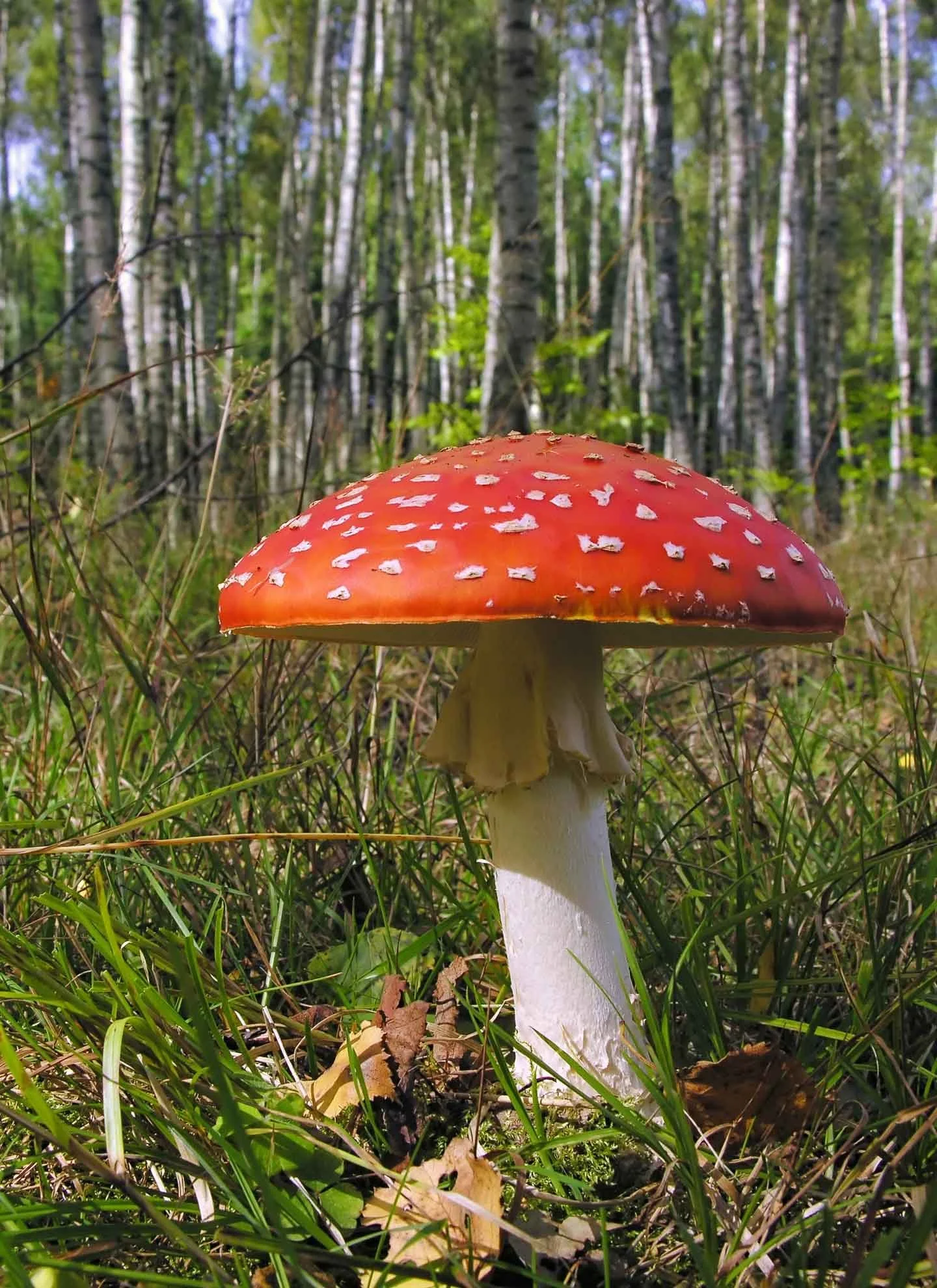
Amanita muscaria
Amanita muscaria (aka A. muscaria) is a member of the Amanitaceae, a family containing some of the most familiar and, in some cases, most dangerous woodland fungi. In Britain it is a native species and is widely distributed, particularly in woodland and heathland habitats on relatively light soils. In Scotland it occurs extensively and is especially associated with Silver Birch (Betula pendula) and Downy Birch (Betula pubescens), although it can form relationships with other tree species too.
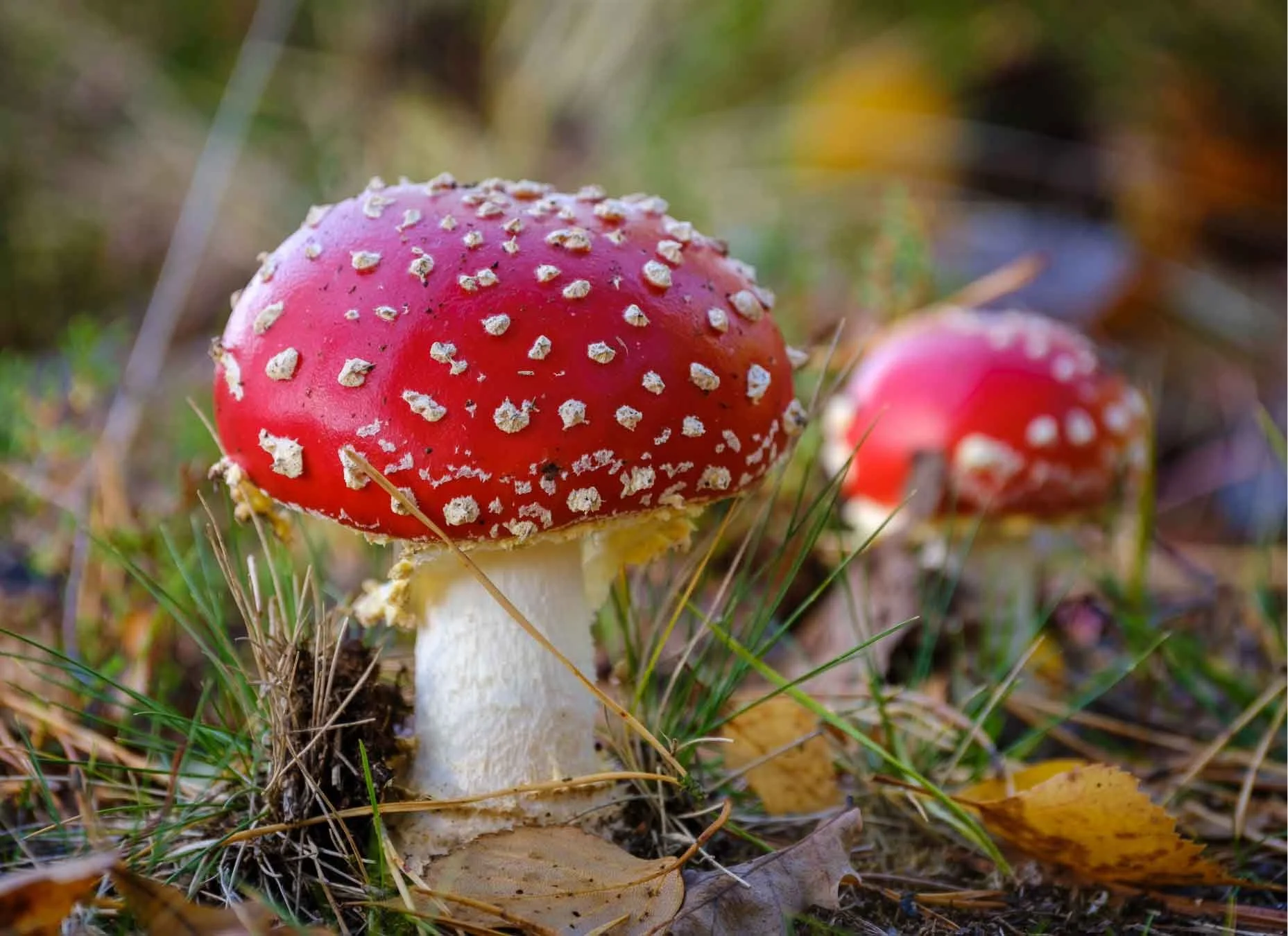
The classic Fly Agaric has a bright red to orange-red cap, often decorated with conspicuous white or cream-coloured flecks or ‘warts’. These spots are not intrinsic structures of the cap but remnants of the universal veil, a protective layer that surrounds the developing fruiting body when it is very young. As the mushroom expands, this veil ruptures, leaving fragments behind on the cap and characteristic remnants around the swollen base of the stem. The underside bears closely packed white to cream gills, while the white stem carries a prominent ring and usually has an enlarged, bulbous base with remnants of the volva. Rain can wash many of the white flecks from the cap, and the intense red colour can fade with age. Consequently, not every Fly Agaric encountered in the woods looks like the archetypal illustration.
This variation is a useful reminder that identifying a fungus from one visual characteristic alone is unwise. The combination of cap colour and warting, gills, ring, basal structure and habitat is much more informative. Even so, few British fungi can match the Fly Agaric for visual distinctiveness. And there is another important distinction to make. The mushroom we see is not the fungus itself in its entirety. It is the fruiting body — the structure produced for sexual reproduction and spore dispersal. The much larger organism consists largely of mycelium, an intricate network of hyphae (hair thin fungal filaments) extending through the soil and interacting with roots and other components of the forest ecosystem. Therefore the visible mushroom as only a fraction of the fungal organism, with the main body existing as mycelium hidden within the environment. So when a cluster of Fly Agarics appears beneath a Birch tree in September or October, what we are really seeing is a brief above-ground expression of an extensive subterranean organism.
Why is it Called Fly Agaric?
The common name has a surprisingly literal origin. For centuries in parts of Europe, crushed or powdered Fly Agaric was associated with the killing of flies. The material was placed in milk or another liquid to attract insects, which were then affected by compounds in the fungus. The specific epithet muscaria derives from musca, Latin for “fly”. Historical accounts describe the practice in parts of Germanic and Slavic Europe and elsewhere, and the association is reflected in the English common name.
The fungus also has a long and complicated ethnomycological history. Historical and anthropological sources document deliberate use of A. muscaria among a number of peoples in Siberia and Northeastern Russia. Research into these traditions describes the mushroom being used for its psychoactive effects and within ritual and cultural contexts, including among communities on the Kamchatka Peninsula.
The chemistry underlying these effects is unusual. The principal psychoactive compounds are ibotenic acid and muscimol, which act on the central nervous system in a quite different way from the psilocybin and psilocin found in so-called ‘magic mushrooms’ (most commonly psilocybe cubensis). Consumption can produce altered perception and consciousness, but can also result in nausea, confusion, agitation, drowsiness and other toxic effects. The variability of the mushroom's chemistry and the unpredictability of intoxication are important reasons why A. muscaria should not be regarded as a benign recreational fungus.
Its historical use is particularly interesting because it illustrates how different cultures can understand the same organism in radically different ways. To a modern woodland visitor in Scotland, it may be a beautiful and slightly magical Autumn mushroom. Elsewhere, it has been a medicinal organism, an intoxicant, a ritual substance and an insecticide.
The folklore surrounding Fly Agaric has also become exceptionally elaborate. Perhaps the best known modern story is that the mushroom is responsible for the imagery of Santa Claus — red-and-white clothing, reindeer, Winter rituals and gifts beneath evergreen trees. There are connections here that are undeniably intriguing, but the familiar “Fly Agaric gave us Santa Claus” narrative is a little less securely established than popular culture sometimes suggests. Similar stories have been repeatedly embellished, and some elements rest on interpretation rather than firm historical evidence. The identification of A. muscaria with the Vedic Soma (see page 14 of this article about ‘Entheogenic Drug Use’ that I wrote if you want a long read!) is another long-running scholarly debate rather than an established fact. However, the actual ecological history of this mushroom is, in many ways, much more fascinating.
The Birch Connection
Walk through a Scottish Birch woodland in Autumn and you may begin to notice a recurring pattern. White-barked trees rise from the heath, grass or moss, and nearby, almost as though placed deliberately beneath them, are often the red Fly Agarics. This visual association has long been noticed. In 1923, British mycologist John Ramsbottom wrote in ‘Nature’ that Amanita muscaria was found amongst almost any clump of Birch in Britain and suggested that the remarkably constant association indicated that its mycelium was involved in Birch mycorrhiza. Today we understand the relationship much more clearly.
Fly Agaric is an ectomycorrhizal fungus. The word “mycorrhiza” literally refers to a fungus-root association, from Greek meaning fungus and root. Ectomycorrhizas are formed externally around the fine roots of many woody plants. Rather than invading and killing the root, the fungus becomes intimately associated with it, creating a specialised interface through which substances can be exchanged. The mature ectomycorrhiza typically includes a fungal mantle surrounding the root and an intricate network of fungal hyphae growing between the root's outer cortical cells, a structure known as the Hartig net. It creates a large surface area interface between fungal and plant tissues through which the exchange of carbon and nutrients can occur. But what makes the partnership particularly elegant is that the two organisms possess complementary abilities.
The Birch can photosynthesise. Its leaves capture sunlight and use carbon dioxide and water to manufacture organic compounds. Some of the carbon fixed through this photosynthesis is transported to the roots and, through the mycorrhizal relationship, ultimately becomes available to the fungal partner.
The fungus, meanwhile, is exceptionally well adapted to exploring soil. Its hyphae are microscopic, often only a tenth of the thickness of a human hair, and can extend far beyond the immediate zone occupied by the tree's finest roots. Collectively, these filaments create a huge absorbant surface. They can explore pores and spaces in the soil that are inaccessible to thicker roots and acquire nutrients that can then be transported back towards the root system.
In broad terms, therefore, the exchange works like this — the Birch supplies carbon derived from photosynthesis, while the fungus supplies mineral nutrients and other resources acquired from the soil. Nitrogen and phosphorus are particularly important components of this exchange, and it is a remarkably effective biological arrangement because neither partner is simply giving something away. The relationship enables both organisms to access resources more effectively than they could in isolation.
The Hidden Architecture of the Partnership
It is tempting to imagine fungal hyphae simply wrapping themselves around a root, like a fine version of a climbing plant, but the reality is considerably more sophisticated. At the ectomycorrhizal interface, both plant and fungus undergo profound physiological changes. The tree adjusts the way it handles carbon, while the fungus changes its metabolism and nutrient transport in response to the association. Studies using Amanita muscaria have helped researchers understand these processes in considerable detail because the fungus is one of the classic experimental models for studying ectomycorrhizas.
One particularly interesting feature is the way the fungus handles the carbon provided by the tree. Research into A. muscaria has identified specialised transport systems for simple sugars such as glucose and fructose. The fungus is therefore not passively coated onto a root, instead it is actively participating in a tightly regulated exchange of carbon compounds. The fungal side of the relationship is equally important for nitrogen acquisition. Ectomycorrhizal fungi can acquire nitrogen in several chemical forms, including inorganic ammonium and organic compounds. Experiments involving Birch seedlings and A. muscaria have demonstrated that the fungal association could provide plants with access to forms of nitrogen that non-mycorrhizal seedlings could not use effectively under the experimental conditions. This matters particularly in woodland soils because nitrogen is not simply sitting around in a form that roots can easily absorb. It is contained within organic matter, microbial biomass and complex compounds, but ectomycorrhizal fungi are much more capable of participating in the processes that make nitrogen available to plants.
Phosphorus is another important nutrient. Mycorrhizal fungi can substantially increase the soil volume explored by a plant and therefore its opportunity to encounter phosphorus and other mineral resources. Modern research increasingly demonstrates that ectomycorrhizal associations contribute to the acquisition and movement of nitrogen, phosphorus, potassium, sulphur, calcium and micronutrients, although the precise mechanisms differ between fungal species and host plants.
The result is not simply a larger root system. It is a different kind of root system — one functionally extended through the presence of another organism.
Birch — Pioneer Tree & Fungal Partner
The relationship becomes even more interesting when we consider the ecology of Birch itself. Silver Birch is a classic pioneer tree. It produces large quantities of very light seeds that can be dispersed by wind, allowing it to colonise open ground rapidly. This capacity has made the Birch an important species in landscapes recovering from disturbance, both in modern times, and historically, including land exposed following the retreat of the Ice Age glaciers.
These ‘pioneer environments’ can be challenging. Young soils may be nutritionally poor, exposed and unstable, while competition for resources develops rapidly as vegetation becomes established. Mycorrhizal fungi can therefore be particularly valuable to pioneer trees. The Birch is not simply providing a home for Fly Agaric. It is providing the fungus with access to a reliable source of carbon, while the fungal partner extends the Birch's capacity to explore the soil. This relationship also helps explain why seeing Fly Agaric near Birch is not merely a coincidence.
The visible mushroom only emerges where the underground mycelium has established a productive relationship with compatible host plants. In Scotland, A. muscaria is particularly characteristic beneath Birch trees, and its fruiting bodies are therefore almost like ecological clues — a sign that somewhere below the surface is a fungal-root relationship that cannot ordinarily be seen. The mushroom itself, in other words, becomes a kind of indicator of hidden biology.
A Forest Floor That Extends Beyond the Tree
This is where the story of Fly Agaric can begin to change our understanding of what a forest actually is. Human perception encourages us to organise nature according to what we can see. We see the trunk, branches and leaves of a Birch and naturally regard those as the tree. We see a mushroom emerging from the soil and naturally regard that as the fungus, but those boundaries can be misleading.
A Birch's roots extend through the soil, and a significant proportion of those roots can be associated with mycorrhizal fungi. The fungal mycelium extends beyond the individual root tips and may occupy a substantial volume of soil. Forest soils consequently contain a biological architecture that is largely invisible from above ground. This is one reason why the language of a “wood wide web” has become so popular. Mycorrhizal fungi can create networks in which fungal hyphae connect different plant roots, and common mycorrhizal networks undoubtedly exist.
However, this is an area where scientific caution is important.
The existence of fungal connections between plants does not automatically demonstrate that forests contain an underground internet through which mature “mother trees” deliberately feed their offspring or transmit messages at will. A 2023 analysis in Nature Ecology & Evolution concluded that several widely repeated claims about common mycorrhizal networks in forests are currently insufficiently supported by field evidence. In particular, the evidence for widespread resource transfer that reliably improves seedling performance, or preferential transfer from mature trees to offspring, is much less conclusive than popular accounts imply. This doesn’t mean that it isn’t true, just that it may not be quite as clear cut. The title of the review suggested that this was due to ‘positive citation bias’, where later papers cite earlier ones in ways that state a finding more strongly than the original data supported, and that inflation compounds as each new paper cites the last. On the other hand I do love Suzanne Simard’s work very much!
Either way, this does not make the fungal networks less remarkable. Quite the opposite. The genuinely interesting discovery is not that trees possess a secret internet in the simplistic sense. It is that the lives of trees are already deeply entangled with other organisms, particularly fungi, and that this entanglement has profound consequences for nutrition, growth and ecosystem functioning. The forest is interconnected, but the connections are biological, contextual and complex rather than magical.
There is another misconception that this relationship can help correct — the importance of not seeing the fungus as a parasite. Finding a Fly Agaric beside a Birch does not mean that the fungus is attacking the tree. Mycorrhizal fungi are fundamentally different from pathogenic fungi. A pathogen exploits living tissue in a way that harms its host. An ectomycorrhizal fungus establishes a regulated relationship with the host in which resources are exchanged. However, this does not mean the relationship is always equally beneficial under every circumstance. Symbiosis is dynamic, and ecological relationships exist along continuums rather than fitting neatly into categories such as “good” and “bad”. The balance of costs and benefits can vary according to environmental conditions, nutrient availability, fungal species, host species and the developmental stage of the organisms.
Nevertheless, the association between Birch and Amanita muscaria is fundamentally one of mutualistic symbiosis, but that word, “mutualistic”, is worth pausing over. We often describe plants as if they are independent organisms that simply happen to live alongside other species. Mycorrhizas reveal how incomplete that picture is. The Birch is not merely a tree with fungi attached to it. Its physiology, nutrition and functioning are partly shaped by its interaction with fungal partners. The fungus, in turn, is not merely an organism living in the soil beneath the Birch. Its life strategy is intimately connected with the tree's photosynthetic productivity. Their lives have become interdependent.
What the Fly Agaric Reveals About Seasonal Change
There is also an understated beauty in the timing of the Fly Agaric's appearance. In Scotland, late Summer and Autumn bring a transformation to the woodland floor. Rain increases (if it ever went away!), temperatures moderate, leaf litter accumulates and the rhythms of the season begin to change. Under these conditions, fungi that have spent much of the year largely invisible may suddenly produce fruiting bodies. The mushroom's emergence can therefore be thought of as an ecological event along an extended timeline, rather than simply the appearance of an object. For most of the year, the fungal organism is participating in the underground life of the woodland. Then, briefly, it changes form and becomes visible. The red cap rises through grass, moss and fallen leaves, produces spores and eventually collapses back into the ecosystem. The mushroom is temporary, but the relationship is not.
This distinction is particularly important when thinking about fungi. We instinctively associate permanence with the visible organism — tree trunks remain in one place for decades, while the mushroom appears and disappears within days. Yet the apparent fragility of the fruiting body tells us very little about the longevity or importance of the organism beneath it. The mushroom may be ephemeral, but the mycelium can persist and continue its association with roots long after the red cap has vanished.
More Than a Partnership Between Two Species
It would also be misleading to imagine the relationship as a simple two-way transaction between one mushroom and one Birch tree. The soil is an immensely complicated biological environment. Fungal hyphae exist alongside bacteria, other fungi, nematodes, microarthropods, plant roots, dead organic matter and countless other biochemical interactions. Fly Agaric itself is eaten by various woodland organisms, including slugs, small mammals and fungi-associated insects. Its fruiting bodies become part of the wider food web just as the tree's leaves and roots do. In this sense, the birch–Fly Agaric relationship is one component of a much larger ecological system.
The birch captures atmospheric carbon.
The tree transfers some of that carbon below ground.
The fungus uses it to sustain its own growth.
Its hyphae explore the soil.
Nitrogen and phosphorus are acquired and transferred through the mycorrhizal interface.
Other organisms interact with the fungal network and fruiting body.
Dead leaves return carbon and minerals to the soil.
The soil community breaks down, transforms and redistributes those materials and eventually, the resources that passed through one organism become available to another.
What looks from above like a single mushroom beneath a single tree is therefore embedded within a constantly moving system of matter and energy.
A Different Way of Looking at a Fly Agaric
There is something genuinely strange about encountering the Fly Agaric and perhaps this is why it has acquired such a strong sense of enchantment in human culture. Its colours are almost excessive. Its form is almost a caricature rather than an ordinary organism. It emerges suddenly from the Autumn landscape, often beneath white-barked birches, and disappears again after a short period. But we do not need to invoke magic to explain why it feels magical.
The real story is more extraordinary.
The red cap is the visible tip of an organism that spends most of its life underground. Its relationship with Birch involves the intimate exchange of carbon and nutrients at microscopic interfaces surrounding fine roots. Its mycelium extends the tree's reach into the soil. The tree, in turn, supplies the carbon that sustains the fungus. The two organisms are not independent occupants of the same habitat; they are partners whose lives overlap. And this relationship forms part of a still larger community of organisms living in soil, roots, leaf litter, moss and wood.
The Fly Agaric therefore offers us an invitation to reconsider what we mean when we say that we are “standing beneath a tree”.
We are not standing beneath a tree in isolation.
We are standing above its roots.
Above its fungal partners.
Above microbial communities.
Above an intricate chemical and biological landscape through which water, carbon and nutrients are continually moving and in which the visible forest is only one of the layers.
Final Thoughts
There is also a wider lesson here that reaches beyond mycology. Much of modern life encourages us to think in terms of individual things — individual trees, individual organisms, individual species, but ecology repeatedly disrupts that assumption. Living systems are characterised not only by the organisms within them but by the relationships between those organisms, and the Fly Agaric and the Birch make this particularly tangible because the relationship has a visible signature. A red mushroom beneath a silver-barked tree that tells a story.
It tells us that the soil is not inert.
It tells us that the roots are not alone.
It tells us that a tree's relationship with its environment extends far beyond what we can see.
And it suggests that perhaps one of the most useful ways to develop a deeper nature connection is not simply to learn the names of more species, but to learn the relationships between them. Once we understand that the Fly Agaric forms ectomycorrhizal associations with the Birch tree, the mushroom changes. It is no longer simply a beautiful red-and-white toadstool — it becomes evidence of a hidden exchange. Once we understand that the fungus receives carbon from the tree, while contributing to the acquisition of nutrients from the soil, the Birch changes too. Its roots are no longer just roots. They are part of a living interface with another organism.
The woodland floor begins to look different.
A mushroom is not simply “there”, it is connected, and perhaps that is the deepest lesson that Fly Agaric can offer us.
The forest is not made up of separate lives standing beside one another. It is made up of relationships. Some of those relationships are visible. Most are not. Underneath the brilliant red cap of Amanita muscaria, beneath the pale bark of the Birch, another forest is taking place — a forest of roots, hyphae, nutrients, sugars, water and microscopic exchange that is largely invisible to us.
But it is one of the reasons the woodland exists as it does.
If you have enjoyed this article and would like to support what we do by donating £2 or more to buy saplings to plant on our Social Croft, please follow the link below:


















A small collection designed to gently open the door into deeper relationship with the natural world.
This complete set of four Forest Healing booklets brings together practical guidance, reflective ideas, and simple nature connection practices that can be used anywhere — from ancient woodland to a nearby park, garden, or even a single Sit Spot outdoors.
Written to be accessible, grounding, and easy to follow, these booklets offer a pathway into the core practices of Forest Bathing (Shinrin-yoku), Silvotherapy, and everyday nature connection. Rather than asking you to achieve anything, they simply invite you to slow down, notice more deeply, and allow nature to become an active presence in your wellbeing.
Across the four booklets you will explore:
• What Forest Bathing, Silvotherapy, and Nature Connection actually are
• The key benefits of spending mindful time in natural environments
• The practice of the “Sit Spot” and how to develop your own relationship with a chosen place
• Simple, practical Forest Bathing invitations you can try alone or with others
• Ways to bring nature connection into everyday life, even in small moments
Together, they form a gentle introduction to practices that have been shown to support reduced stress, improved mood, greater clarity of thought, and a deeper sense of belonging within the natural world.
These are not academic texts or rigid instruction manuals. They are invitations — encouraging you to step outside, slow your pace, and rediscover the quiet intelligence of trees, weather, and landscape.
Whether you are completely new to nature connection or looking to deepen an existing practice, this collection offers a simple, supportive starting point for building a more intentional and restorative relationship with the living world around you.
A small set of booklets that can change the way you experience even the most familiar patch of nature.
Buy all Four Forest Bathing and Nature-Connection Booklets for £11.00 including FREE P&P within the UK.
Postage to the Rest of the World is £4.