

The Three-Circle Model in Forest Bathing
4th September 2022
I am very interested in the work of Professor Miles Richardson from the University of Derby and his work on the importance and benefits of connection with nature. Nature-connectedness is beneficial in several ways: firstly, it can promote physical, mental and emotional health and wellbeing; and secondly, level of nature-connectedness is related to increased levels of environmental awareness and stewardship – the more connected to nature we are, the less inclined we are to cause damage to it. In this article we look at his Three Circle Model that provides an easily accessible explanation about how exposure to, and a connection with the natural world affects our wellbeing through emotional regulation and balance (WERB).
The Three Circle Model of Emotional Regulation
This model supports research into Forest Bathing in Japan that helps to identify three dimensions in emotional regulation – drive, calm and threat. We experience these three emotions each day, in different ways and to different degrees, and each has different feelings associated with it: joy, contentment, anxiety, each of which brings with it different motivations, such as pursuit (joy), rest (calm), and avoidance (threat).
What is Emotion Regulation or Emotional Balance (and why is it important?)
There is evidence that people actively seek out nature in order to regulate and balance their emotions, but what does this actually entail? Emotional regulation is a term used, particularly within psychology, to describe a person’s ability to effectively manage and respond to emotional experiences. Regulating and balancing emotions in this way can be a conscious or unconscious action but is a very important and an almost constant function of human life. People consciously and unconsciously use a range of emotional regulation strategies daily to help them to respond to and deal with hundreds of emotion-provoking stimuli, ideally in an appropriate, beneficial and healthy way. Emotional regulation includes responses to both positive and negative feelings, and how we can strengthen them, use them, influence them and control them. Studies into emotional regulation show that there is a significant positive correlation between emotion regulation and depression management and that people with lower levels of anxiety usually demonstrate higher emotional regulation and balance. Our ability to keep our emotions regulated is important for psychological and emotional wellbeing and as emotional functioning can influence physiological functioning such as blood pressure and heart rate, this can have physical benefits too. Beyond these, emotions can provide the motivation for behaviour change towards healthier behaviours and responses in a way that purely cognitive responses cannot always.
Physiological Responses and the Sympathetic and Parasympathetic Nervous Systems
Before looking at the Three Circle Model, we are just going to look at the concepts of ‘fight or flight’ and ‘rest and digest’ that humans have developed as evolutionary responses to their environments and how these may be viewed as maladaptions to our environment in modern times.
For 99% of human existence, we have spent most of our time in the natural environment. Most of our physiological functions have evolved in, and designed for, a natural environment. It is only in the last couple of hundred years, since the Industrial Revolution, that we have become predominantly urban dwellers. However, the human race has not adapted fast enough to keep up, and many people find that urban living puts them in a permanent state of stress.
We start by looking briefly at of an important part of the human nervous system, the autonomic nervous system, that functions to regulate the human body's unconscious actions and comprises the Sympathetic and Parasympathetic nervous systems.
The sympathetic nervous system directs the body's rapid involuntary response to dangerous or stressful situations. A flood of hormones boosts the body's alertness and heart rate, sending extra blood to the muscles and pumping adrenaline around the body. The sympathetic nervous system prepares the body for intense physical activity and is often referred to as the ‘Fight or Flight’ response.
The parasympathetic nervous system has almost the exact opposite effect and relaxes the body and inhibits or slows many high energy functions, and sometimes referred to as the ‘Rest and Digest’ response.

When we are under artificial lighting, sitting in a traffic jam, working long hours or experiencing ‘technostress’ (the negative psychological link between people and the introduction of new technologies), this constant bombardment of stimuli can activate the ‘fight or flight’ response, even though there is not a Sabre-Tooth Tiger in sight. The body often reacts to these stresses as if they are potentially life-threatening, even when they are not. This is because the sympathetic nervous system is not only triggered by physically dangerous situations (coming face-to-face with a Sabre-Tooth Tiger) but also by emotionally dangerous situations such as rush hour traffic, demanding jobs and bosses and social media.
The Three Circle Model of Emotional Regulation
The three-circle model of emotion regulation pictured below was developed by Gilbert (2005; 2014) and adapted by Richardson to provide a simplified illustration of the complex physiological processes involved in emotion regulation and to explain how the regulation and balancing of emotions are related to wellbeing. In this illustration, Richardson has adapted the model to use elements of nature to represent both the three types of emotion (see drive, contentment and threat below) and the emotions nature may evoke. An eagle is used to explore ‘Drive’ and the pursuit of joy; a bird at rest for ‘Contentment’, calmness and connection; and a wild boar for ‘Threat’ and the avoidance of anxiety. The circle of arrows illustrates the interplay between the different emotional states, whilst the arrows on the left and right show the physiological responses found from exposure to nature during activities such as Forest Bathing.
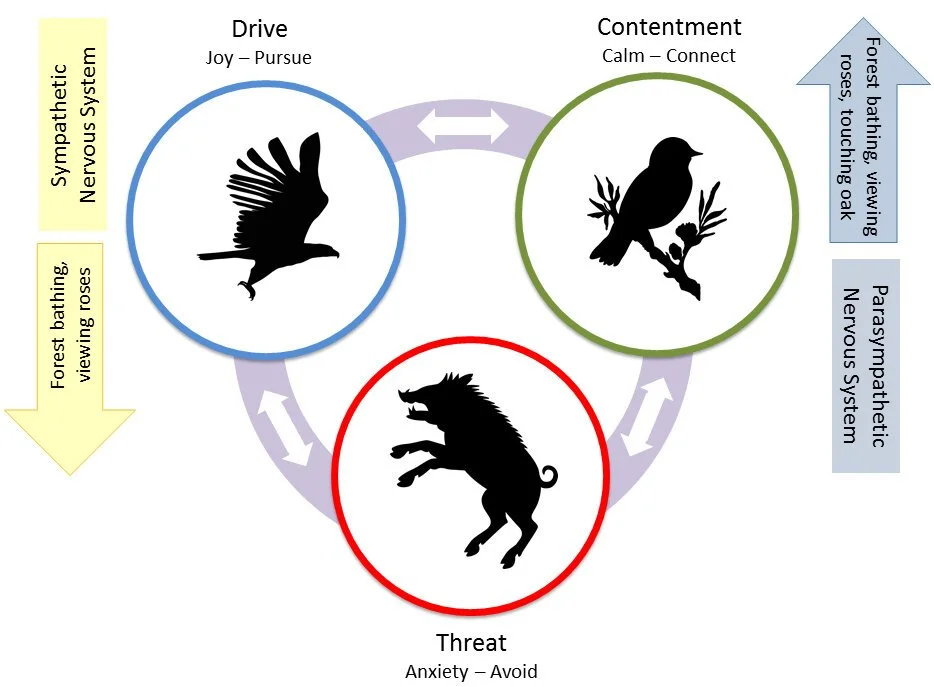
From https://findingnature.org.uk/2019/06/05/how-nature-helps-manage-our-emotions/
Drive
Drive (which is sympathetic nervous system activating) is required to seek out rewards and relates to positive feelings such as joy. The eagle is used both to represent ‘drive’ and to represent the joy that a person might feel on seeing an eagle.
Contentment
Contentment is an emotion-regulating activity that encourages activation of the ‘rest and digest’ response (the parasympathetic nervous system) and encourages suppression of the sympathetic nervous system (the fight or flight response). The image of the bird at rest is therefore used both to represent calm and contentment, but also the response that a person might feel of they stopped to view a bid at rest themselves.
Threat
Experiencing threat cause a rapid activation of fight or flight response (the sympathetic nervous system) and so this relates to our self-protection system and feelings such as anxiety. The image of the wild boar is used to represent both the concept of threat, and also the anxiety some may feel at an unexpected encounter with a wild boar.
Emotional Balance
We need a balance between the three circles or emotional states in order to maximise psychological and emotional wellbeing and itis this between the three systems that produces different mood states and physiological responses. It is also important to appreciate that this model provides a simplified illustration of a more complex interplay between the three responses that together producing a blended patterns of responses, rather than one system increasing as another decreases. An appropriate balance between drive, contentment and threat is required in which the drive systems are deactivated upon successful achievement of a goal to balance energy expenditure and provide a positive emotional response in the form of contentment, balanced against experiencing threats that motivate people and ready them for action.
Forest Bathing, Nature Connection and Emotional Regulation
(Nature) Mindfulness activities such as Forest Bathing can increase awareness of our own thought processes, enable us to explore and appreciate our external world through nature-connectedness, and in doing so can certainly have a positive effect on own feelings of contendness. Forest Bathing practices such as Sit Spot that encourage us to set aside some time each day, or a few times a week, are a great way to build emotional regulation skills, in addition to the other inherent benefits of spending time in nature.
Further Reading and Links
Joy and Calm: How an Evolutionary Functional Model of Affect Regulation Informs Positive Emotions in Nature - https://link.springer.com/article/10.1007/s40806-016-0065-5
https://findingnature.org.uk/2019/06/05/how-nature-helps-manage-our-emotions/




































A small collection designed to gently open the door into deeper relationship with the natural world.
This complete set of four Forest Healing booklets brings together practical guidance, reflective ideas, and simple nature connection practices that can be used anywhere — from ancient woodland to a nearby park, garden, or even a single Sit Spot outdoors.
Written to be accessible, grounding, and easy to follow, these booklets offer a pathway into the core practices of Forest Bathing (Shinrin-yoku), Silvotherapy, and everyday nature connection. Rather than asking you to achieve anything, they simply invite you to slow down, notice more deeply, and allow nature to become an active presence in your wellbeing.
Across the four booklets you will explore:
• What Forest Bathing, Silvotherapy, and Nature Connection actually are
• The key benefits of spending mindful time in natural environments
• The practice of the “Sit Spot” and how to develop your own relationship with a chosen place
• Simple, practical Forest Bathing invitations you can try alone or with others
• Ways to bring nature connection into everyday life, even in small moments
Together, they form a gentle introduction to practices that have been shown to support reduced stress, improved mood, greater clarity of thought, and a deeper sense of belonging within the natural world.
These are not academic texts or rigid instruction manuals. They are invitations — encouraging you to step outside, slow your pace, and rediscover the quiet intelligence of trees, weather, and landscape.
Whether you are completely new to nature connection or looking to deepen an existing practice, this collection offers a simple, supportive starting point for building a more intentional and restorative relationship with the living world around you.
A small set of booklets that can change the way you experience even the most familiar patch of nature.
Buy all Four Forest Bathing and Nature-Connection Booklets for £11.00 including FREE P&P within the UK.
Postage to the Rest of the World is £4.