

The Timeless Traditions and Cultural Significance of Hogmanay: A Celebration Rooted in Nature
30th December 2024
As the bells toll midnight, and the world ushers in a New Year, the vibrant celebration of Hogmanay takes centre stage across much of Scotland. Steeped in tradition and cultural significance, Hogmanay transcends a mere New Year's Eve festivity — it encapsulates the essence of Scottish heritage, community spirit, and the anticipation of renewal. But beyond its revelry and festive spirit, Hogmanay also embodies a deep-rooted connection between cultural practices and the natural world.
When is Hogmanay?
Hogmanay starts on New Year’s Eve in (most of)* Scotland and continues until the 2nd of January. Many of the Hogmanay traditions have their roots in the Norse celebrations of the shortest day on the Winter Solstice, and the ancient Gaelic celebration of Samhain. Indeed ‘Yuletide’, as the period from the Winter Solstice until the early New Year is sometimes known in Scotland, derives from the Old Norse word for the midwinter festival of Yule (or Juul). Hogmanay was the traditional time to exchange presents in Scotland until the 1950s, as celebrating Christmas was often frowned upon from the 16th Century until then. From 1560, during the Scottish Reformation (the religious conflict between Protestants and Catholics) Christmas was effectively banned as the Calvinist church took a dim view of the Catholic practices celebrated at Christmas and so discouraged those. It was actually banned by law from 1640 to 1712, still frowned upon for about 200 years after that, and Christmas only became a public holiday in Scotland in 1958 (and Boxing Day didn’t become a holiday until 1974). So right up until the late 1950s many Scots worked over Christmas and instead celebrated their Winter Solstice holiday at New Year, a time when family and friends would gather for a party and exchange presents.
* In some of the predominantly Gaelic speaking areas such as the Western Isles (and also in Glen Finnan), New Year is sometimes celebrated on January 12th as this is the date that corresponds most closely with the old Gaelic calendar. The modern monthly divisions – January, February etc. – did not exist in ancient Gaelic culture. Instead, the year was divided into seasonal quarters beginning with Ciad Mìos an Earraich (literally, ‘the first month of Spring’) around the beginning of our modern February. When the new-style months eventually came, they never quite shook off the old meaning either. Faoilleach, the first month of the year corresponding to our modern January, means ‘wolf-month’. And going off at a further interesting tangent, the full Moon names used by the American Old Farmer’s Almanac are said to come from a number of places, including Native American, Colonial American, and European sources, and January’s full moon is known as the ‘Wolf Moon’, apparently because wolves were more often heard howling at this time. I wonder what the link is or if that’s just coincidence?
Anyway - back to Hogmanay …
The Origins of Hogmanay
The origins of Hogmanay can be traced back to ancient Pagan and Viking customs, interwoven with the Gaelic celebration of Samhain. With its roots firmly planted in the seasonal cycle and agricultural life, Hogmanay marked the passage from the old year to the new, aligning with the Winter Solstice and the rebirth of the Sun. Historically this would have been a time when ancient communities would gather to acknowledge the Earth's tilt, marking the astronomical event with celebrations that honoured the changing seasons and the rebirth of light. This connection to nature's rhythms persists in contemporary Hogmanay celebrations, symbolising the cycle of life, death, and rebirth.
The origin of the actual word ‘Hogmanay’ is less clear, and certainly not agreed upon. Some suggest it may have come from the Old French word hoguinané, referring to a New Year’s gift, others that is comes from the Gaelic og maidne which means ‘new morning’ or a Gaelic derivation from haugmenn, the Icelandic word for ‘hill-men’, or elves, who banished trolls into the sea. A different faction believe that it comes from the Old Norse word for Yuletide, which is ‘hoggo-nott’. Although its origins are unclear, it is widely believed that the celebrations were introduced to Scotland by the Vikings, who invaded Scotland in the 8th and 9th Centuries.

‘Guizers’ dressed as Vikings at the Up Helly Aa Fire Festival in Shetland.
Norse Influence
In the early 8th and 9th centuries the Vikings arrived in the Shetland Islands looking for land and subsequently ruled both Orkney and Shetland until the 15th Century. The earliest record of Viking conquests in the Western Isles (The Hebrides) was a raid on Iona, a small island off the west coast of Mull, in AD 795. There is disagreement as to the degree of large-scale migration that occurred from Scandinavia to the Western Isles, and how much trading as opposed to plundering occurred. Norse place names are common on Lewis and Harris, although modern-day DNA profiling shows the inhabitants of the Hebrides to be more Scots than Norse. Interestingly, the terms ‘Norse’ and ‘Viking’ refer to the same Germanic people who lived in Scandinavia during the Viking Age and who spoke Old Norse. ‘Norse’ actually refers to Norsemen who were full-time traders, whereas the Vikings were farmers-turned-seafaring-pirates who mainly plundered, although many appear to have settled down and become farmers again.
The Treaty of Perth in 1266 returned both the Hebrides and the Isle of Man to Scotland for 4,000 marks and an annual payment of 100 marks. However, the treaty also included confirmation of Norwegian sovereignty over Shetland and Orkney which stood until Scotland regained control on 20 February 1472 after the islands had been used as security for the wedding dowry of Margaret of Denmark, the future wife of King James III of Scotland. The marriage was seen as a way of uniting Denmark and Scotland, following years of disagreements about taxation of the Hebrides Islands. In 1468, Margaret's father, the impoverished King of Denmark, Norway and Sweden, Christian I, had agreed to pay a large dowry for his daughter's wedding, pledging Orkney and Shetland as security until the dowry was paid, as he lacked the funds to pay the dowry up front. He paid 50,000 florins for the Orkneys and a further 8,000 florins for the Shetlands.
Anyway - back to Hogmanay …
Hogmanay Traditions
Singing Auld Lang Syne
Central to the celebration of Hogmanay is the idea of bidding farewell to the old year and welcoming in the new year with a sense of optimism and hope. One of the most iconic traditions is the singing of "Auld Lang Syne", a poignant poem by Scotland's national bard, Robert 'Rabbie' Burns. The phrase ‘auld lang syne’ literally translates to ‘old long since’ and basically means ‘days gone by’, ‘for old times’ sake’ or ‘the good old times’. The song itself is about two friends catching up over a drink or two, and talking about their long and sometimes distant friendship. In many ways it serves as a reminder to keep in touch with your friends and loved ones in the forthcoming year. This heartfelt anthem, sung across the globe at the stroke of midnight, symbolises friendship, unity, and the remembrance of times gone by.
Redding the House
It has long been considered unlucky in Scotland to start the New Year in a dirty or untidy house, so getting the house ready for the New Year traditionally involved a thorough housecleaning or ‘redding’, when the ashes would be removed from the fireplace, the chimney swept, and a new fire laid. Some people would read the ashes, much like reading tea leaves to make predictions about the coming year, whilst others would carry a smoking Juniper branch from room to room to clear out any lingering spirits. This cleaning also included paying bills and clearing debts, all before ‘the bells’ at the stroke of midnight.
First Footing (And Dark Haired-Men)
‘First footing’ (or the ‘first foot’ in the house after midnight and thus in the New Year) is still common across Scotland, where visitors arrive at neighbours’ houses carrying the symbolic gifts of a lump of coal for warmth, a cake for sustenance, or whisky for good cheer. This tradition has ties to the Pagan belief in luck-bringing spirits and the celebration of renewal associated with the first visitor of the year. Ideally, it is said the first footer should be a dark-haired man in order to ensure good luck for the house for the forthcoming year. This is often attributed to the days of Norse influence when fair-haired visitors were likely to be Vikings whose arrival seldom brought good luck for those whose door they knocked upon.
Cultural Nature Connection and Hogmanay
At its core, Hogmanay embodies a deep reverence for nature. The festival's rituals and traditions are often imbued with symbolic gestures honouring the Earth, such as the burning of Juniper branches to ward off evil spirits and purify the surroundings. The act of ‘first-footing’, signifies prosperity and warmth for the coming year, rooted in the importance of community and sharing during the harsh Winter months.
The Tradition of Fire
Fire plays a central role in many Hogmanay celebrations, symbolising purification, the driving away of darkness and the banishment of malevolent spirits. The lighting of bonfires across Scotland and the swinging of fireballs in Stonehaven are elemental practices that harken back to such ancient fire ceremonies observed to ward off evil spirits and welcome the lengthening days. These activities continue to unite communities in warmth, fostering a connection to the elements and invoking a sense of renewal, as well as illuminating the night sky and banishing darkness, both literally and metaphorically.
Nature-Centric Resolutions
Hogmanay is also a time for introspection and setting intentions for the future. Beyond typical New Year's resolutions, this tradition can often involve a deeper connection to nature. People may vow to spend more time outdoors, reconnect with the land, or contribute to environmental conservation efforts, recognising the intrinsic link between personal wellbeing and the health of the planet.
Modern Day Celebrations
In modern times, Hogmanay has evolved into a grand celebration featuring street parties, concerts, and fireworks, yet its roots in nature-centric practices remain intertwined with the festivities. The annual torchlight procession in Edinburgh and other Scottish cities not only creates a breathtaking spectacle but also pays homage to ancient customs that celebrated light during the darkest time of the year.
Up Helly Aa
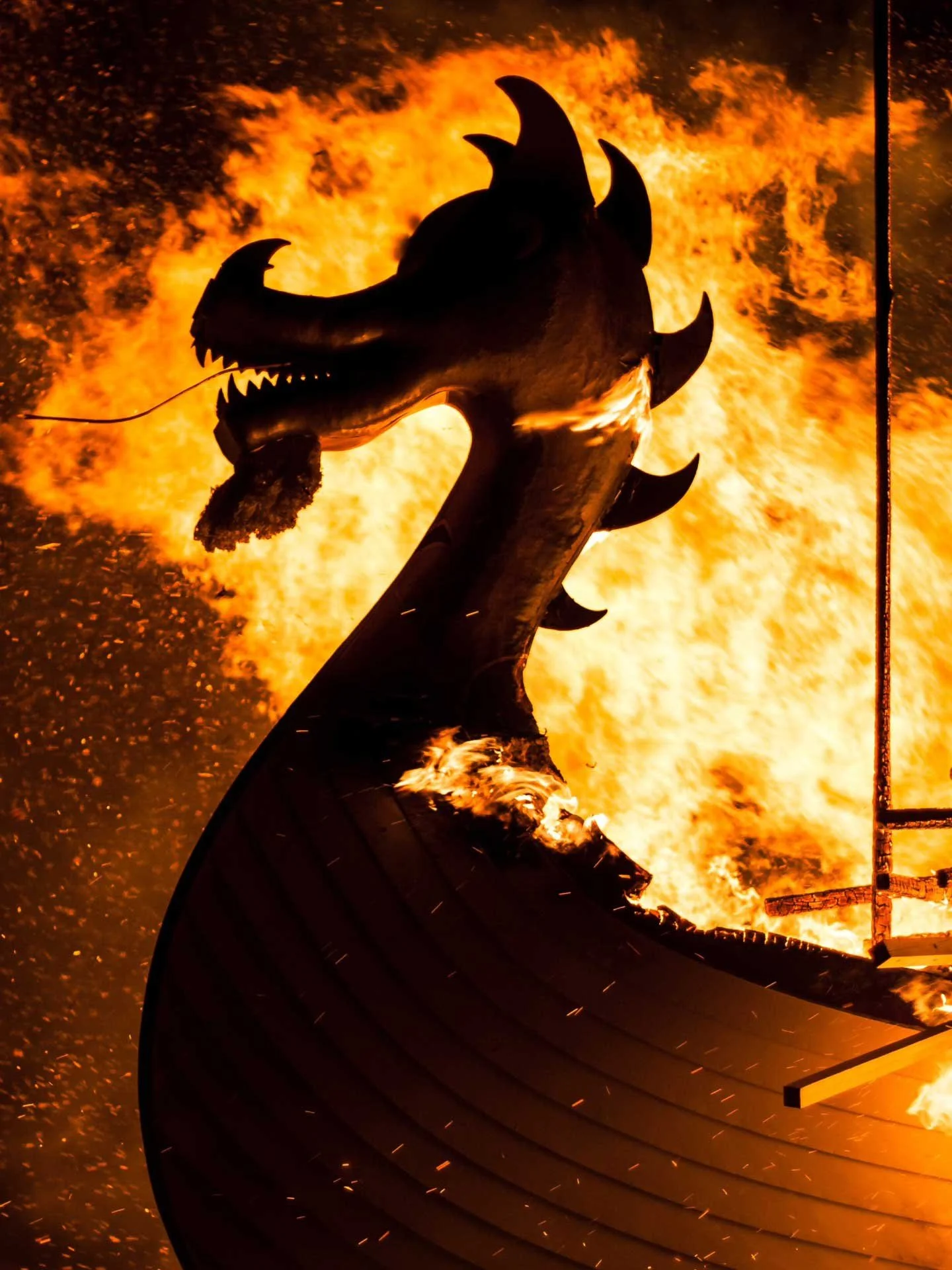
In Shetland, the Viking influence probably remains strongest. The end of the Christmas season is sometimes known as ‘Uphalyday’ in the Scots language (Epiphany in English). It first appears in the form ‘Vphalyday’ in records of the 1470s and means ‘finish of the holiday’ (the word ‘up’ meaning over or finished). The night before this feast is called ‘Uphalyday E(v)en’ while the night of the feast itself is ‘Uphalynicht’. The most well-known use of this Scots feast name is in Shetland where, by the late 19th century, the name had taken on the local form ‘Uphellya’ in the Shetland dialect. Up Helly Aa is still held in Lerwick on the last Tuesday of January to mark the end of Yule and to celebrate the rebirth of the Sun after a long winter. Each festival involves a flaming torchlit procession by squads of participants in Viking attire (known as guizers) and culminates in the burning of an imitation Viking galley — a testament to the Norse influence on Scottish heritage.
Final Thoughts
Hogmanay stands as a testament to the enduring connection between culture and nature. It is a reminder of the significance of embracing traditions rooted in the natural world, promoting a sense of unity, hope, and renewal as each year transitions into the next. Its origins in ancient rituals and reverence for the natural world are a continuing reminder to us of the importance of respecting traditions, fostering community ties, and nurturing our relationship with the environment. Amidst the merriment and festivities, perhaps a deeper significance of Hogmanay lies in its reflection of the Scottish spirit — a blend of resilience, camaraderie, and the embracement of change. It is a time for communities to come together, reinforcing bonds and embracing the spirit of new beginnings.
So, as we step into the New Year, let us carry forward these age-old practices, celebrating our bond with nature and the spirit of renewal and interconnectedness that Hogmanay embodies. By embracing this rich cultural heritage and the nature-centric practices of Hogmanay, we can find inspiration to foster a deeper connection with the environment, enriching our lives and preserving traditions for generations to come.






There is something rather special about the expression holding space. It suggests that sometimes we do not need somebody to tell us what to do, give us advice, solve our problems or make our pain disappear. Sometimes what we need most is simply for somebody to remain alongside us while we experience whatever it is that we are experiencing.