

How Birds Breathe Differently from Humans
9th March 2024
Birds are truly marvels of nature, displaying an incredible array of adaptations that enable them to thrive in a huge variety of environments. One of the most fundamental yet intriguing aspects of avian (bird) biology is their respiratory system. Unlike mammals, birds have evolved a fairly unique respiratory system that allows for a far more efficient gas exchange, enabling them to meet the high metabolic demands associated with flight, especially at high altitudes. Birds have exceptionally high metabolic rates compared to mammals, primarily due to the energy demands of flight and endothermy (maintaining a constant body temperature). As a result, efficient respiration is essential for meeting these metabolic needs. The avian respiratory system allows for rapid gas exchange, ensuring a constant supply of oxygen to tissues and organs. In this article, we will explore the unique features of avian respiration and highlight the key differences between birds and humans in terms of how they breathe.
Anatomy of the Avian Respiratory System
Birds have evolved a highly efficient respiratory system tailored to meet the demands of their active lifestyles, efficient flight, and varying environmental conditions. Unlike mammals, which have a diaphragm for breathing, birds lack a diaphragm altogether. Instead, avian respiration relies on a system of air sacs connected to the lungs, providing a continuous flow of oxygen-rich air.
The journey of air through a bird's respiratory system begins with inhalation. One of the most remarkable features of avian respiration is the unidirectional (one-way) airflow pattern. Unlike humans, where air enters and exits the lungs through the same pathway, birds have a system that ensures a one-way flow of air through the lungs. This efficient mechanism maximises gas exchange and enhances oxygen uptake, critical for sustaining the high metabolic rates required for flight. Air enters through the nostrils (nares) and travels down the trachea into the posterior air sacs. From there, it passes through the lungs, where gas exchange occurs, and then moves into the anterior air sacs before being expelled during exhalation. Upon exhalation, air from the lungs is expelled into posterior air sacs, while fresh air from the anterior air sacs is simultaneously drawn into the lungs. This means that a single breath of oxygen-rich inhaled air remains in the respiratory system for two complete inhalation and exhalation cycles before it is fully spent and exhaled out the body.
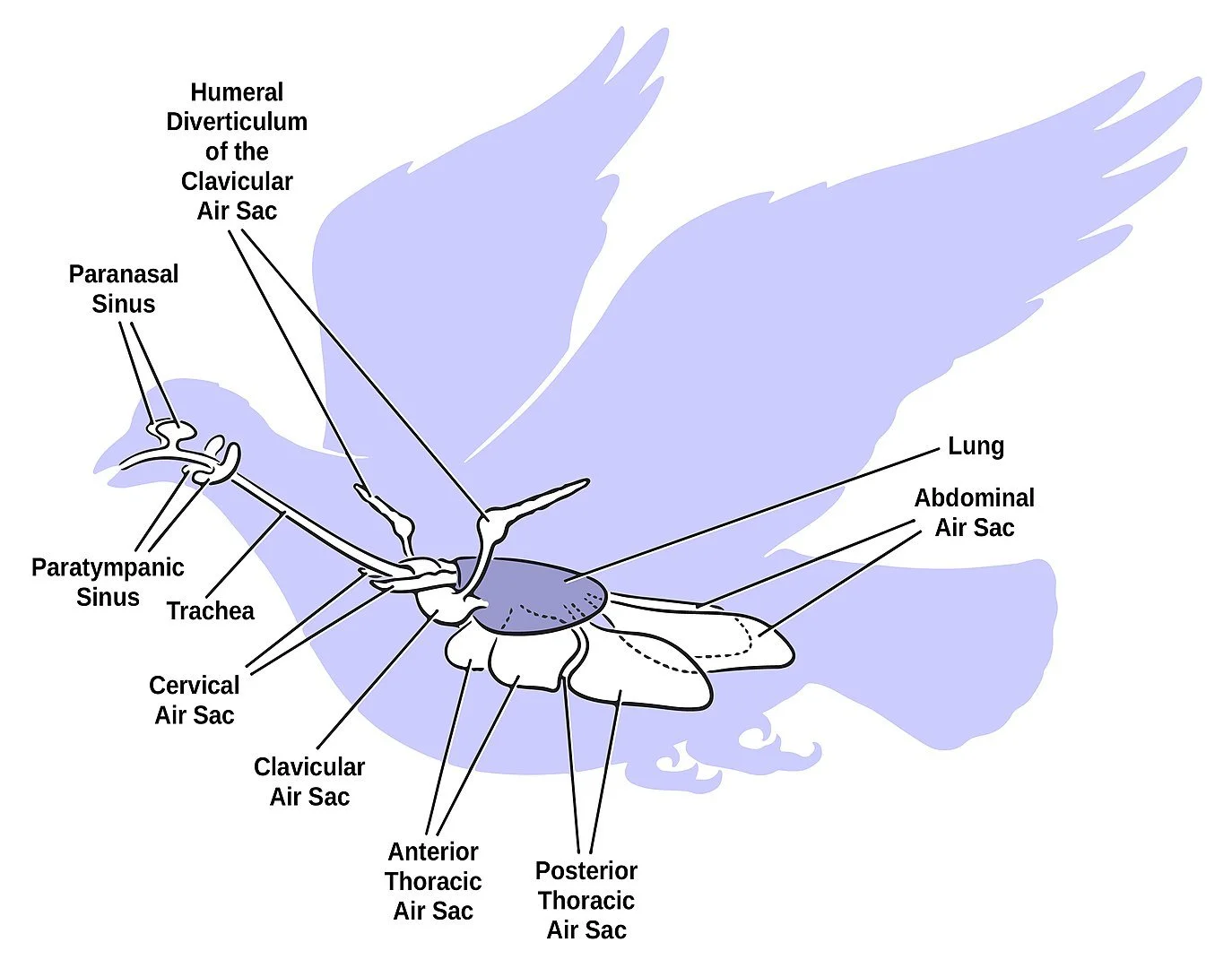
By C. Abraczinskas - Sereno PC, Martinez RN, Wilson JA, Varricchio DJ, Alcober OA, et al. (Sept 2008). Evidence for Avian Intrathoracic Air Sacs in a New Predatory Dinosaur from Argentina. PLoS ONE 3(9): e3303., CC BY 2.5, https://commons.wikimedia.org/w/index.php?curid=4901228
Air Sacs
Central to the avian respiratory system are the air sacs, which play a crucial role in maintaining a continuous flow of air through the lungs. These air sacs are thin-walled structures located in various regions, including the thorax and abdomen. They do not participate in gas exchange but serve as reservoirs for air, facilitating a continuous unidirectional flow of oxygen-rich air through the respiratory system. Birds have nine air sacs in total, including two cervical sacs, two anterior thoracic sacs, two posterior thoracic sacs, and three abdominal sacs. These sacs act as bellows, moving air through the respiratory system during both inhalation and exhalation.
Parabronchi
Within the avian lungs, gas exchange occurs across a network of tiny air capillaries called parabronchi. These are arranged in a highly efficient manner to maximise gas exchange. Air flows through the parabronchi in a unidirectional manner, facilitated by a system of air sacs and specialised muscles that control the movement of air within the respiratory system.
Crosscurrent Exchange
The efficiency of avian respiration is further enhanced by a unique mechanism known as crosscurrent exchange. This process involves the flow of blood and air in opposite directions within the parabronchi, ensuring that a concentration gradient is maintained along the entire length of the respiratory surface. As a result, oxygen diffuses more efficiently into the bloodstream, while carbon dioxide is expelled with equal efficiency. In mammals, blood flows through the lungs in a direction perpendicular to the airflow, allowing for efficient gas exchange. However, in birds, the blood flow and air flow are not perpendicular but rather arranged diagonally. This arrangement ensures that the oxygen concentration in the blood remains higher than that in the air, facilitating maximum oxygen uptake even at high altitudes or during strenuous activity.
Breathing Mechanisms: Birds vs. Humans
Inhalation
In humans, inhalation is primarily driven by the contraction of the diaphragm and intercostal muscles, which expand the chest cavity, creating a negative pressure gradient that draws air into the lungs. In contrast, birds lack a diaphragm and rely on a combination of rib movements and changes in the volume of their air sacs to facilitate inhalation. As the air sacs expand, fresh air is drawn into the respiratory system, flowing through the parabronchi and exchanging gases with the blood.
Exhalation
Exhalation in birds is a passive process, driven by the elasticity of the respiratory system and the compression of the air sacs. As the bird's body cavity decreases in volume, stale air is expelled from the lungs and out of the respiratory system. This continuous flow of air through the avian respiratory system ensures efficient gas exchange, allowing birds to sustain the high metabolic rates required for activities such as flight.
Adaptations for Flight
The unique respiratory system of birds is closely intertwined with their ability to fly. Flight imposes significant challenges on respiratory physiology, requiring birds to extract oxygen from the air very efficiently while minimising the weight of respiratory structures. Avian lungs are relatively small and rigid, with thin air sacs that penetrate deep into the body cavity. This design maximises surface area for gas exchange while minimising the weight of respiratory organs, allowing for optimal flight performance. Bats are mammals and demonstrate that flight is not impossible without avian respiration, but the scope of their flight is more limited in duration and altitude.
High Altitude Adaptations
Some bird species have evolved adaptations that allow them to thrive in high-altitude environments where oxygen levels are lower. These adaptations may include increased lung capacity, enhanced oxygen-carrying capacity of the blood, and specialised respiratory pigments that facilitate oxygen uptake in low-oxygen conditions.
Final Thoughts
The respiratory system of birds is a remarkable example of evolutionary adaptation, finely tuned to meet the unique physiological demands of avian life. From the elaborate network of air sacs to the efficient crosscurrent exchange mechanism, every aspect of the avian respiratory system is optimized for maximum efficiency. By understanding the intricacies of avian respiration, we gain valuable insights into the remarkable adaptations that have enabled birds to conquer the skies and thrive in diverse habitats across the globe.
If you have enjoyed this article and would like to support what we do by donating £2 or more to buy saplings to plant, please follow the link below:

































A small collection designed to gently open the door into deeper relationship with the natural world.
This complete set of four Forest Healing booklets brings together practical guidance, reflective ideas, and simple nature connection practices that can be used anywhere — from ancient woodland to a nearby park, garden, or even a single Sit Spot outdoors.
Written to be accessible, grounding, and easy to follow, these booklets offer a pathway into the core practices of Forest Bathing (Shinrin-yoku), Silvotherapy, and everyday nature connection. Rather than asking you to achieve anything, they simply invite you to slow down, notice more deeply, and allow nature to become an active presence in your wellbeing.
Across the four booklets you will explore:
• What Forest Bathing, Silvotherapy, and Nature Connection actually are
• The key benefits of spending mindful time in natural environments
• The practice of the “Sit Spot” and how to develop your own relationship with a chosen place
• Simple, practical Forest Bathing invitations you can try alone or with others
• Ways to bring nature connection into everyday life, even in small moments
Together, they form a gentle introduction to practices that have been shown to support reduced stress, improved mood, greater clarity of thought, and a deeper sense of belonging within the natural world.
These are not academic texts or rigid instruction manuals. They are invitations — encouraging you to step outside, slow your pace, and rediscover the quiet intelligence of trees, weather, and landscape.
Whether you are completely new to nature connection or looking to deepen an existing practice, this collection offers a simple, supportive starting point for building a more intentional and restorative relationship with the living world around you.
A small set of booklets that can change the way you experience even the most familiar patch of nature.
Buy all Four Forest Bathing and Nature-Connection Booklets for £11.00 including FREE P&P within the UK.
Postage to the Rest of the World is £4.